Bonita Springs Tree Removal handles tree root removal and root pruning in Bonita Springs, FL, with twenty-plus years on this coast, serving surrounding cities including Estero, Naples Park, Florida Gulf Coast University, Fort Myers Beach and Naples. Root work is quoted only after we have seen what the roots in question are doing for the tree, because that is the part that cannot be undone.
Almost every root call here starts as somebody else’s problem: a plumber has found roots in a lateral, a septic contractor has condemned a drain field, a slab is lifting, or an irrigation line keeps failing at the same point. The tree is the second half of the conversation, and it is the half where a wrong cut is permanent.
So the sequence is always the same. Expose the roots without damaging them, work out which are structural and which are not, then decide between cutting, barriering, redesigning the hardscape, or in some cases removing the tree because the honest answer is that it and the drain field cannot both stay.
Where Roots Cause Trouble Here
Sewer Laterals and Failed Joints
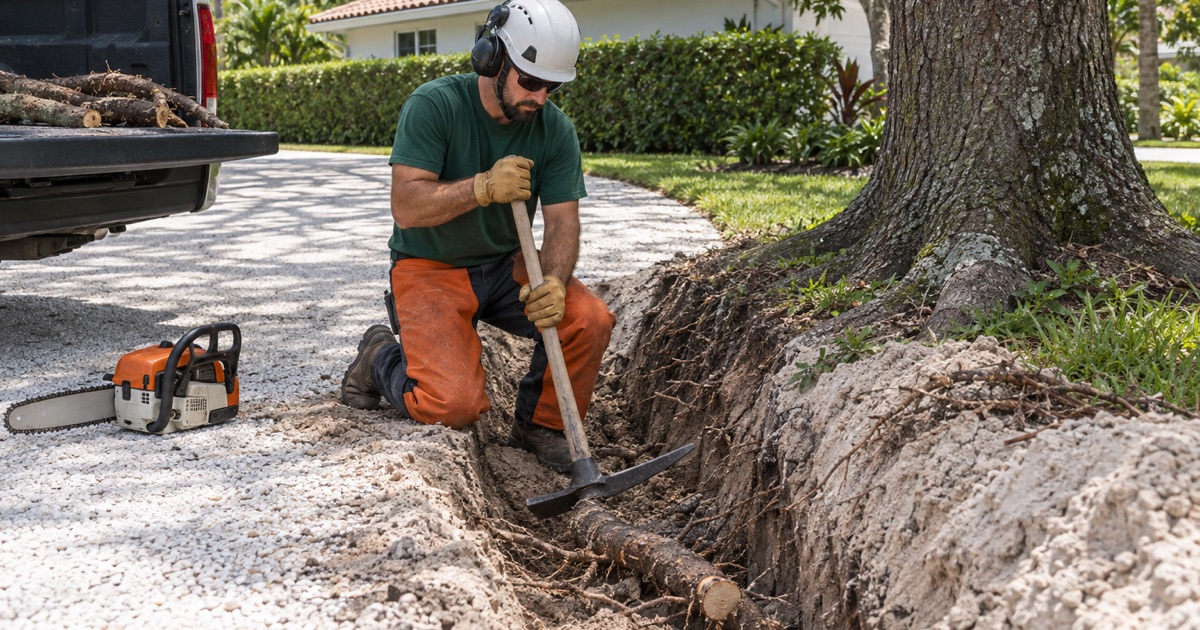
Roots do not bore through sound pipe; they find a crack or a failed joint, enter, and then colonize the moist interior until the line blocks. That means the durable fix is a plumbing repair at the defect, with root work at the trench so the same point is not recolonized while the pipe is open. We coordinate directly with the plumber rather than each trade working one end of the same excavation, because the trench is open once and it is much cheaper to do both jobs then.
Septic Drain Fields
A drain field is a wide, shallow, permanently moist area, which from a tree’s point of view is the best ground on the property. Once roots are established in one they keep returning, so cutting alone rarely settles it and the realistic options narrow to relocating the field or removing the tree. Where the tree matters to the owner we check whether the roots involved sit outside the structural zone before recommending anything, since losing anchorage to save a drain field is not a trade worth making.
Driveways, Walkways and Pool Decks
Lifted hardscape is the most visible root problem and the one most often fixed badly. A large buttress root running straight out from the trunk may be holding the tree up on that side, and cutting it to level a slab can leave a stable-looking tree that is no longer anchored. Exposing the root with an air spade tells us whether we are looking at structure or at a secondary root, and that single distinction usually decides between cutting, barriering and rebuilding the slab over the top.
Cutting Roots Without Losing the Tree
Anchorage and the Root Plate
The root plate is the mass of structural roots and soil that keeps a tree upright, and on sand with a shallow hardpan it is wider and shallower than most people picture. Cutting into it on one side creates a failure direction, and the tree gives no outward sign of it until wind arrives from the wrong quarter. We map the plate before quoting and say plainly when a proposed trench line cannot be dug without compromising it.
Distance Rules and Why We Cite the Standard by Name
The trade’s maintenance standard, ANSI A300, sets out a proportional relationship between trunk diameter and how close to the trunk roots may be cut, and we work to it. We cite it by name rather than by clause number on purpose, because the numbering differs between parts and editions and quoting a number that has been renumbered is worse than useless. What matters on site is the proportion: the bigger the trunk, the further out any cut has to be.
Air Spade Work and Root Collar Excavation
An air spade removes soil with compressed air and leaves roots intact, which is the only practical way to see a root system without damaging what you are trying to assess. On this ground it does double duty, because buried root collars are extremely common under raised beds, added mulch and regraded lawns. Uncovering a collar often reveals girdling roots or basal decay that explains a decline nobody had connected to the soil at all.
Barriers, Recovery and the Honest Answer
Root Barriers and Where They Earn Their Cost
A barrier redirects roots downward past a slab, a utility or a wall rather than stopping growth, so it needs real depth and unbroken continuity to do anything at all. The right moment to install one is when the hardscape or utility is being rebuilt anyway and the ground is already open. Retrofitting a barrier into undisturbed soil beside a mature tree usually severs more roots during installation than the barrier will ever protect.
Soil Decompaction and Recovery Work
After root loss, whatever the cause, the useful work is making the remaining root zone as productive as possible. Air spade decompaction restores pore space in compacted sand, a proper mulch ring kept clear of the trunk moderates soil temperature and moisture, and correcting drainage matters where the seasonal water table sits within eighteen inches of the surface for months. Watering through the following dry season is the part owners most often skip and the part that most often decides the outcome.
When Removal Is the Honest Answer
Sometimes the tree and the infrastructure cannot both stay, and saying so early saves an owner from paying twice. A tree whose structural roots must be cut to fix a drain field or a foundation is a tree that will need removing later, at a higher price and possibly after a failure. We put that reasoning in writing, with the alternative priced beside it, so the decision is made on the facts rather than on how the estimate was worded.
- 20+ Years on This Coast
- Written Estimate Before Any Cut
- No Topping, No Hurricane Cuts