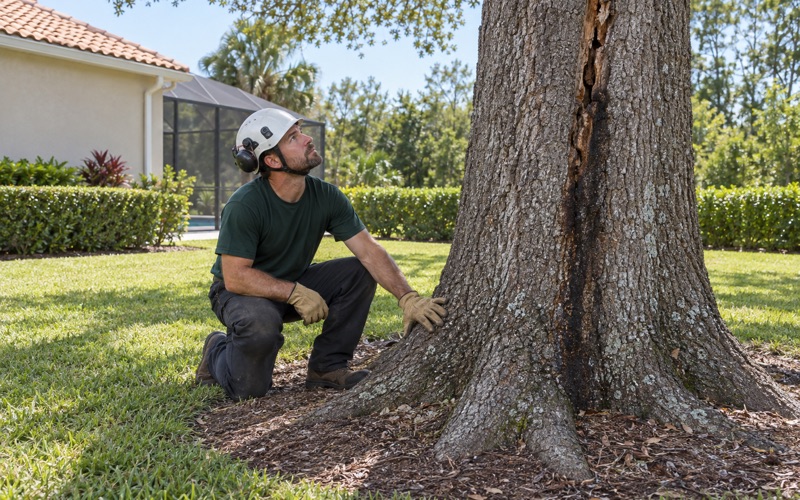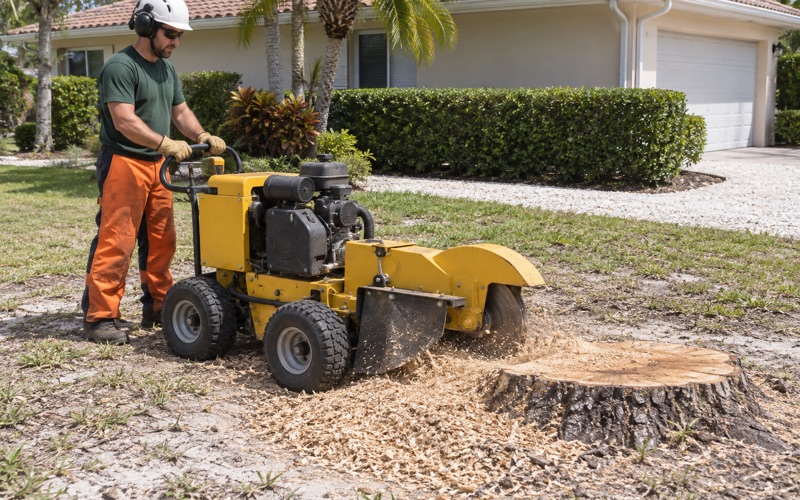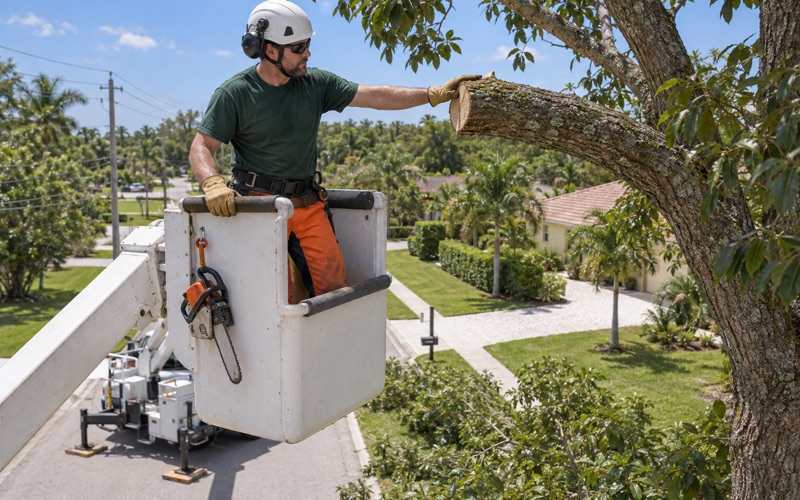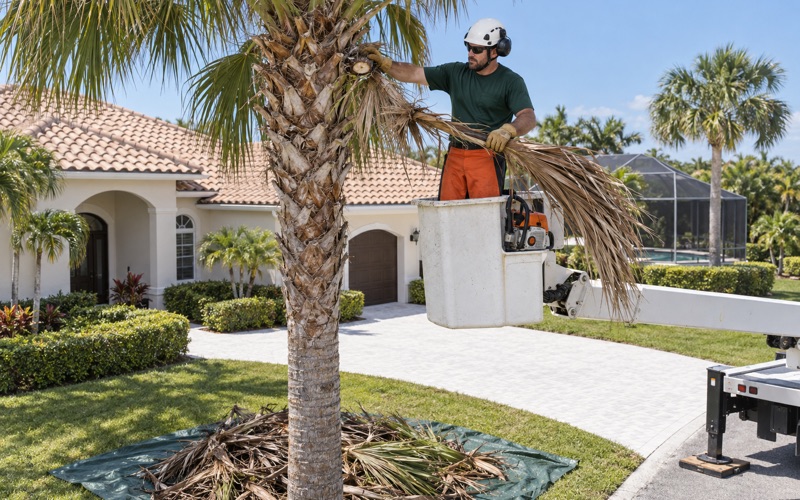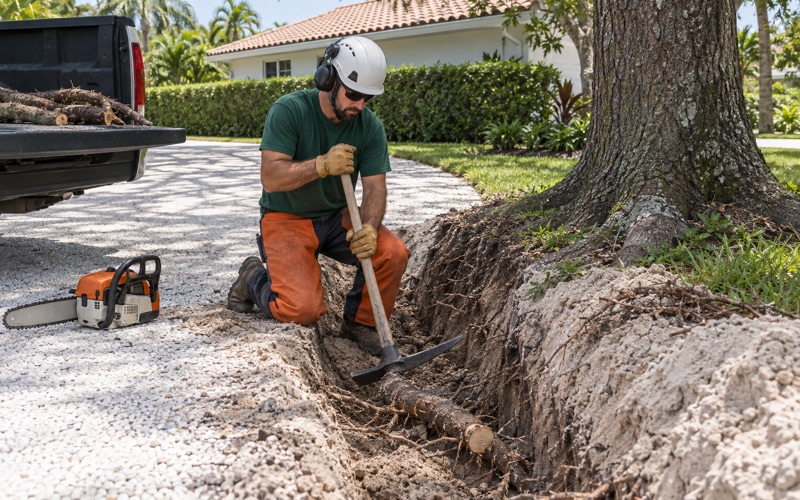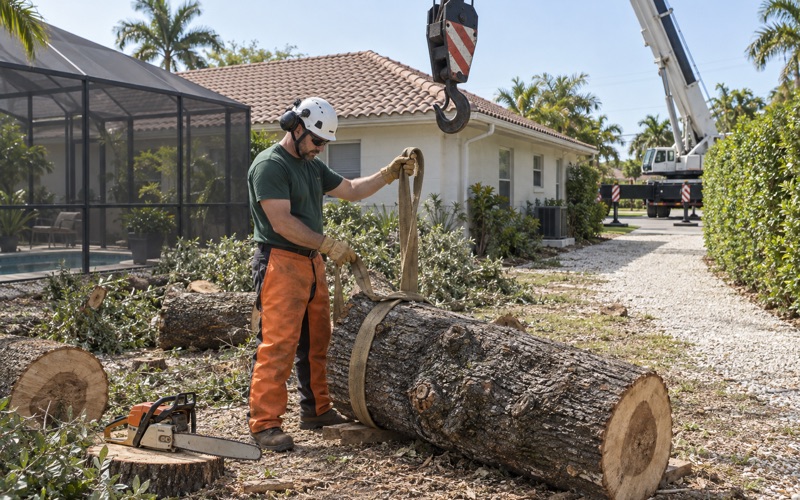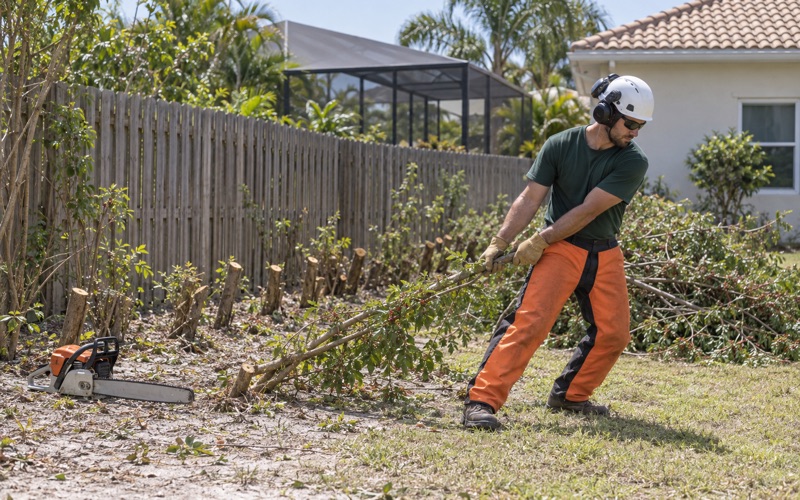
Bonita Springs Tree Removal handles tree removal in Sanibel with crews who have worked this coast for more than twenty years, and who treat the island as its own jurisdiction rather than an extension of the mainland. Every job here begins with a written estimate that prices the cutting, the hauling and the disposal on separate lines, so an owner can see what the wood costs to move before anyone climbs. That separation matters more here than anywhere else we work.
We work across Lee, Collier and Hendry counties, and we tell owners plainly where the rules change at each line. Sanibel is the sharpest of those changes: the permission a crew needs on this island is issued by the City, on the City’s schedule, and no amount of mainland habit substitutes for knowing it. Our estimates for island work name which approvals a job needs and who issues them, before a saw ever comes out of the truck.
A city that certifies its own mangrove trimmers
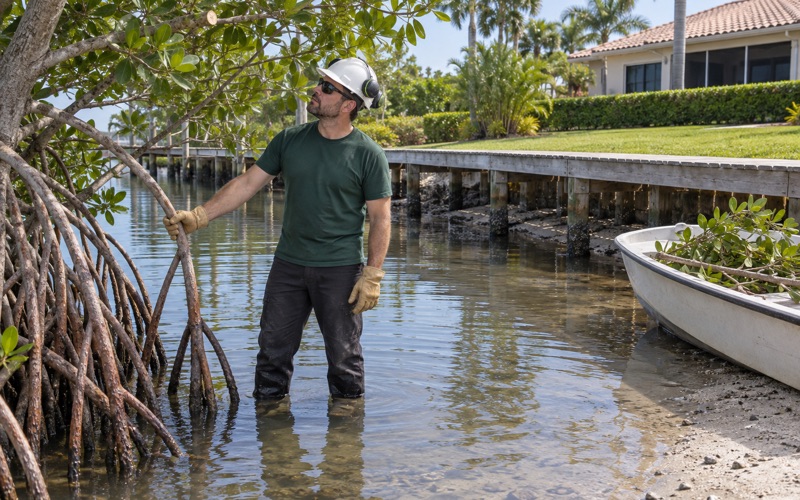
The State of Florida has delegated mangrove authority to only seven local governments, and the City of Sanibel is one of them. The Florida Department of Environmental Protection publishes that list: Miami-Dade County, Broward County, Hillsborough County, Pinellas County, the Town of Jupiter Island, Sarasota County and the City of Sanibel, with delegation of the mangrove program authorized under Section 403.9324 of the Florida Statutes. The City states it in a single line, that the State of Florida has delegated authority to the City of Sanibel to regulate the trimming and alteration of mangroves on the Island.
The operational consequence is simple, and it is exactly where mainland habits fail. A homeowner or a crew calls a City phone number rather than a Department of Environmental Protection district office, and the answer comes back from City Natural Resources staff at 239-472-3700. These rules govern work on this island only, and nothing in them describes what a crew has to do on the next island over.
Notification first, then an inspection, then the cut
Notification to the City of Sanibel is always required before taking any action involving mangroves, and an inspection by the City’s Natural Resources staff is always required before trimming them. The City describes inspection before and after the work as how the law is correctly interpreted and applied, which makes it substantive rather than clerical. The consequence for an owner is a scheduling one: mangrove work here is not same-day work, and a crew that arrives and starts cutting has broken the rule before the first cut lands.
The ten-foot line and a certification the City tests for
Mangroves greater than ten feet in height may only be trimmed by a Professional Mangrove Trimmer, and the state delegated to the City the authority to set the standards for certifying them. Certification here means passing a City test establishing familiarity with the City and State mangrove trimming and preservation standards. That leaves two credential questions on an island mangrove job rather than one: whether a person holds the certification at all, and whether they hold the one this City examines for.
The City publishes its own riparian fringe limits, and they are banded by height. Mangroves under six feet may not be trimmed at all; those from six to twenty-four feet may not be trimmed more than twenty-five percent in any one year and may not be cut to a height below six feet; those over twenty-four feet may not be reduced in height, though twenty-five percent of the lateral foliage may be reduced annually. Outside the riparian fringe, a permit from the City Natural Resource Department is required to alter or trim mangroves at all.
Looking for tree-removal closer to Ave Maria? See Tree-Removal Services in Ave Maria.
A vegetation permit for pruning, not only for removal
The City lists six situations that require a Vegetation Permit, and several are unsurprising: obtaining a development permit, removing protected native trees or shrubs, trimming or altering mangroves, and chemical control of aquatic plants. Two of the six catch visiting crews out. Trimming or removing any vegetation seaward of the 1974 Coastal Construction Control Line needs a permit whether the plant is coming down or only being shaped, and pruning more than twenty-five percent of the leaf area of a protected native tree or shrub is a permitted activity in its own right.
A quarter of the leaf area is a permit line, not a judgment call
That leaf-area threshold is a standard almost nobody outside this island works to. Elsewhere, deciding how hard to reduce a healthy native tree is an arboricultural judgment bounded by ANSI A300 and the pruning objectives written into the specification. Here, crossing a quarter of the leaf area turns the same decision into an application to the City, so we size island pruning against that line deliberately and say in the estimate whether the reduction an owner has asked for clears it or crosses it.
The Coastal Construction Control Line trigger is easy to miss because it is a line on a map rather than a condition of the tree. Seaward of the 1974 line, removal or trimming of any vegetation needs a Vegetation Permit, healthy or not, native or not. On a gulf-side lot that can mean the sea grape screen behind a deck is regulated differently from the same plant on the landward side, so we establish which side of the line the work falls on before we quote it.
Hand tools and machines are two different permits
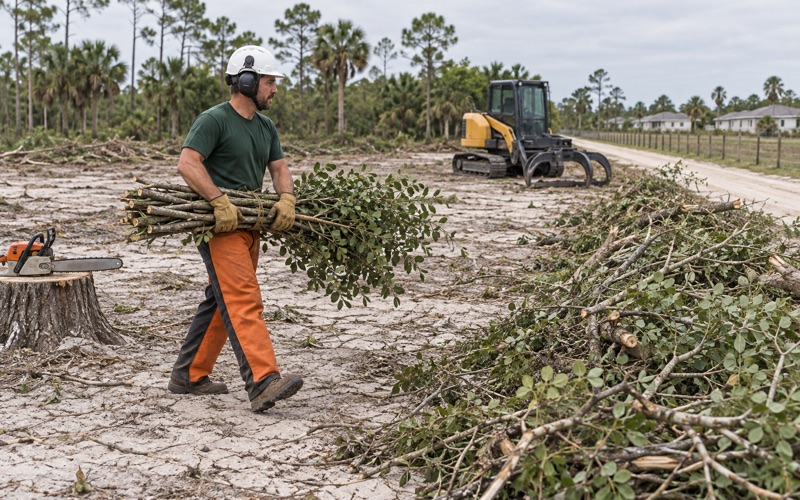
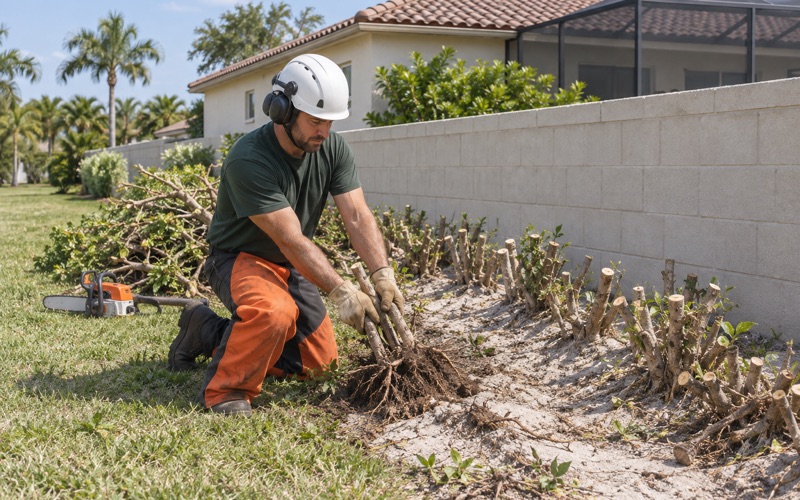
On invasive exotic vegetation the trigger is the tool rather than the plant. Hand removal of invasive exotics on developed property does not require a vegetation permit, while mechanical removal always requires both a development permit and a vegetation permit, under Section 122-191 of the Sanibel Land Development Code. The machine that makes the job quick is the machine that makes it a permitted development activity, which is why a bid built around a skid-steer and a grapple is a different bid from one built around loppers and a hand saw.
Eight exotics that must go, and a pine the City can order down
The City names eight invasive exotics by species: Brazilian pepper, melaleuca or punk tree, earleaf acacia, Java plum, scaevola or exotic inkberry, lead tree, mother-in-law’s tongue and air potato. Complete removal of all City-listed invasive exotic vegetation is required prior to issuance of a Certificate of Occupancy, and thereafter a homeowner is required to maintain the property free of these plants in perpetuity. In perpetuity is the City’s own wording, which makes exotic control a standing obligation attached to the land. Three of the eight are not trees at all, so part of what a clearing job covers here is not tree work.
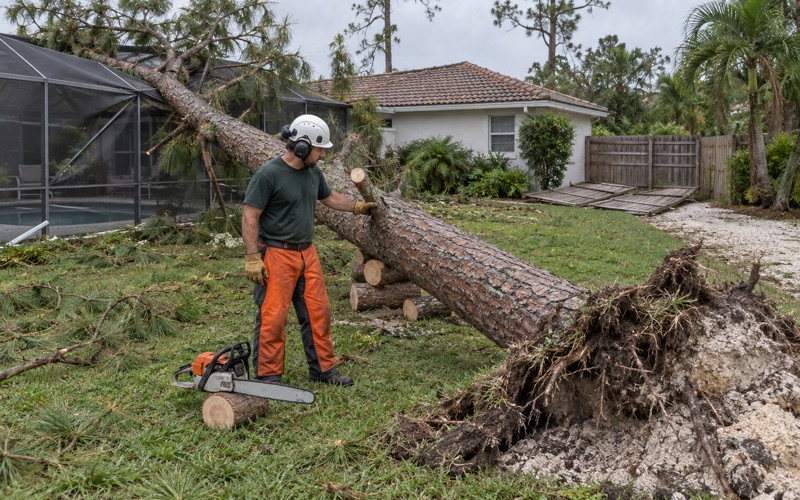
Australian pine sits under its own part of the City Code, at Sections 30-121 through 30-127. An owner may keep an existing pine, but the City states the exception in its own terms: if the City determines that a pine, or any other tree, is a danger to health, safety or welfare, or to City infrastructure such as a lift station, topping or removal of such trees is required. The City also notes that under state law it continues to prohibit the sale and planting of Australian pines.
The reasoning behind that is published rather than assumed. Assessments after Hurricane Charley found Australian pines were the single biggest cause of blockage of roadways, loss of electric power and disruption of water and sewer service on Sanibel, and the City describes the species as shallow rooted and brittle, with great potential to cause property damage, personal injury, destruction of utility infrastructure and blockage of roads in tropical storms or hurricanes. A restoration study the City cites raised native plant diversity on a five-acre tract from fourteen species to eighty-six within three years of clearing the pines.
Two things follow for an owner. The City can compel a removal on hazard grounds and has a documented storm rationale for doing so, which is why we treat a mature Australian pine near a power drop or a lift station as a conversation to have before storm season rather than after it. Topping appears in that ordinance as the City’s own word for a permitted remedy on one species, and it is not arboriculture: we do not top, hat rack or hurricane-cut anything else, on any tree or any palm, whoever asks.
What Florida Statutes section 163.045 does not reach
Florida Statutes section 163.045 bars a local government from requiring a notice, application, approval, permit, fee or mitigation to prune, trim or remove a tree on residential property when the owner holds signed documentation from an ISA-certified arborist or a Florida licensed landscape architect that the tree poses an unacceptable risk. It is a genuine tool and we use it where it fits, with the risk assessment done to the ISA Best Management Practices for Tree Risk Assessment. On this island, three limits decide how much of it actually lands.
The first is the plainest: subsection four of the statute expressly excludes mangroves, so nothing in it touches the City’s delegated mangrove program, and no arborist letter substitutes for notification, inspection and a certified trimmer. The second is that the documentation has to carry a risk finding, with removal the only means of practically mitigating the risk below moderate. That makes it a hazard-tree route and not a general exemption from a Vegetation Permit for a healthy protected native, and it says nothing at all about the leaf-area pruning trigger on a tree that is not a hazard.
The third limit is the definition of the property. The statute reaches a single-family, detached building on a lot actively used for single-family residential purposes, which on this island covers 2,364 owner-occupied one-unit detached homes in the 2024 American Community Survey five-year estimates, and excludes condominium and attached dwellings entirely. Where an owner qualifies, we put the condition report and the reasoning on the record before the saw starts; where they do not, we say so at estimate stage rather than letting the City be the one to explain it.
Two island facts sit behind every price we quote here. No disposal gate of any kind exists on Sanibel, so every load of wood leaves by the causeway and reaches a Lee County gate, where horticultural material runs $43.92 per ton with a $15 minimum. The toll onto the island is collected westbound only and is priced by axle, so a chip truck towing a chip box crosses as a four-axle combination at $12.00 on a transponder, every trip it makes.
A large share of the housing here is seasonal, and a written record is what makes an inspection worth anything when the owner is out of state. We photograph what we find, put the condition report in writing before a tree comes down, and book storm-season work ahead of the season rather than into the queue behind everyone else. When a tree does not need to come down, when a reduction inside the permit line or a cable is the honest answer, that is what the report says.
- 20+ Years on This Coast
- Written Estimate Before Any Cut
- No Topping, No Hurricane Cuts