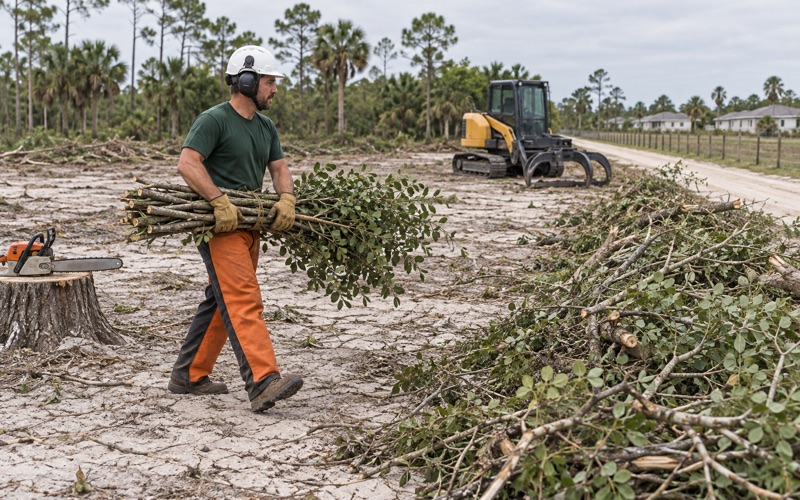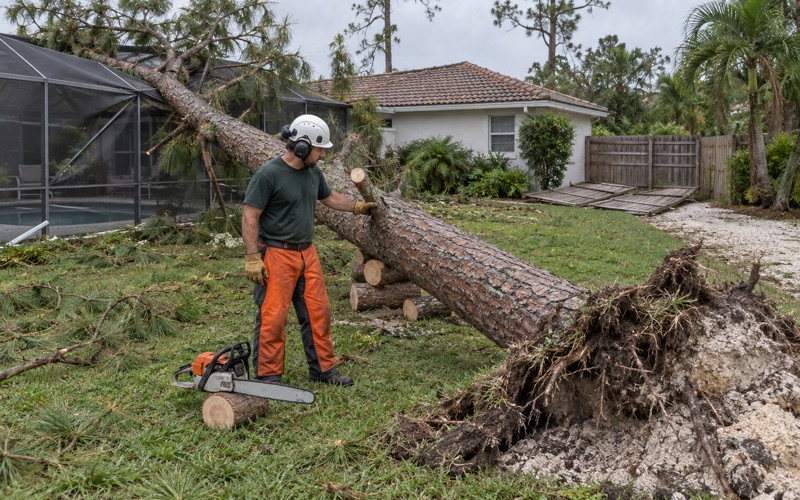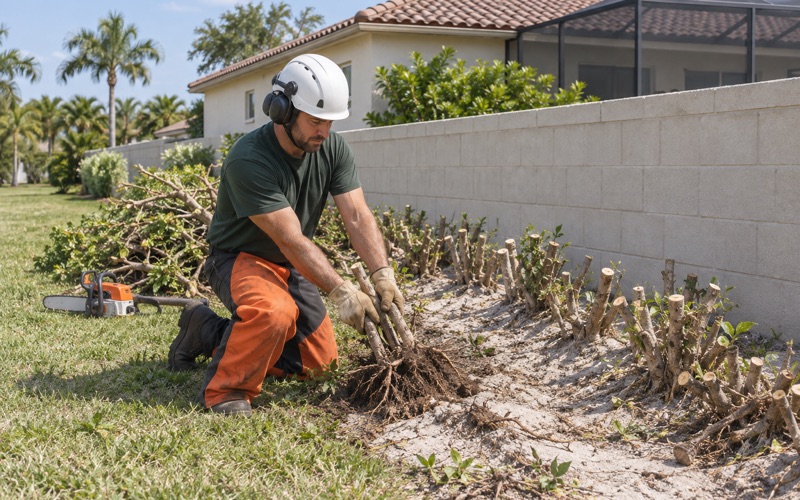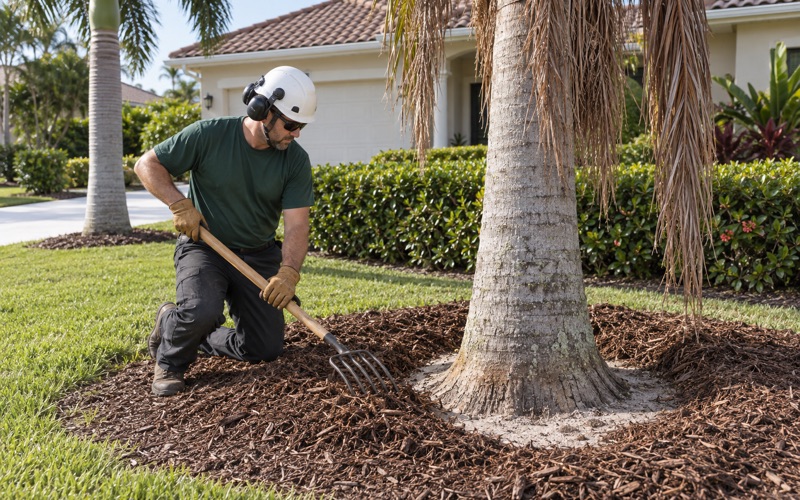
Bonita Springs Tree Removal handles tree removal in Punta Rassa, and on this peninsula the opening question on a job is almost never about the tree itself. It is about who owns the ground it stands on. Most of the work here sits on association common property, and that changes the paperwork, the sign-off and the order the job has to happen in. We settle it before we quote, because on association ground the answer decides who is even able to ask for the work.
Punta Rassa has no city hall, no mayor, no council and no municipal tree code, so nothing about a removal is settled at a village counter. It is unincorporated ground, which means Lee County’s Land Development Code is the code that reaches this address and Lee County Community Development is the office that issues the vegetation permit. Knowing which authority actually governs a job, before an estimate is written, saves a week of telephone calls to the wrong desk. That is the layer most estimates on this peninsula get wrong before anyone climbs anything.
The statute everyone cites, and the housing it does not reach
Florida Statutes section 163.045 is the rule most homeowners have heard of, and it is genuinely powerful where it applies. It bars a local government from requiring notice, application, approval, permit, fee or mitigation to prune or remove a tree on residential property when the owner holds signed documentation from an ISA certified arborist or a Florida licensed landscape architect that the tree poses an unacceptable risk. Subsection three bars any replanting requirement, and subsection four leaves mangroves out of it entirely.
Where the definition stops
The reach of that statute is set by its own definition of residential property: a single-family, detached building on a lot actively used for single-family residential purposes. Set that against the housing here and the picture inverts. In the 2024 American Community Survey five-year estimates, 77.8 percent of housing units in Punta Rassa sit in structures of twenty or more units, against 137 owner-occupied one-unit detached homes in the whole place. On the dominant property type on this peninsula, the arborist documentation route simply does not apply.
That is the reverse of how the statute is usually described, and it is the single most useful thing to know before a removal is quoted here. A condominium, a townhome, a duplex and any attached or multifamily dwelling all fall outside the definition, as do vacant lots and commercial ground. What governs those is the county’s ordinary tree permitting, run through the Land Development Code rather than through a private arborist letter. We say so at the estimate stage rather than after a board has been told the job needs no permit.
The 137 detached homes, and what changes for them
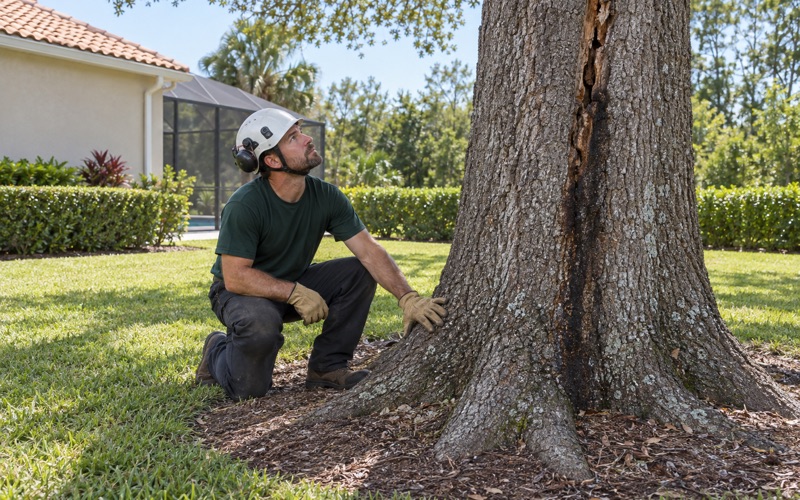
For the small share of Punta Rassa that is genuinely single-family and detached, the statute does what it says, and our own written condition report still goes on the record for any tree we recommend taking down. The documentation the statute contemplates is not a sentence on an invoice; it references the ISA Best Management Practices for Tree Risk Assessment, Second Edition, and the standard is that removal is the only means of practically mitigating the tree’s risk below moderate. Where that test is not met, our recommendation is pruning, a cable, or leaving the tree alone, and we will say so in writing.
Looking for tree-removal closer to Fort Myers? See Tree-Removal Services in Fort Myers.
Common property, the letter of authorization, and the single-tree permit
Lee County Community Development publishes a vegetation permit submittal requirements sheet, and one category on it was written for exactly this kind of ground. The single-tree category covers removing individual trees within an existing community on common property, and it asks the application description to list tree species, quantity, location and photographs of the trees to be removed. In a place where most housing sits in buildings of twenty or more units, that is the category most removals here fall into.
Who signs, and in what order
The same county sheet states that if the permit applicant is not the owner of the property, a letter of authorization must be submitted with the application. On association ground that sentence sets the running order: the board or the management company authorizes the work, the authorization goes in with the application, and the crew is scheduled after the permit exists rather than before. A resident who wants a tree gone cannot start that chain alone, however clearly the tree is leaning over their own lanai.
We work to that order rather than around it. Our estimate names the trees by species and location so the description a board needs is already written, and the photographs the county asks for come from the same inspection. For owners who are only here part of the year, those written findings and photographs go out by email, so an inspection still means something when nobody is standing in the yard. It also means the file the association keeps is a record rather than a memory.
The thresholds that do not apply here
The county’s clearing categories also name single-family triggers that are worth ruling out early: a detailed site plan for a single-family lot of five acres or more in unincorporated Lee County, a lot on a barrier island, or a Pine Island lot of two acres or more. Punta Rassa is a mainland peninsula at the foot of the causeway, not a barrier island, so on its face the ordinary unincorporated-county thresholds are the ones in play. We treat that reading as something to confirm with Lee County Community Development on the specific parcel rather than as settled, because the wrong assumption here costs an application cycle.
What the storm record actually says about this peninsula
The National Hurricane Center’s tropical cyclone report on Hurricane Ian records landfall near Cayo Costa at 130 knots on the twenty-eighth of September 2022, then a second landfall near Punta Gorda at 125 knots. For Punta Rassa it publishes a storm surge of 8.37 feet above mean higher high water. That is a gauge-referenced figure and it belongs to this place, but it is not the same measurement as the above-ground-level inundation depths the same report gives for other locations.
We are careful about that distinction because the two get quoted interchangeably, and because the same report carries no canopy mortality figure for anywhere. Nobody can tell you what percentage of trees this peninsula lost, and any number offered is invented. What we can tell you is what salt water standing in sand does to a root plate over the following seasons, which is a slower story than a single storm day. Delayed post-storm mortality is why a tree that looked fine in November is a removal by March.
A low, flat spit with a post-causeway canopy
This has always been a low, flat, exposed spit. Cattle pens and a dock were built here in 1861, and between 1868 and 1878 1.6 million head of cattle were shipped out to Cuba; a ferry ran across to Sanibel from 1912 until the causeway and its drawbridge opened in 1963. Almost everything standing here is post-causeway development, and 31.7 percent of the housing stock predates 1980, which is a useful bracket for how old the planted canopy around a building is likely to be.
Ground that holds water, not rock
The tidal and coastal soils described for this county are sand, shell and muck rather than anything a grinder has to fight. The Estero series is very poorly drained and flooded during daily high tides; Kesson carries black mangrove, batis and oxeye daisy as its native vegetation; Wulfert muck sits in mangrove swamp and floods on ordinary daily tides. Captiva soils form in thick deposits of sand and shell fragments, with a water table within ten inches for one to two months and within ten to forty inches for about ten months of the year.
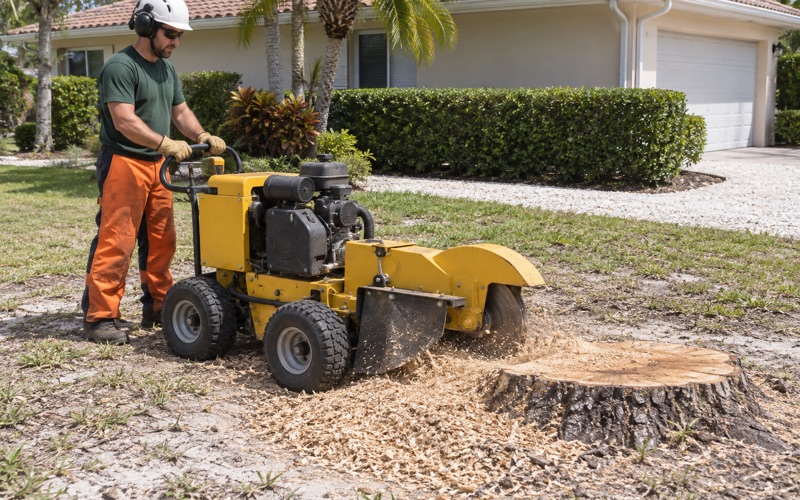
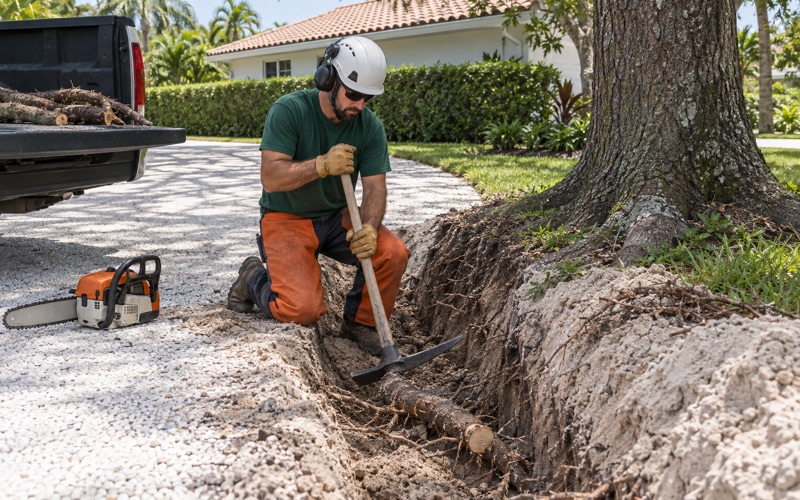
That changes the machine and the method rather than the price of a permit. A stump grinder here meets water close to grade for most of the year instead of rock or hardpan, sand and shell give a root plate very little to hold, and sulfide-bearing tidal muck at the mangrove edge is not ground at all. Which series is mapped on a given parcel is a question for the survey, not something we will guess at from the street.
Mangroves, disposal, and a toll that is not your cost
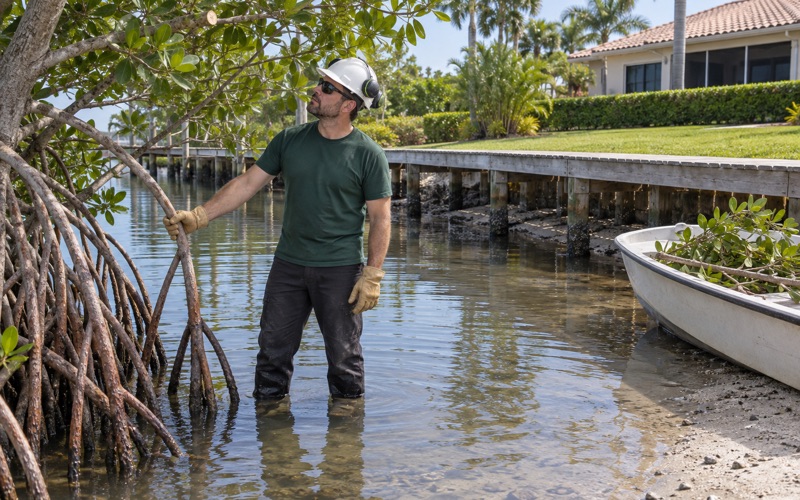
Shoreline work on the Caloosahatchee and San Carlos Bay frontage brings in a different authority again. Florida’s Department of Environmental Protection publishes the list of local governments with delegated mangrove authority, and it names seven statewide: Miami-Dade County, Broward County, Hillsborough County, Pinellas County, the Town of Jupiter Island, the City of Sanibel and Sarasota County. Lee County is not on it, and neither is any body here, so a mangrove on this frontage is a state matter under the Mangrove Trimming and Preservation Act and, where a permit is needed, a South District permit.
The exemption an owner can rely on is narrow. On a shoreline of 150 feet or less it covers a riparian fringe no more than ten feet pretrimmed, never cut below six feet; a professional mangrove trimmer raises the pretrimmed height to twenty-four feet; anything sixteen feet or over is staged at no more than a quarter of its foliage a year. First-time trimming of a red mangrove requires ten days of written notice, and herbicides used to defoliate a mangrove are prohibited outright.
Where the wood goes
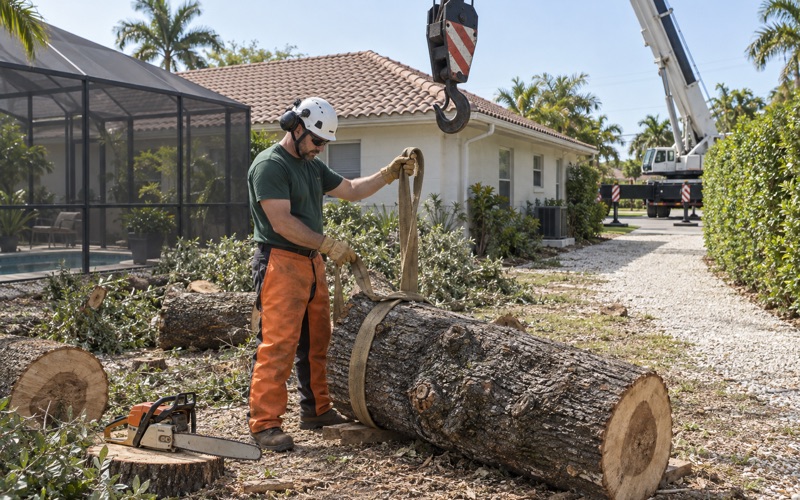
Hauling and disposal are a real line on this coast, not a rounding error, which is why we price them separately on every estimate. Lee County’s horticultural gate rate at its Buckingham horticulture facility is $43.92 per ton for the 2026 fiscal year, with a $15 minimum. Curbside yard waste is a different route with its own limits: bundles of fifty pounds and no more than six feet long, and fifty pounds of unbundled palm fronds. A written estimate that separates the cutting from the moving lets a board see which half of the number it is actually approving.
One local fact worth stating plainly, because it gets borrowed from island jobs: the Sanibel Causeway toll plaza sits at the mainland end of the crossing, here at Punta Rassa. Lee County describes three traffic lanes processing on average over three million vehicles annually, all of them flowing westerly toward Sanibel Island. A Punta Rassa address is on the mainland side of that plaza, so the toll is charged going out to the islands and does not enter the price of work done here.
What we will not do here
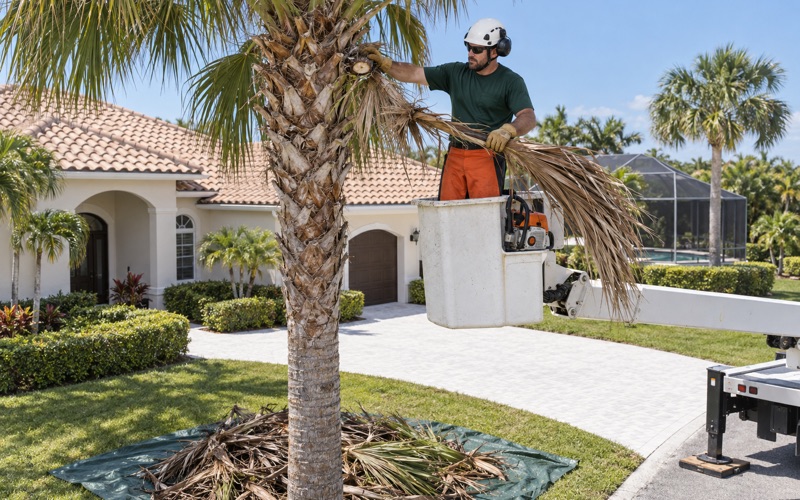
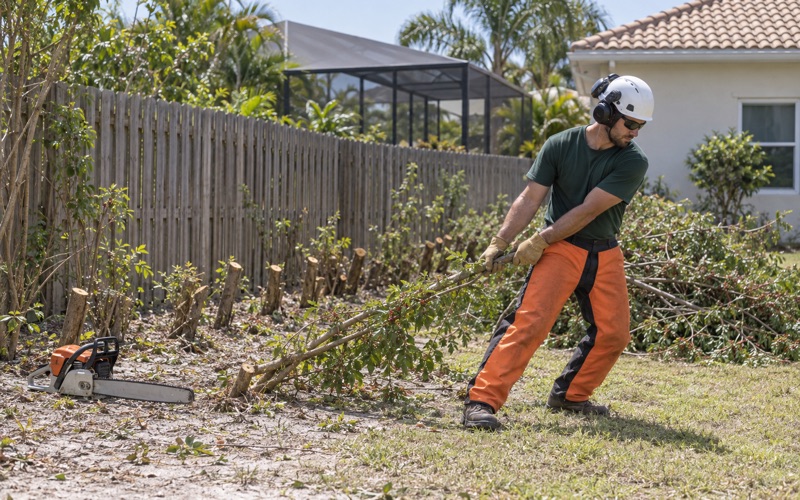
There is no topping, no hat racking and no hurricane cut on any tree or palm on this peninsula, whoever asks for it. Those cuts are sold hard before storm season and they leave a palm or a hardwood weaker than it was, with decay entering at every stub. Palms and hardwoods are separate jobs on our schedule for the same reason: a palm has no branch collar to cut back to, and pruning it like an oak is how a crownshaft gets damaged.
- 20+ Years on This Coast
- Written Estimate Before Any Cut
- No Topping, No Hurricane Cuts