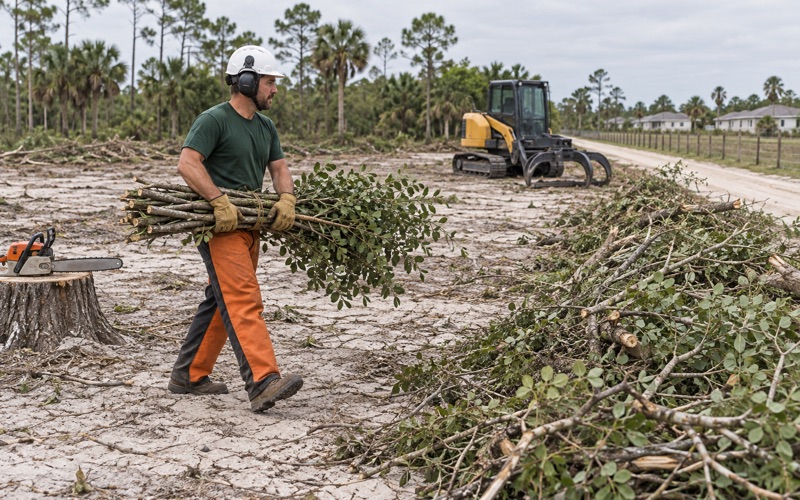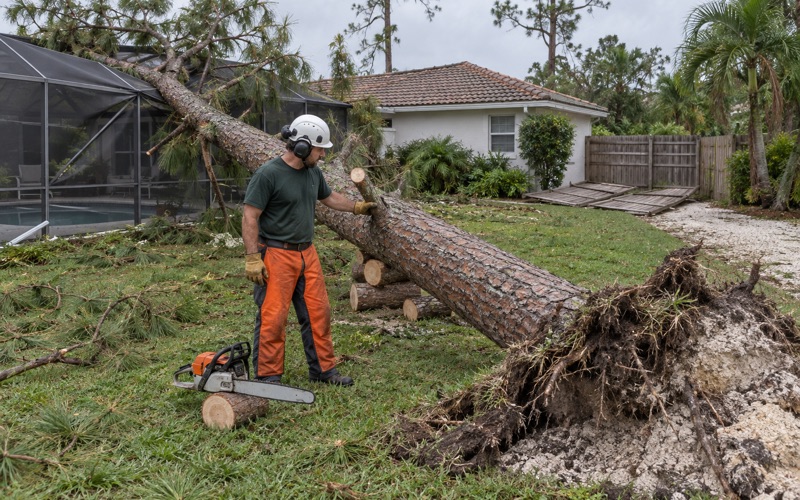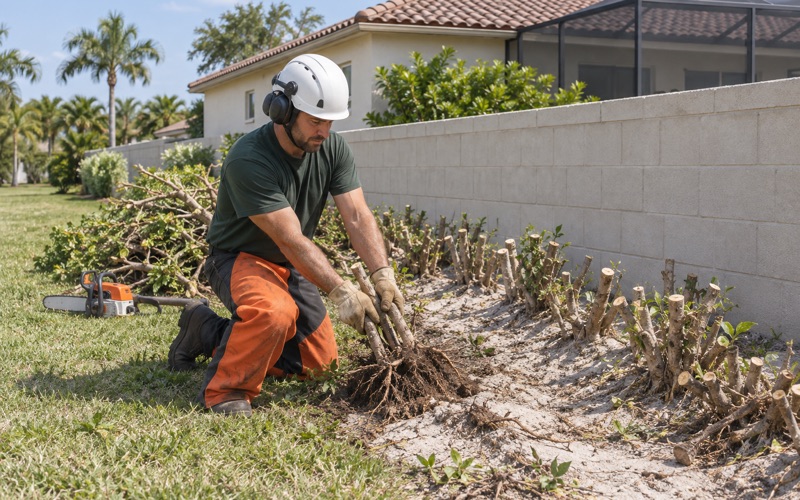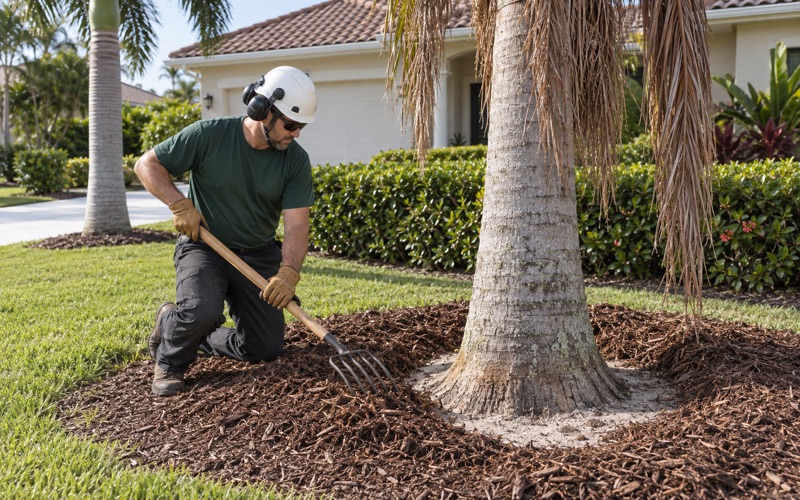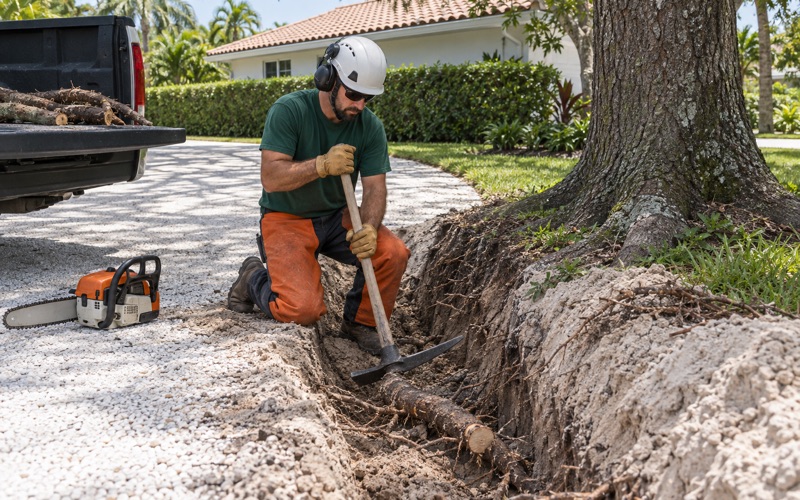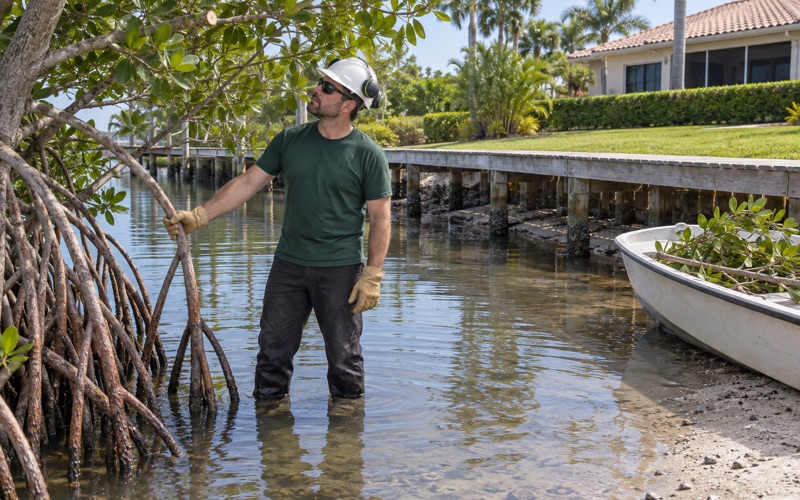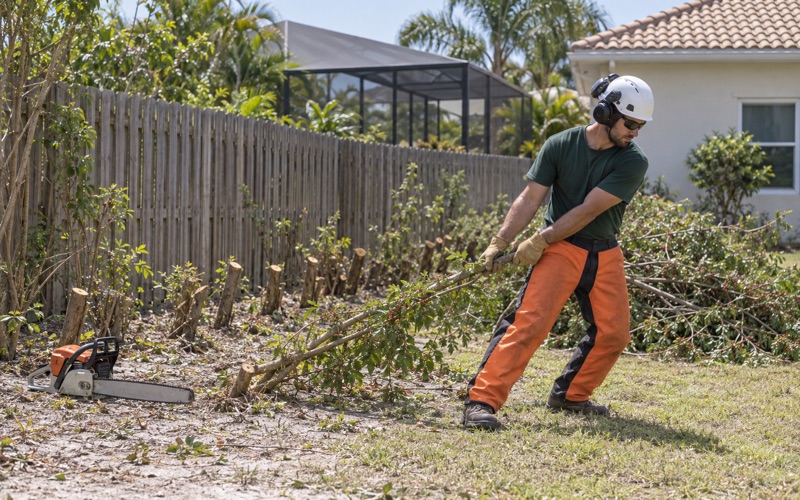
Bonita Springs Tree Removal handles tree removal in North Fort Myers, and we have spent more than twenty years working this coast, where the ground is sand and hardpan rather than soil over rock. We take down hazardous trees, clear storm-damaged wood, prune to a written standard, and grind stumps below grade on properties across Lee County. Every job starts with a written estimate, with hauling and disposal carried on their own line so a property owner can see exactly what it costs to move the wood off the lot.
What makes this place its own job is who the customer turns out to be. A large share of the work here sits on ground the resident does not own, which means the person who called us may not be the person who can authorize a saw. We sort that out before we quote rather than after, and we put the reason a tree should come down in writing, with photographs, so the decision survives the meeting it has to go through.
A drop zone that is a park lot, not a yard
Nearly half of all housing units in North Fort Myers are mobile homes, 49.1 percent of them by the 2024 five-year American Community Survey, and owner-occupied manufactured homes outnumber owner-occupied detached houses, 8,796 against 7,822. Lee County’s own community plan says the same thing in its own words, that mobile homes account for over half of the total housing units here while making up 17 percent of the county’s stock. That is not a demographic footnote for a tree crew. It changes the shape of the drop zone on most of the calls we take.
Narrow lots, private streets, and nowhere to drop a stem
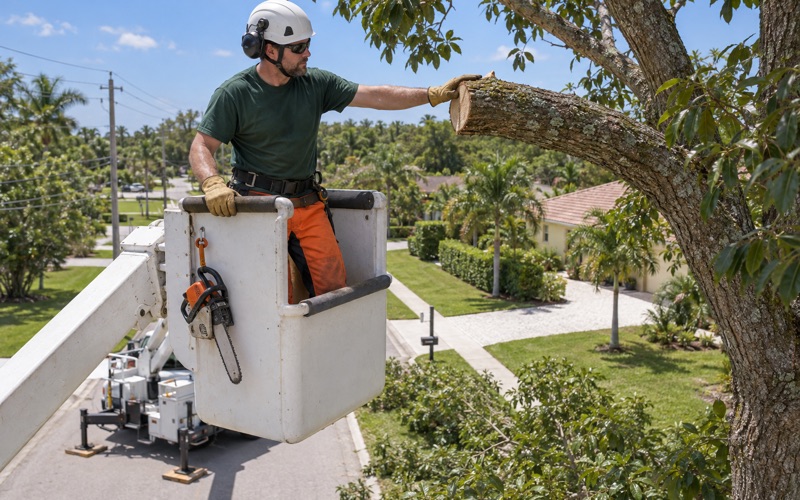
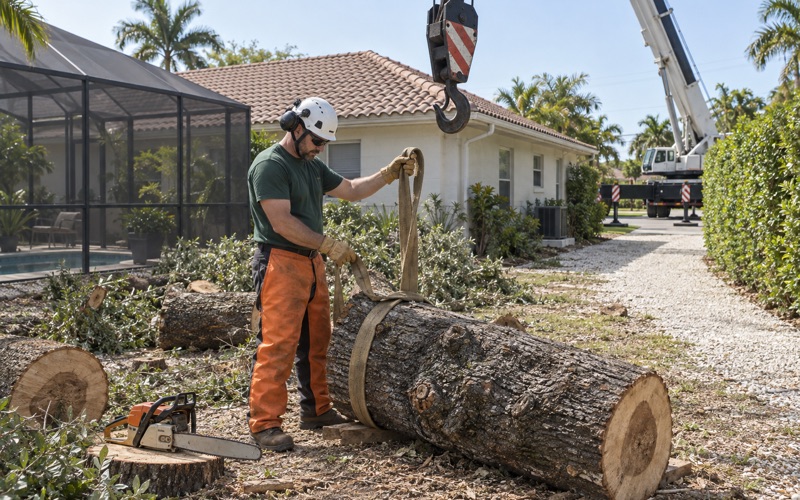
On a park lot the setbacks are the park’s, not a zoning map’s, the streets are private and often too narrow for a boom to swing freely, and the neighboring home sits the same short distance away on both sides. There is frequently nowhere on the property to lay a stem down, so a job that would be a straightforward felling on an acre becomes a rigging job or a crane pick. We size the access to the property rather than the other way around, from narrow-gate machines behind a fence to a crane set in the street.
That matters to a budget, and we would rather say so at the estimate than discover it halfway through a Saturday. A tree on a manufactured-home lot often costs what its access costs, not what its diameter suggests, and the written estimate we leave behind separates the cutting from the hauling and disposal so the difference is visible. When a tree does not need to come down at all, we say that too, including when directional pruning or a cable is the honest recommendation.
Panel roofs and roof-overs take a limb differently
A manufactured home does not carry site-built trusses. It typically has a light panel roof or a roof-over added later, and neither was designed for the point load a dropped limb or a landing pad delivers. Damage a shingled truss roof would shrug off can be structural on that assembly, which is why we rig pieces down to a controlled speed rather than letting them fall, and why we do not use the roof as a work platform or a place to set gear.
Looking for tree-removal closer to Captiva? See Captiva Tree-Removal.
Who signs when the ground is rented
On rented ground the tree question runs through the park owner or, in a cooperative park, its board. Florida Statutes chapter 723 governs mobile home park lot tenancies, and section 723.022 makes the park owner responsible for maintaining buildings and improvements in common areas in a good state of repair, and the common areas themselves in a good state of appearance, safety, and cleanliness. The same section requires compliance with applicable building, housing, and health codes and with properly promulgated park rules.
What the statute does not do is settle every tree on every rented lot. A tree standing in a common area is unambiguously the park owner’s responsibility; a tree on an individual lot is governed by the prospectus and the lot rental agreement, which is a document the park keeps rather than a rule we can quote in advance. So we ask one question before we price anything, which is who owns the ground this tree stands on, and we address the estimate to whoever that turns out to be.
A board meets on its own schedule
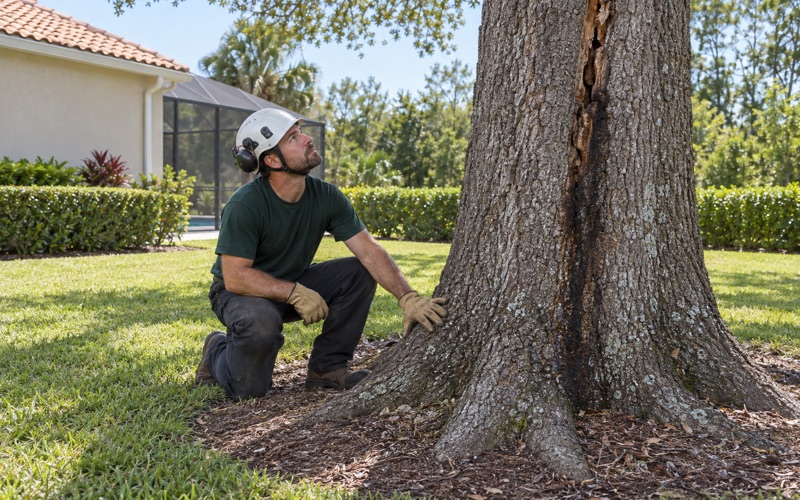
A park board or a management company decides on a calendar, not on a phone call, and a leaning tree does not wait for the next meeting. That is why every tree we recommend taking down gets a written condition report, with photographs and the reason stated plainly, before the saw starts. The report is a document a board can circulate, attach to minutes, and act on without anyone having to remember what the crew said in the driveway.
Season matters too. The North Fort Myers Fire Control and Rescue Service District, an independent special district with its own elected five-member board and three stations covering a 36 square-mile first response area, puts its resident population at roughly 50,000 year-round and nearly 70,000 in winter. Many of the people who need to sign are not here in the wet season, so we book storm-season work before the season rather than scrambling after it, and we send written findings and photographs to owners who are away.
What the county requires, and what the ground allows
There is no city hall in North Fort Myers. This is an unincorporated census designated place in Lee County, so there is no municipal code, no city permit counter and no city arborist to call, and every governmental answer runs to the county, to an independent special district, or to a private board. Lee County’s Land Development Code is the code that applies, and its section 14-411 says so on its face, barring anyone from cutting down, removing, relocating or otherwise damaging a protected tree located in the unincorporated areas of the county without first obtaining a permit.
The counter that issues those permits is the county’s Division of Environmental Sciences in Fort Myers, and the form is the Application for Vegetation Removal. Its single tree category for common elements is the line that fits a large share of the work here, priced at $30 plus $1 per tree, capped at $25 per acre, and doubled where the work was done before the permit was pulled. An applicant who is not the owner has to submit a letter of authorization, which is another reason we settle the ownership question first.
The state shortcut is narrower than it sounds
Florida Statutes section 163.045 is the state provision homeowners hear about as a way around a local tree permit, and it reaches this place like anywhere else in Florida. Read its definition, though: it applies to a single-family, detached building located on a lot that is actively used for single-family residential purposes. A manufactured home on a rented park lot is not that, and the statute has not been read to cover it. Given how much of the housing here sits on rented ground, the shortcut covers a smaller slice of this stock than an owner-occupancy figure suggests.
Under the pad, hardpan and fill
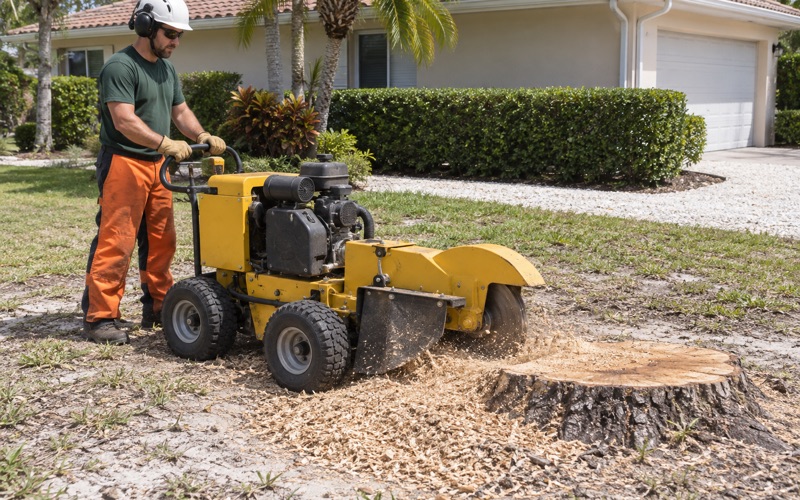
Ground conditions decide how a stump job ends. The state soil here, Myakka fine sand, puts a spodic hardpan starting at about 20 inches with a water table under 18 inches for one to four months in most years, and the Matlacha series, 20 to 48 inches of dredge and fill over marine sediments, carries shell and limestone pieces wherever a pad was raised. We grind below grade with that in mind and quote the wear where the fill is, instead of finding it at the machine.
Severe pruning is a citable offense here
Here, ANSI A300 and the ISA pruning practices are not aspirational; they are the standard a citation is written against. Land Development Code section 10-421(c) requires vegetation required by the code to be pruned only to promote healthy, uniform, natural growth, in accordance with the American National Standard for Tree Care Operations, A300 Part 1, and the International Society of Arboriculture’s Best Management Practices. Trees must not be severely pruned to permanently hold growth at a reduced height or spread, and severely pruned trees must be replaced by the property owner at the sizes set in section 10-420.
The county said as much in a formal warning letter sent to tree service contractors, property management companies, landscape architects and lawn maintenance contractors, warning that excessive or severe pruning such as hat racking, topping, shaping, balling or poodle tailing would face swift and increased enforcement. Severe pruning, it said, is irreparable damage to the tree, and no further warning tickets would be issued. Citations go to the property owner or manager and to the pruning contractor alike, which makes a cheap crew an expensive decision for whoever hired it.
The fines are written per tree: $100 for a first offense, $250 for a second and $500 for a third. The county’s own worked example runs fifteen excessively pruned trees on a site to a $1,500 citation for the tree contractor and a separate $1,500 citation for the property owner. Where corrective pruning cannot structurally conserve what is left, a notice of violation adds a requirement to replant three trees for every tree that was excessively pruned.
What we will not do to a tree
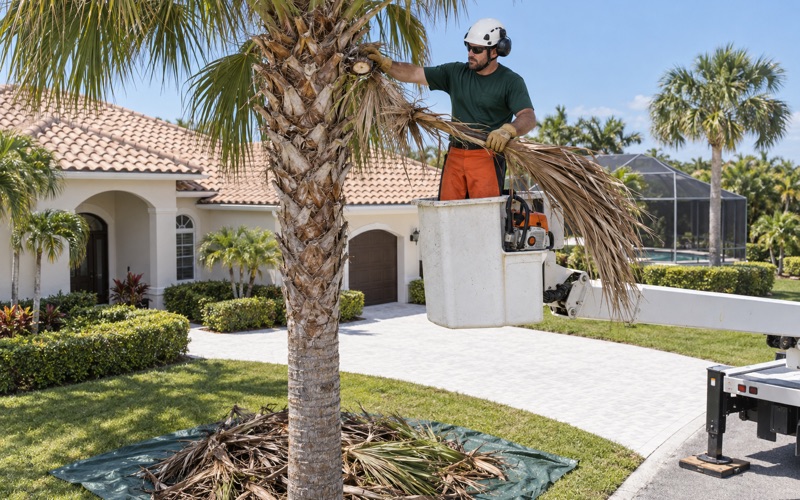
We do not top, hat rack or make hurricane cuts, on a hardwood or a palm, whoever asks for them, and a palm is pruned as its own job by crews who know it has no branch collar to cut back to. Florida issues no state tree or arborist contractor license and no county here can issue one either, so anyone claiming to be licensed for this work is describing something that does not exist. What we put on the estimate instead is ISA certification and verifiable general liability and workers’ compensation coverage.
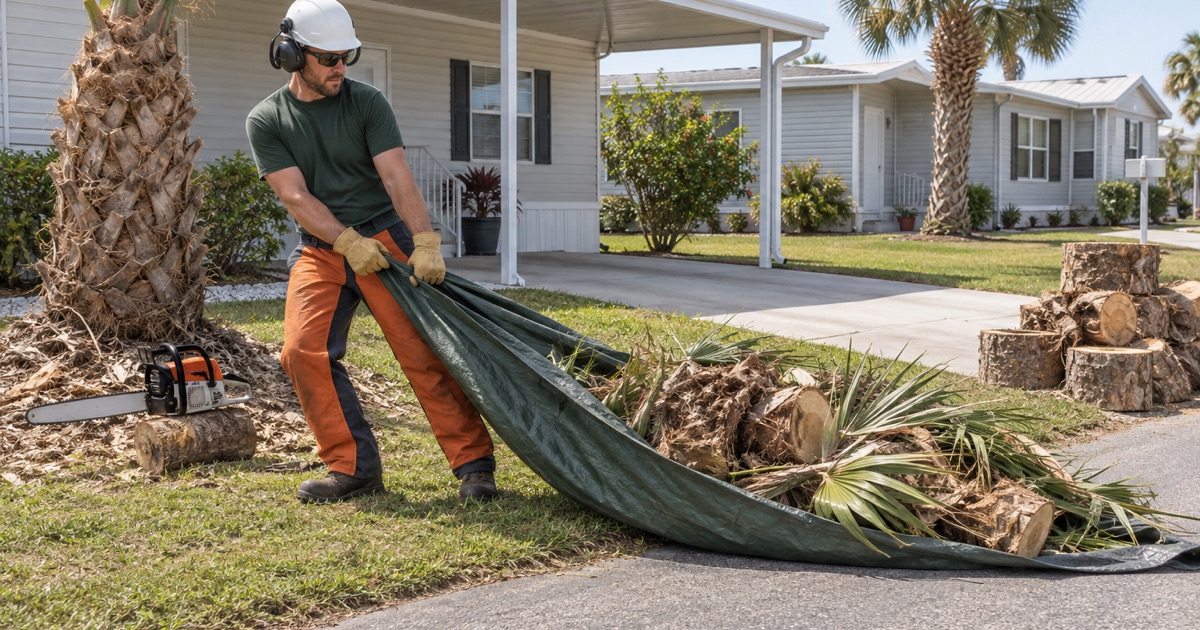
The wood still has to leave, and the county’s yard waste rules cap what the curb will take: vegetative material no longer than six feet and no heavier than fifty pounds, bundled or containerized to that limit, with palm fronds bundled once they pass fifty pounds. A removal produces far more than that, and the hauler serving a given address here is a franchise question the county answers by address rather than by name. We haul our own debris and price it on its own line, so nobody is left with a pile the truck will not take.
- 20+ Years on This Coast
- Written Estimate Before Any Cut
- No Topping, No Hurricane Cuts