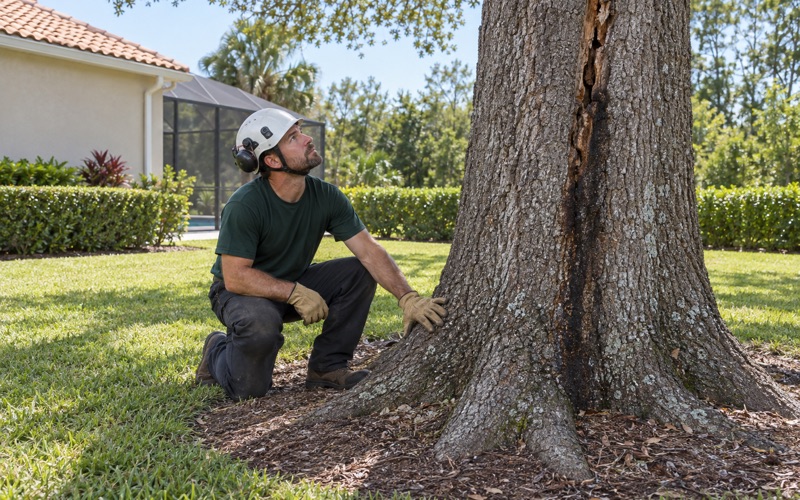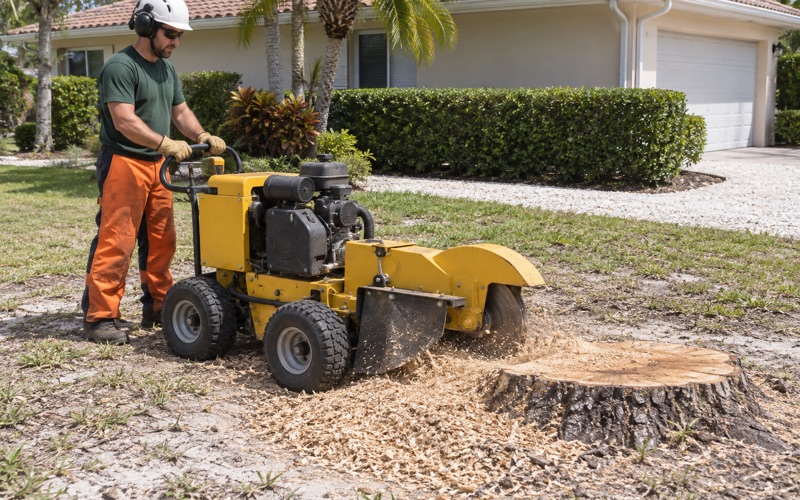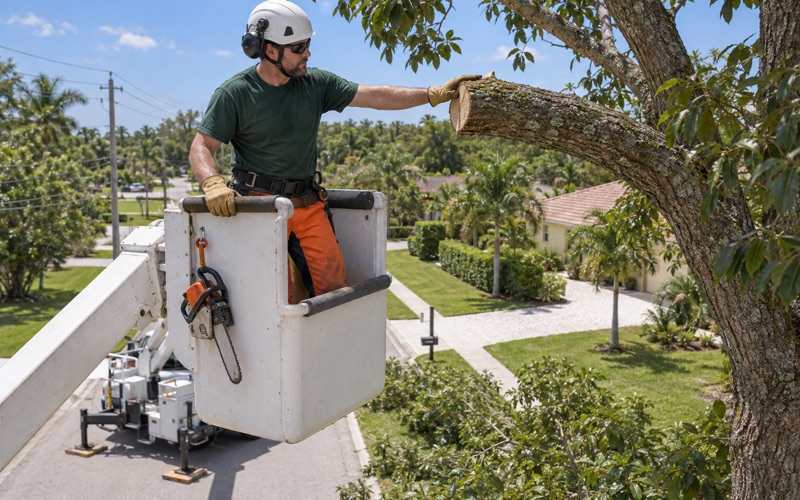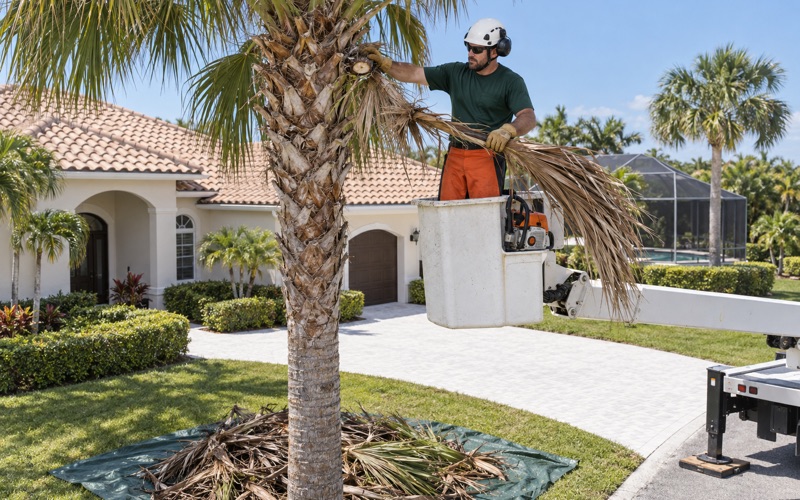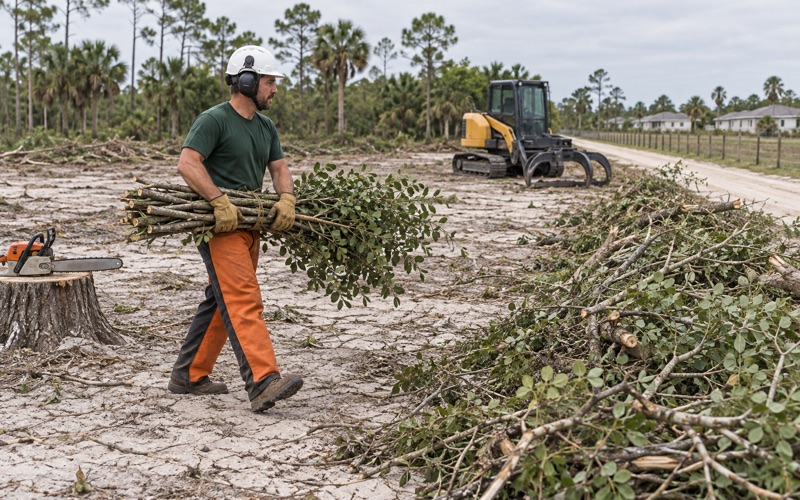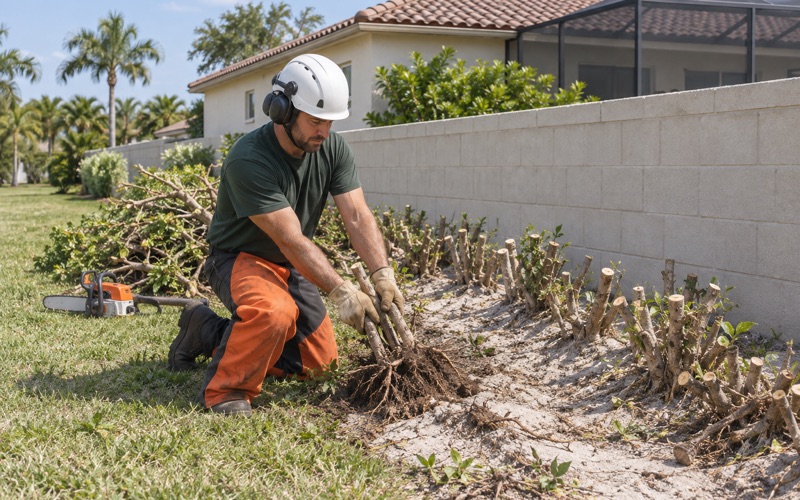
Bonita Springs Tree Removal has spent twenty-plus years doing tree removal in Naples Park and the rest of this coast, and the first thing we measure on arrival is usually not the tree. It is the distance between the two houses standing beside it. What a removal costs here, and how long it ties up an avenue, is decided by lot width, setback and the route a chipper can take to the stem long before anyone forms an opinion about the size of the canopy.
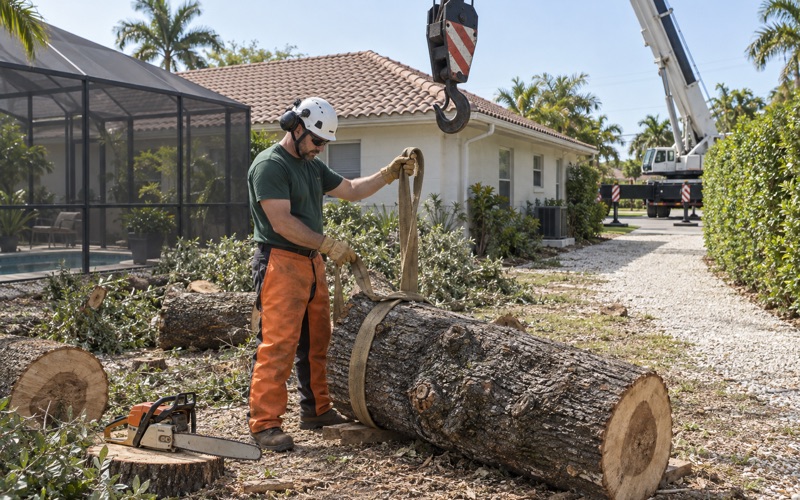
That shows up in what we hand you. Every job gets a written estimate before anything is cut, with hauling and disposal priced on their own line, because on a lot this narrow the wood is often the expensive half of the work rather than an afterthought. If a crane pick over the roof is the only safe way out of a back yard, you see it priced that way at the start instead of discovering it halfway through the morning.
We also give a straight answer when a tree does not need to come down at all. Sometimes the honest recommendation is directional pruning or a cable rather than a removal, and we would rather say so and lose the job than take out a sound tree on a street where mature shade is already scarce.
A 1951 grid of numbered avenues, and what it leaves for a truck
Naples Park was platted and opened on 4 November 1951 by M. H. Davis Properties, with lots advertised from $149.00, laid out as a rigid grid of numbered east-west avenues running between 91st and 111th Avenue North, bounded east by U.S. 41 and west by Vanderbilt Drive.
The whole place covers about 1.23 square miles, and the grid is continuous with no through-collector alternatives inside it. Equipment staging, street blockage and neighbor access are recurring job-site facts here rather than occasional ones.
Lots platted for a house, not for a drop zone
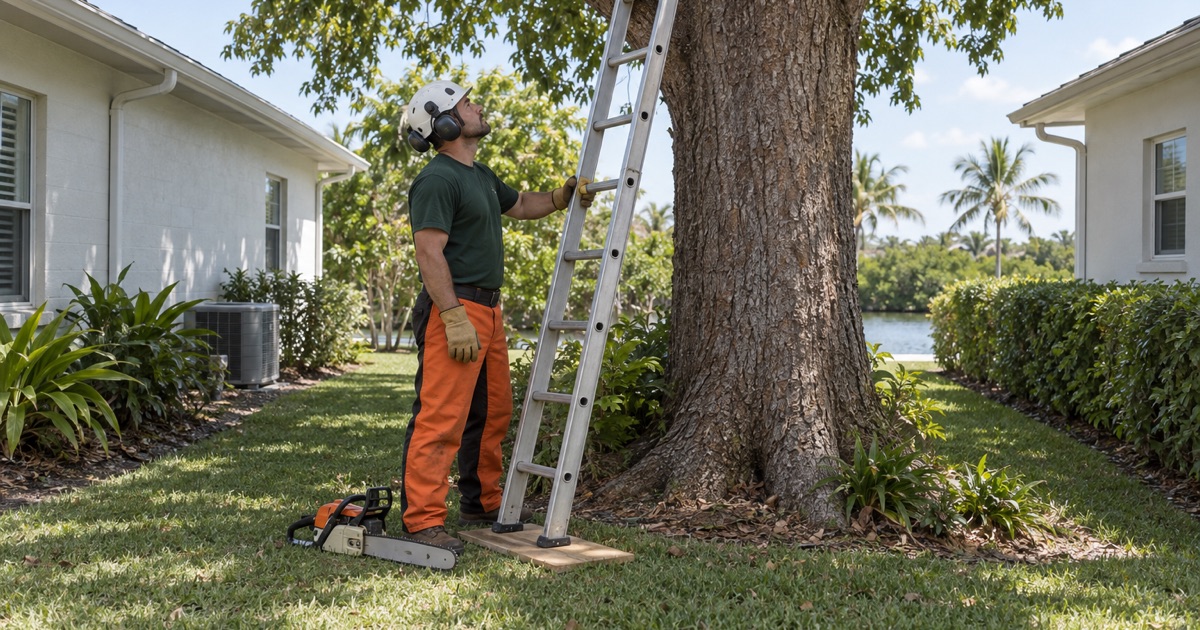
American Community Survey five-year figures put 84.7 percent of the housing units here in one-unit detached buildings. Read against 1.23 square miles, that share describes something specific: a dense platted grid of small detached lots, not a low-density subdivision with room to work. Detached is not the same as roomy, and a crane setup, a chipper, a log truck and a drop zone all have to fit between two houses sited to a mid-century plat with a neighbor’s roof close on both sides.
So we size access to the property instead of to the equipment we happen to own. Narrow-gate machines reach a fenced back yard that a full-size loader will never see, and where nothing fits down the side, the work goes vertical and the wood leaves over the structure rather than past it. Which of those a given lot allows is a measurement we take before quoting, not a judgment we make once the crew is already parked.
Rock sitting inside a stump grinder’s rated cut
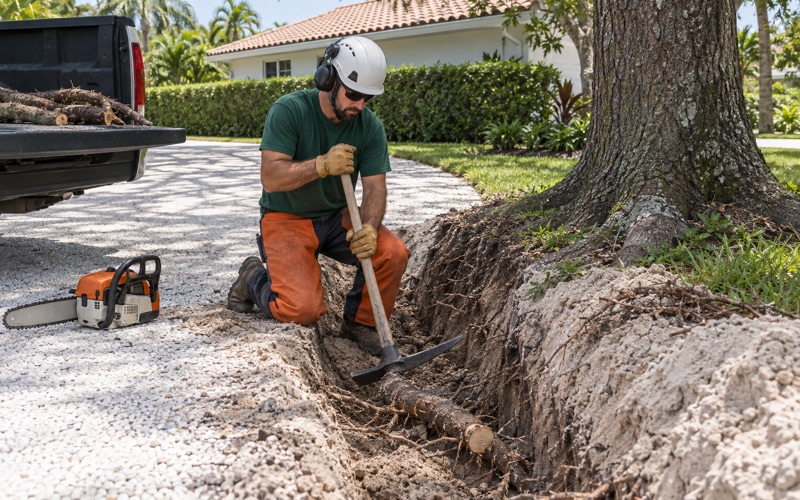
The ground under this grid is shallow sand over limestone. The Hallandale series carries a lithic contact at 7 to 20 inches, with hard fractured limestone at 16 inches in the typical pedon; the Boca series puts limestone at 20 to 40 inches, with a water table within 12 inches of the surface for four to nine months in most years. On both profiles, rock sits inside the rated cut of a stump grinder.
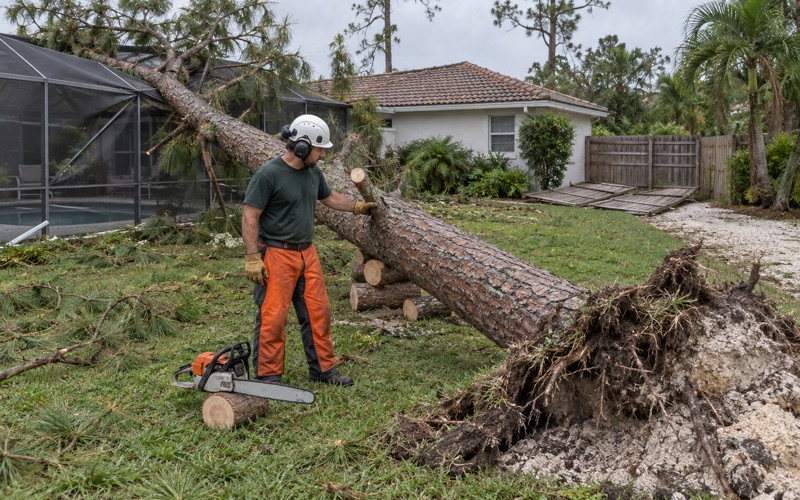
A below-grade cut has to be planned around rock rather than driven through it, which is a cost question we would rather raise in the estimate than in an invoice. The same saturated shallow profile is also what lets a large root plate lift whole in a wind event instead of the stem failing, so what looks like a healthy trunk is not the whole risk picture.
Palms are a different job, and much of the work here
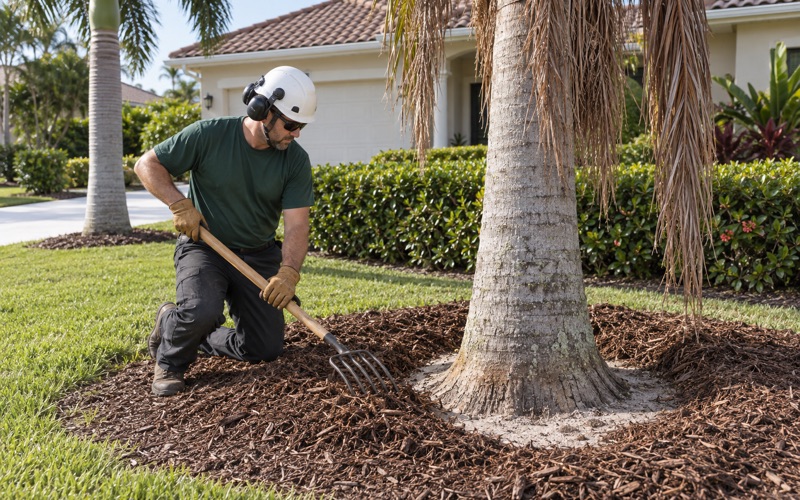
Structurally a palm is not a tree: no cambium, no branch collar, no compartmentalization, a single growing point, a trunk diameter fixed for life and every root adventitious. Our crews treat palms and hardwoods as the separate trades they are, because there is no branch collar on a palm to cut back to and pruning one by hardwood habits does lasting damage.
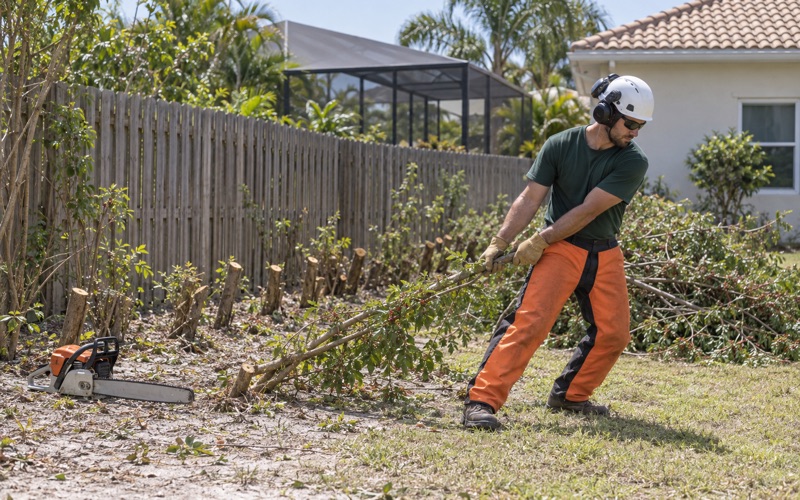
Ganoderma butt rot, caused by Ganoderma zonatum, is untreatable, occupies the lower four to five feet of trunk, and cannot be diagnosed until the conk forms, at which point removal and stump grinding are the only answer. On lots this size, the grinding is the access problem rather than the felling. We do not top, hat rack or hurricane cut anything, palm or hardwood, whoever asks for it.
Looking for tree-removal closer to Florida Gulf Coast University? See Florida Gulf Coast University Tree-Removal.
Whose code is actually in force at a Naples Park address
There is no city hall in Naples Park. This is an unincorporated community and census-designated place in Collier County, with no mayor, no council, no municipal ordinance and no city tree department of any kind. Collier County is the general-purpose local government at these addresses, the Board of County Commissioners adopts the code, and the Growth Management Community Development, Development Review Division administers it.
Not part of the City of Naples
The name causes genuine confusion, and the confusion has consequences for a homeowner trying to do the right thing. The Collier County Supervisor of Elections states plainly that there are three municipalities within the county: the City of Naples, the City of Marco Island and Everglades City. Naples Park is not among them, so anyone quoting a municipal ordinance at an address on one of these numbered avenues is quoting the wrong government’s rules back at you.
Collier County Land Development Code 3.05.00
Vegetation removal here falls under Collier County Land Development Code section 3.05.00, Vegetation Removal, Protection and Preservation. The county’s own Vegetation Removal Affidavit, revision 4/8/2025, states that it is unlawful to remove or otherwise destroy vegetation, including by placing additional fill, without first obtaining a vegetation removal permit from the Development Review Division, and that no permit issues until all applicable federal, state and county approvals have been obtained.
The same form notes that a permit for a new single-family house allows clearing up to one acre, that clearing beyond one acre requires a full vegetation removal permit, and that the affidavit itself is not an authorization to clear. Read cold, it leaves a homeowner convinced that one declining tree in a back yard is a county paperwork problem.
The statute the county’s own form never mentions
On qualifying property, it is not. Florida Statutes section 163.045 provides that a local government may not require a notice, application, approval, permit, fee or mitigation for the pruning, trimming or removal of a tree on residential property when the owner possesses documentation from an ISA-certified arborist or a Florida licensed landscape architect that the tree poses an unacceptable risk, and subsection (3) bars any replanting requirement. The county affidavit does not mention that statute anywhere on the form.
We say that out loud rather than quietly working around it. The statute binds a local government, which means it reaches Collier County at an unincorporated address exactly as it reaches an incorporated city elsewhere in the state. That gap between the county’s published process and the state law sitting over it is not a trick to exploit; it is the reason a careful homeowner here can read the county’s own paperwork and still reach the wrong conclusion about their own yard.
What the exemption covers, and what it leaves out
The definition is narrow. Section 163.045(1)(b) describes residential property as a single-family, detached building on a lot actively used for single-family residential purposes, so the exemption does not reach condominiums, townhomes, duplexes, any attached or multifamily dwelling, a vacant platted lot, or commercial and industrial property. With most of the housing stock here detached, the statutory shape and the built shape line up on most parcels.
That alignment is not a guarantee, because the statute reaches a building type rather than a neighborhood. A duplex, a converted attached unit or an unbuilt lot on the same avenue sits outside it. The statute also binds a local government and not a private covenant, and the Naples Park Area Association is a voluntary community body rather than a recorded-covenant authority over the plat.
Documentation before the saw starts
Unacceptable risk is a defined term rather than an opinion. Under ISA Best Management Practices, Tree Risk Assessment, Second Edition (2017), it means removal is the only means of practically mitigating the risk below moderate. The statute is equally specific about the signature: an ISA-certified arborist or a Florida licensed landscape architect, and nobody else. Florida issues no state tree or arborist contractor license at all, so any company advertising one is describing something that does not exist.
We put a written condition report on every tree we recommend taking down, so the reason is on the record before the first cut rather than reconstructed afterwards. Seasonal and second-home owners get those findings with photographs, which is what makes an inspection worth anything when nobody is standing in the yard. Where a removal is going to rest on section 163.045, we tell you directly that the signed documentation has to carry one of those two credentials.
The lagoon edge, the power drop, and where the wood goes
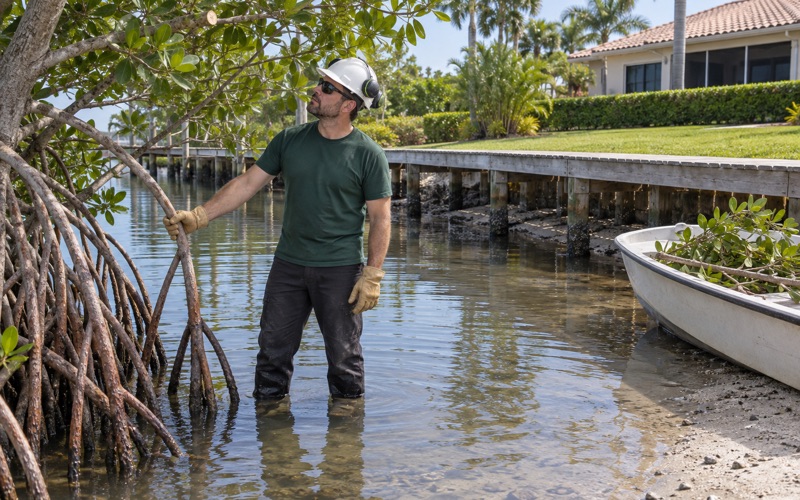
Vanderbilt Lagoon lies immediately west of the grid, so tidal shoreline is never far from a job here, and nothing in the residential exemption reaches mangroves. Section 163.045(4) excludes them expressly, and Florida’s Mangrove Trimming and Preservation Act, sections 403.9321 through 403.9333, protects white, red and black mangrove. Exempt owner trimming is limited to a fringe of 10 feet or less in pretrimmed height on a shoreline of 150 feet or less, a professional mangrove trimmer raises that limit to 24 feet, and herbicides used to defoliate a mangrove are prohibited outright.
The permit for that work is a state permit at this address. The Department of Environmental Protection lists exactly seven local governments holding delegated mangrove authority, and Collier County is not among them, so shoreline work here goes through the department’s South District office in Fort Myers. Working across Lee, Collier and Hendry counties, we give a straight account of where those lines fall rather than assuming one county’s answer travels to the next.
Ten feet of service drop, and who owns the limb
Electric service here is Florida Power and Light, which makes the service drop the customer’s responsibility within 10 feet of the structure, publishes a three-year feeder and six-year lateral trim cycle, and removes all resulting debris on scheduled clearing. After a storm the arrangement reverses, and the utility leaves debris where the tree fell. On a grid this tight, with drops crossing rear lots, which side of that 10-foot line a limb sits on decides whose job it is.
The wood has to be paid to leave
There is no free disposal for removal wood in this county. The landfill gate charges $55.75 per ton residential and $57.50 per ton commercial for horticultural waste; the county drop-off centers accept horticultural material at $15.00 per cubic yard with a one cubic yard maximum, which no removal job meets; and municipal solid waste must be transported by an authorized hauler unless a Self-Hauler Permit has been issued. Routine curbside collection here is handled by the county’s franchise hauler, Waste Management.
The declared-storm debris program does not cover ordinary work either. Lot-clearing debris, routine yard waste and lawn maintenance debris are named non-eligible, county contractors may not enter private property under FEMA guidelines, and a contractor may place debris at the curb only when disposal is not included in the contract price, with documentation required if requested. That is exactly why disposal is its own line on our estimate, and why we book storm-season work before the season rather than scrambling after it.
- 20+ Years on This Coast
- Written Estimate Before Any Cut
- No Topping, No Hurricane Cuts