Bonita Springs Tree Removal has worked on tree removal in Naples for more than twenty years, and the first thing we tell an owner here is that the permit question is answered by state law rather than by city code. That is unusual enough to say plainly. The City of Naples is an incorporated municipality with its own tree ordinance, and it is also the one jurisdiction in this part of the coast that publishes, on its own website, the state statute limiting what that ordinance can ask of a private homeowner.
What that means on a particular property depends on the kind of building standing on it, where the tree is rooted, and whether the water at the bottom of the yard is tidal. We answer those three questions before we quote, because each of them can change the job, the paperwork and the price. Every estimate we write is on paper before anything is cut, with hauling and disposal carried as their own line, since in Collier County the wood costs real money to move and an owner should see that figure by itself.
A city that publishes the law limiting its own ordinance
Florida Statutes section 163.045 bars a local government from requiring a notice, application, approval, permit, fee or mitigation for the pruning, trimming or removal of a tree on residential property, provided the owner holds documentation from an ISA-certified arborist or a Florida licensed landscape architect that the tree poses an unacceptable risk. Subsection (3) of the same statute bars the local government from requiring anything be replanted in its place. The law arrived in 2019 and was amended in 2022. For a qualifying Naples property, that is the entire residential permit answer.
The city does not bury that. Its tree protection and urban forest pages state that the statute was approved by the Legislature and the Governor in 2019, and that on March 4, 2020 the City Council approved amendments to its tree ordinance because the city’s own code conflicted with it. The city also records that the 2022 revision of the statute had no impact on its code. No other local government around here publishes the preemption against itself in that way.
The documentation is the instrument, not the license
Florida issues no state tree or arborist contractor license, and state law preempts local occupational licensing, so neither Collier County nor the City of Naples licenses tree work at all. What the statute actually keys on is a signature: only an ISA-certified arborist or a Florida licensed landscape architect can sign the risk documentation that switches the exemption on. Underneath that, the things worth verifying on any crew you let onto a Naples lot are general liability coverage and workers’ compensation, both of which should be produced on request rather than described.
When the honest answer is not removal
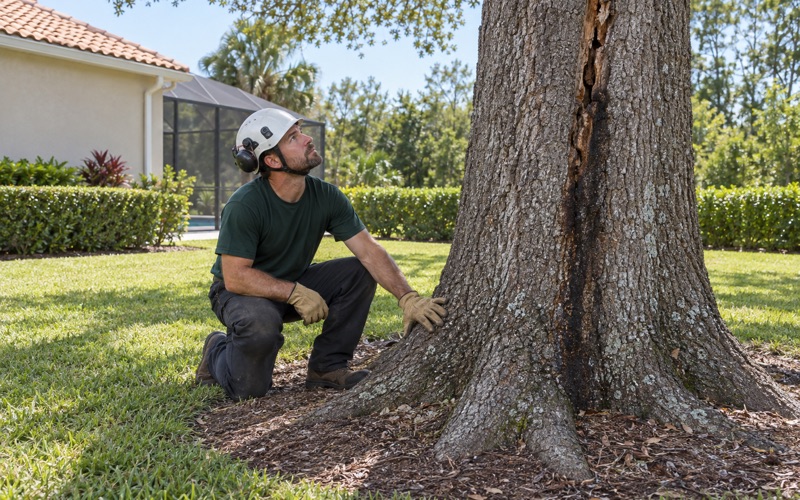
A preemption that makes removal easier is not an argument for removing anything. We write a condition report on any tree we recommend taking down, so the reasoning sits on the record before the saw starts, and we say so just as plainly when a tree does not need to come down at all. Directional pruning over a roofline, a cable through co-dominant stems with included bark, or a root collar excavation to see what is actually happening at grade will often be the honest recommendation. We do not top, hat rack or hurricane cut anything, on any tree or any palm, whoever asks.
Looking for tree-removal closer to Cypress Lake? See Cypress Lake Tree-Removal.
What the statute reaches, and the housing it does not
The exemption is narrower than the market it sits in. Residential property is defined in section 163.045(1)(b) as a single-family, detached building located on a lot that is actively used for single-family residential purposes. That wording does not reach a condominium, a townhome, a duplex, any attached or multifamily dwelling, a vacant or platted-but-unbuilt lot, or commercial and industrial ground. An arborist letter is worth exactly nothing on a building the statute never described.
The condominium owner is outside it twice
In Naples that exclusion covers a large share of the housing. American Community Survey five-year figures put 22.4% of the city’s housing units in buildings of 50 or more units, against 3,764 owner-occupied one-unit detached homes, so high-rise and attached stock is not a fringe case here. The same owner is excluded a second time on the disposal side: Collier County’s storm-related debris program classes condominiums, apartments, trailer parks, golf courses and cemeteries as commercial property, and answers the question of whether the county will collect their debris with a flat no.
Practically, that means a condominium association here pays for its own tree work and its own hauling in every season, storm or no storm. We quote that work the same way we quote a single-family lot, with the disposal line separated out, because the association board is usually comparing our number against a budget rather than against a neighbor. Nothing about the state exemption changes what the association has to do, and we would rather say that in the estimate than discover it afterward.
Old stock, and the canopy that grew up with it
Naples also carries the oldest housing in this stretch of coast, with 44.9% of its units built before 1980. Trees planted around a house of that vintage have had four decades or more to put on wood, and they are frequently much closer to a roof, a pool cage or a service drop than anything a builder would site today. Age is not by itself a defect, but it does mean the failure we are asked to prevent is usually a mature laurel oak or a long-neglected sabal palmetto rather than a young tree behaving badly.
40.8% of units here are for seasonal, recreational or occasional use, so on a great many jobs nobody is standing in the yard when we look at the tree. Those owners get written findings and photographs, and the authorization comes back by e-mail. Storm damage on a closed-up house is routinely found weeks after the weather that caused it, which is one reason we book storm-season work before the season rather than scrambling through it.
Limestone inside a stump grinder’s rated cut
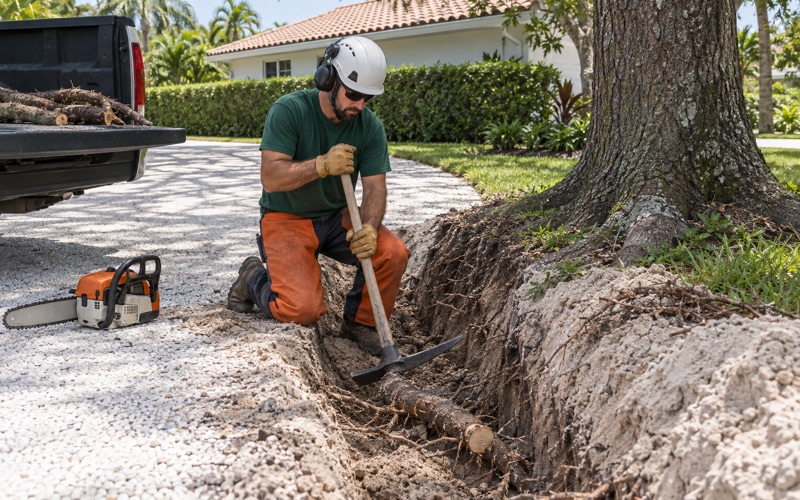
The ground under coastal Collier County is shallow sand over rock, and that is a working fact rather than a geological aside. The Hallandale series carries a lithic contact at 7 to 20 inches, with hard fractured limestone at 16 inches in the typical pedon. The Boca series puts limestone deeper, 20 to 40 inches with 34 inches typical, and holds a water table within 12 inches of the surface for four to nine months in most years. Either way, rock sits inside the depth a stump grinder is rated to reach.
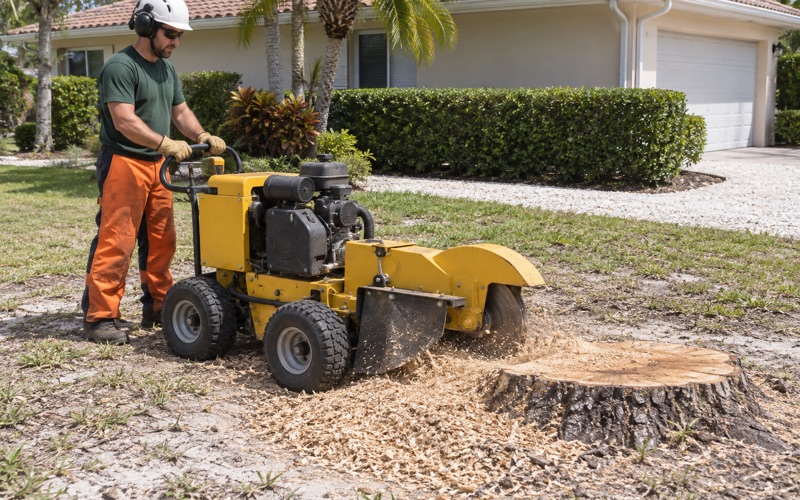
That changes the quote before it changes the schedule. A below-grade cut planned to a fixed depth in sand becomes a cut into limestone partway down, which is a teeth-and-wear question and sometimes a question of how deep the grind can honestly be promised on that particular lot. We would rather write the achievable depth into the estimate than hand over a stump that was ground to rock and call it finished.
What shallow rock does to a root plate
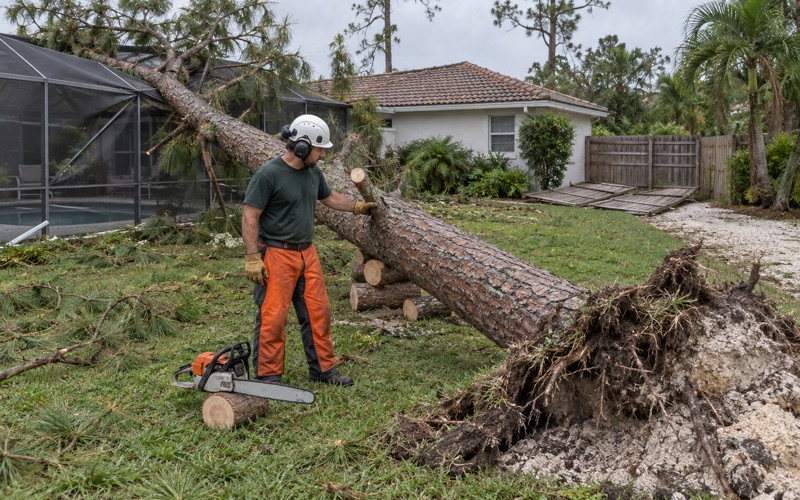
The same rock explains a failure pattern owners see after every wind event. Where limestone sits at 16 to 34 inches, a large tree’s structural roots have no vertical room, so the plate spreads sideways through saturated sand instead of anchoring downward. That geometry lifts a whole root plate out of the ground rather than snapping a stem, which is why a leaning trunk with a heaving lawn on one side is a different conversation from a broken limb.
Palms are a separate trade
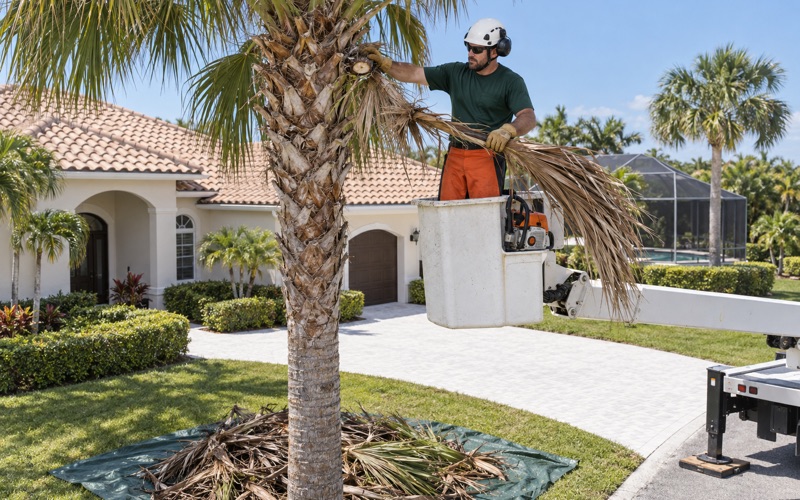
Much of the work in this city is palms, and a palm is not structurally a tree. There is no cambium, no branch collar, no compartmentalization of decay, a single growing point and a trunk diameter fixed for life. Our crews cut palms to the nine and three clock rule and leave the crown full, because a thinned crown is the one that snaps off in a storm rather than the one that survives it.
Two palm diseases end the conversation before pruning starts. Ganoderma butt rot, caused by Ganoderma zonatum, is untreatable, occupies the lower four to five feet of trunk and cannot be diagnosed until the conk forms, at which point removal and stump grinding are the only responsible outcome. Thielaviopsis trunk rot is worse to look at from a distance, because it drops a healthy-looking canopy with no warning at all.
Tidal shoreline, state permits, and where the wood goes
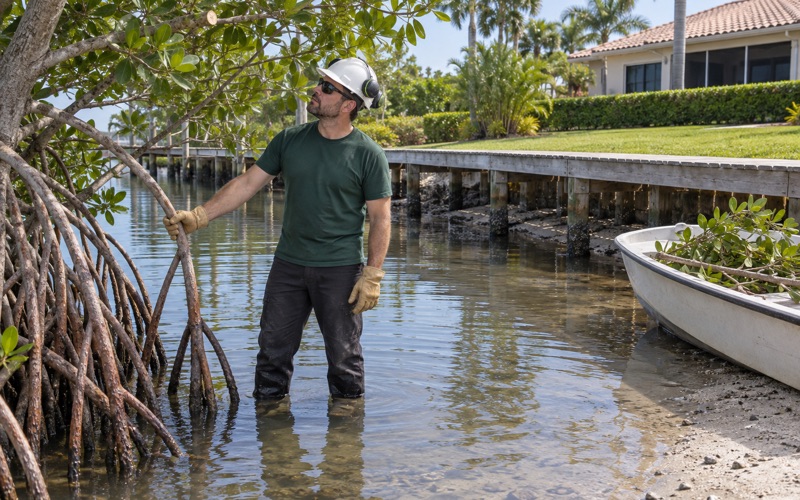
Naples Bay, the Gordon River and Gordon Pass put tidal shoreline inside the city limits, which makes mangroves a routine question here rather than an exotic one. Neither the state exemption nor the city ordinance reaches them: subsection (4) of the statute expressly excludes mangroves, and Florida’s Mangrove Trimming and Preservation Act governs instead. The Department of Environmental Protection’s list of local governments holding delegated mangrove authority names seven, and nothing in Collier County is on it. A mangrove permit for a Naples shoreline is a state permit, issued by the Department’s South District office in Fort Myers.
What the trimming exemption actually allows
A riparian owner on a shoreline of 150 feet or less may trim a fringe of 10 feet or less pretrimmed height without a permit, and never below 6 feet. A professional mangrove trimmer raises that pretrimmed limit to 24 feet. Anything 16 feet or taller has to be staged at no more than 25% of its foliage a year, first-time trimming of red mangroves requires 10 days’ written notice, and herbicides used to defoliate a mangrove are prohibited outright.
After the line is restored, the tree is still yours
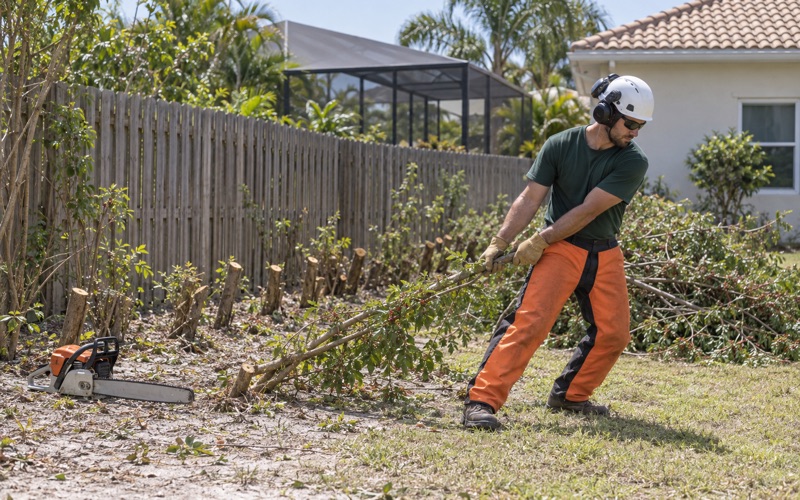
Florida Power and Light publishes a three-year feeder and six-year lateral trim cycle, removes all resulting debris on scheduled clearing, and makes the service drop the customer’s responsibility within 10 feet. After a storm the utility leaves debris where the tree fell. That single sentence produces most of our post-storm calls in Naples: the power is back, the tree is on the ground, and it is the owner’s tree again.
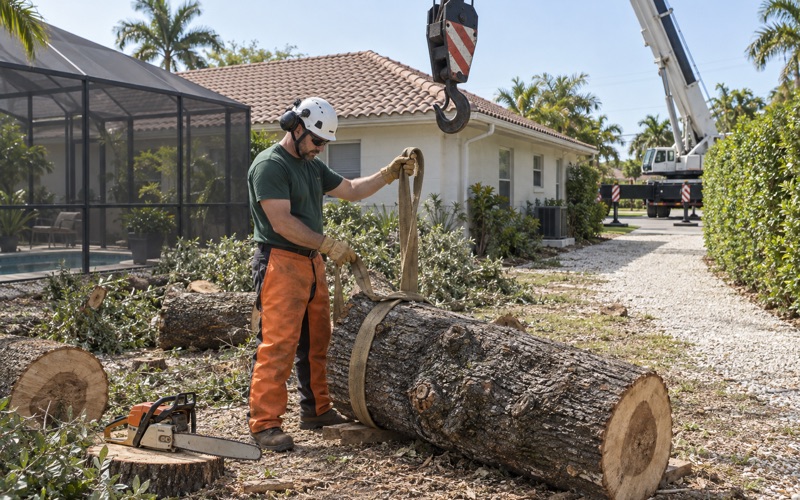
There is no free outlet for removal wood here in any season. Collier County charges $55.75 per ton residential and $57.50 per ton commercial for horticultural waste at the landfill gate, the drop-off centers take horticultural material at $15.00 per cubic yard with a one cubic yard maximum, and municipal solid waste has to move by an authorized hauler unless a Self-Hauler Permit has been issued. That is why our estimates carry hauling and disposal as their own line, priced against the gate rather than folded into a headline number.
- 20+ Years on This Coast
- Written Estimate Before Any Cut
- No Topping, No Hurricane Cuts