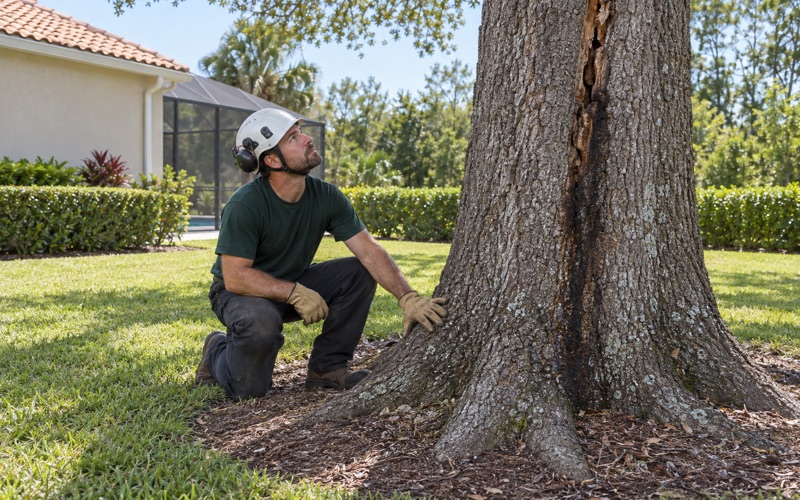
Bonita Springs Tree Removal has handled tree-removal in Marco Island for more than twenty years, and on this island the work starts with what sits under the tree rather than what stands above it. Every job opens with a written estimate that carries hauling and disposal on their own line, so the cost of moving the wood off the island is visible before anyone agrees to anything. When we recommend that a tree come down, the reason goes into a written condition report first, and when the honest answer is a prune or a cable instead, that is the answer you get.
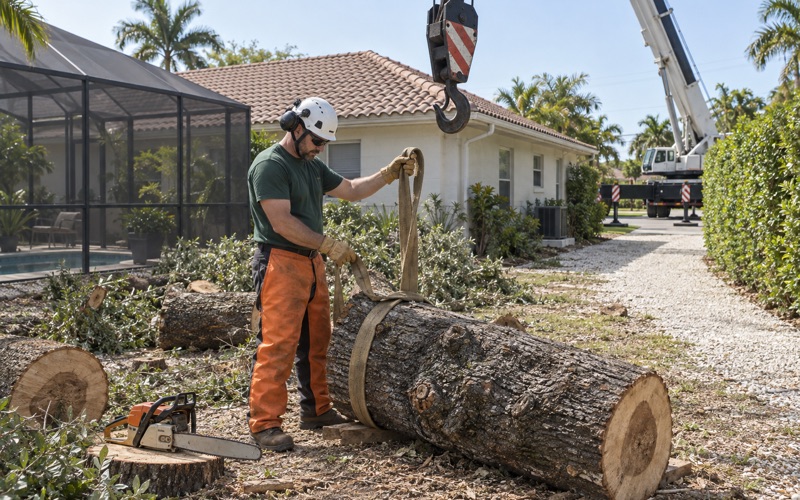
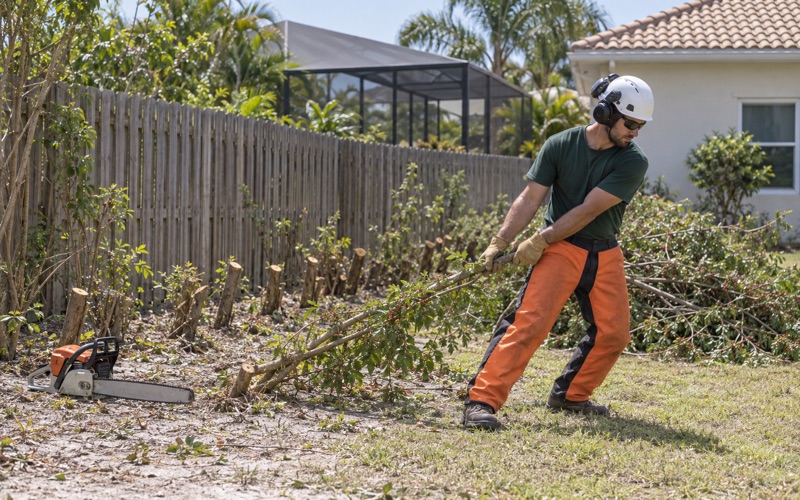
Palms and hardwoods are separate jobs on this island and we crew them that way, because a palm has no branch collar to cut back to and nothing in its trunk that can seal a wound. Access gets sized to the property, from a narrow-gate machine that fits through a fenced side yard to a crane pick set over a pool cage on a lot with no other approach. What we will not do, whoever asks for it, is top a tree or hat rack it, on any species and any trunk.
Fill from twenty inches to more than eighty, and shell through the profile
Most of the residential ground on this island is engineered rather than natural. The canals were cut and the spoil was pumped up to build the lots, and the Natural Resources Conservation Service maps that condition as the Saint Augustine series: siliceous, hyperthermic Aquic Udipsamments, somewhat poorly drained, formed in fill material that is the result of dredging and filling operations along peninsular Florida. The survey is not describing soil in the ordinary sense on those lots, it is describing what a dredge left behind.
The numbers in that series description are the ones that matter to a crew standing on the lot. Fill thickness ranges from 20 to more than 80 inches, shell content runs from under 5 percent to 70 percent by volume, and the water table sits at depths of 20 to 30 inches for two to six months in most years. None of that is legible from the surface, which is why we will not quote a stump grind here off a photograph and a street view.
Where the island was never filled
Not every lot on the island is made ground. Where it was never filled, on the older upland and the hammock ground, the coastal Collier soils apply instead: the Hallandale series, with a lithic contact at 7 to 20 inches and hard fractured limestone at 16 inches in its typical pedon, and the Boca series, with limestone at 20 to 40 inches and a water table within 12 inches of the surface for four to nine months in most years. Both of those put rock inside a stump grinder’s rated cut, and which of the three profiles sits under a particular address is not something anyone can settle from the curb.
Looking for tree-removal closer to Estero? See Tree-Removal in Estero.
Seawalls, canal lots, and what a root plate holds onto
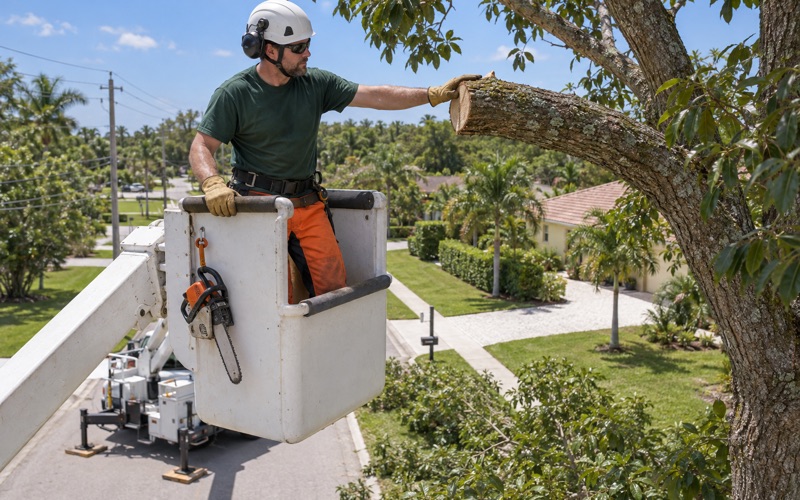
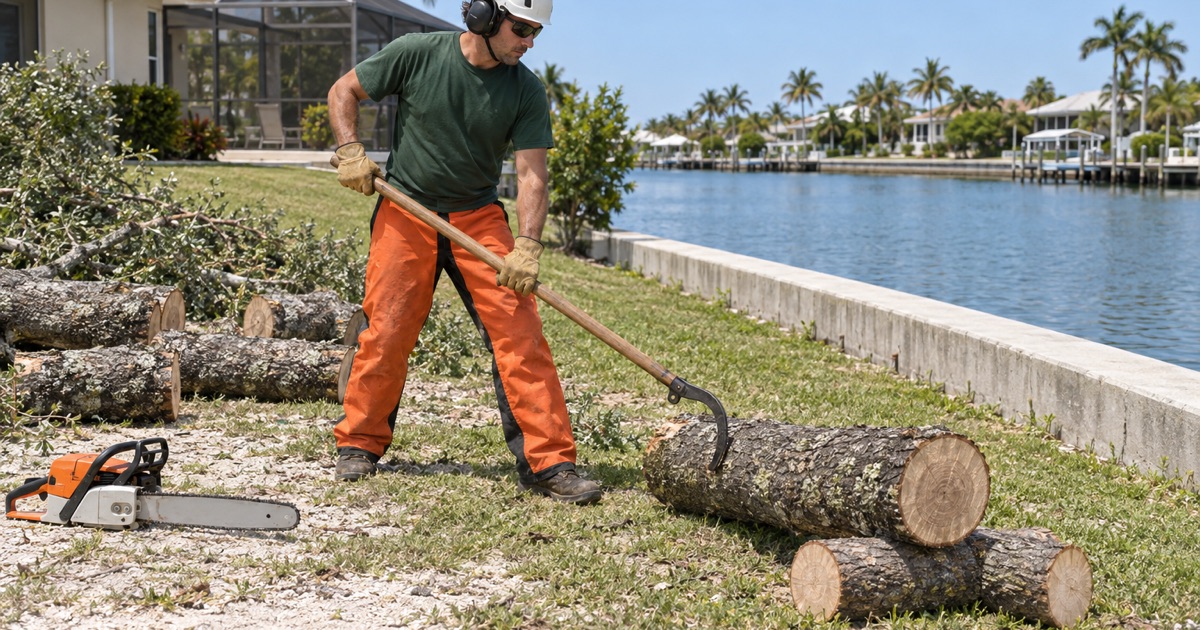
A canal-front removal is a geometry problem before it is a cutting problem. The tree stands on engineered subgrade with a hard vertical edge a few feet away, no soft ground to drop into and water on the far side of the wall, so the drop zone that would exist on a lawn does not exist at all. Rigging every piece over a seawall to a street, a truck or a barge is a different job from felling into open yard, and on a dredge-and-fill canal city it is the ordinary case rather than the awkward exception.
Root plates behave differently in made ground as well. Fill of unknown thickness lying over an unknown original surface gives a root system no consistent horizon to anchor into, and a seasonal high water table keeps the deepest roots in ground that is saturated for part of the year. Root collar excavation with an air spade is often the only honest way to see what a trunk flare is actually sitting in, and on a canal lot that answer decides whether the tree is a removal, a prune or a cable.
Grinding a stump in shell and spoil
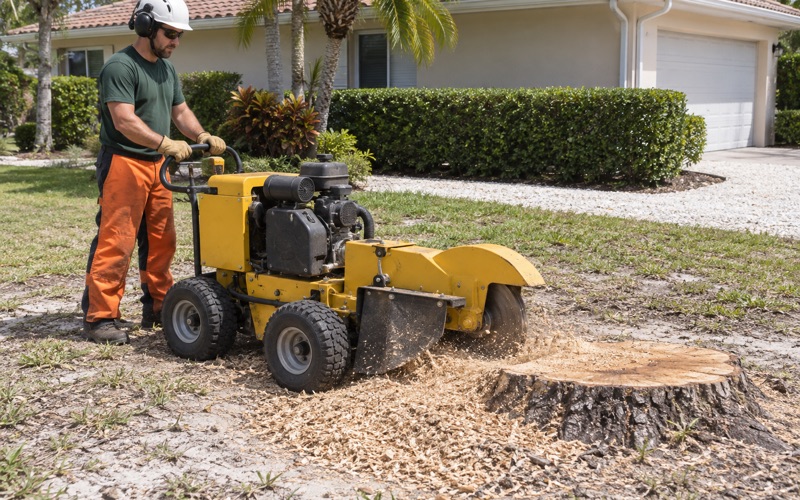
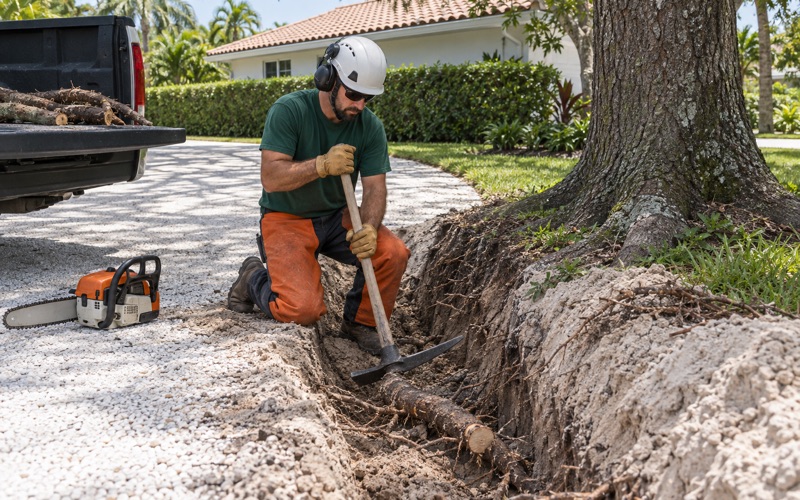
Shell at the upper end of that range wears grinder teeth in a way clean sand never does, and it does it unevenly, because the spoil was not placed to any specification a crew can read now. Depth to refusal is the other unknown: the operator cannot infer it from anything visible at grade, so a below-grade cut on filled ground is quoted with the possibility of hitting shell, rubble or the original surface partway down. We would rather say that in the estimate than discover it with the machine running.
Palms, and the disease that decides the question
Palms are much of the work on this island and they are not trees structurally: no cambium, no branch collar, no compartmentalization, one growing point, a trunk diameter fixed for life and every root adventitious. Ganoderma butt rot occupies the lower four to five feet of the trunk, cannot be diagnosed before the conk forms, has no treatment, and mandates removal plus stump grinding, which on filled ground behind a seawall is the constrained half of the job. Thielaviopsis trunk rot drops a canopy that looked healthy the week before, which is why we look at trunks and not only at fronds.
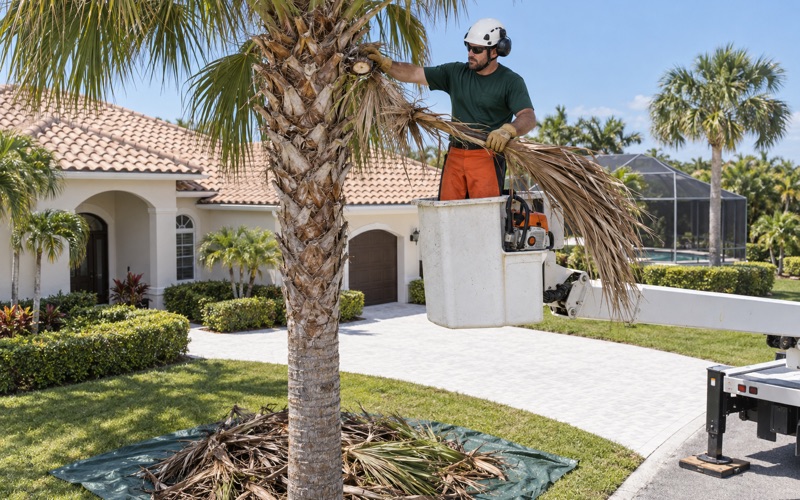
Pruning follows the nine and three clock rule rather than a wind-resistant-looking silhouette, and that is not an aesthetic preference. University of Florida research on hurricane-cut palms found that crowns cut back hard were more likely to snap off than fuller ones, so the cut that looks storm-ready is the one that loses the palm. Nobody on our crews puts a hurricane cut in a palm, whatever a neighbor’s landscaper did last spring.
An incorporated city, and a permit answer written in Tallahassee
The City of Marco Island incorporated on August 28, 1997 and covers the whole barrier island, governed by a seven-member city council with a rotating chair under a council-manager charter. It has its own land development code and its own permit desk, while Collier County still runs the property appraiser, the tax collector, the landfill gate and the declared-storm debris program at every address out here. Knowing which of the two answers a given question is half of quoting a job correctly on this island.
The residential tree-removal question, though, is answered by neither of them. Florida Statutes section 163.045 bars a local government from requiring a notice, application, approval, permit, fee or mitigation for the pruning, trimming or removal of a tree on residential property when the owner holds documentation from an ISA-certified arborist or a Florida licensed landscape architect that the tree poses an unacceptable risk, and it bars a replanting requirement as well. Unacceptable risk is not a loose phrase either: under ISA Best Management Practices, Tree Risk Assessment, Second Edition (2017), it means removal is the only means of practically mitigating the risk below moderate.
There is no state tree or arborist contractor license in Florida for any company to hold, and state law preempts local occupational licensing, so neither the county nor the city licenses this trade. What a homeowner can actually verify is insurance, and we expect to be asked for it: general liability and workers’ compensation, in writing, before a crew arrives. The certification that matters to the statute is the one on the letter, because only an ISA-certified arborist or a Florida licensed landscape architect can sign that documentation.
The condominium owner excluded twice over
The statute defines residential property narrowly, as a single-family, detached building on a lot actively used for single-family residential purposes, so it never reaches a condominium, a townhome, a duplex, any attached or multifamily dwelling, a vacant or platted-but-unbuilt lot, or commercial ground. On this island 31.3 percent of housing units sit in buildings of fifty or more units, which puts a large share of local addresses outside the preemption entirely. On those buildings the arborist letter buys nothing, and the association board rather than the statute is the decision-maker.
The same buildings are excluded a second time after a storm. Collier County’s storm-debris program classes condominiums, apartments, trailer parks, golf courses and cemeteries as commercial property, and answers plainly that commercial properties are responsible for arranging and paying for their own debris removal. The two exclusions land on the same addresses, so on a condominium job the wood is the owner’s to move at the owner’s cost, and that belongs in the estimate before the work is scheduled.
Outside a declared storm there is no free outlet for removal wood at all. Collier County’s landfill gate charges $55.75 per ton residential and $57.50 per ton commercial for horticultural waste, its drop-off centers take horticultural material at $15.00 per cubic yard with a one cubic yard maximum, and municipal solid waste has to move by an authorized hauler unless a Self-Hauler Permit has been issued. Every ton of it crosses the bridge to the mainland to reach the gate, which is why the disposal line on a Marco Island estimate is not the same number it would be on a mainland job.
Just under half of the island’s housing units, 49.2 percent, are for seasonal, recreational or occasional use, so on a great many jobs the owner is not standing in the yard when the tree is looked at. We write findings up and photograph them for exactly that reason, and send them to whoever is authorizing the work, which is as often a property manager or a board as a resident owner. An inspection that only exists in a conversation on the driveway is worth very little to an owner who is out of state.
Mangroves on a shoreline where the permit is the state’s
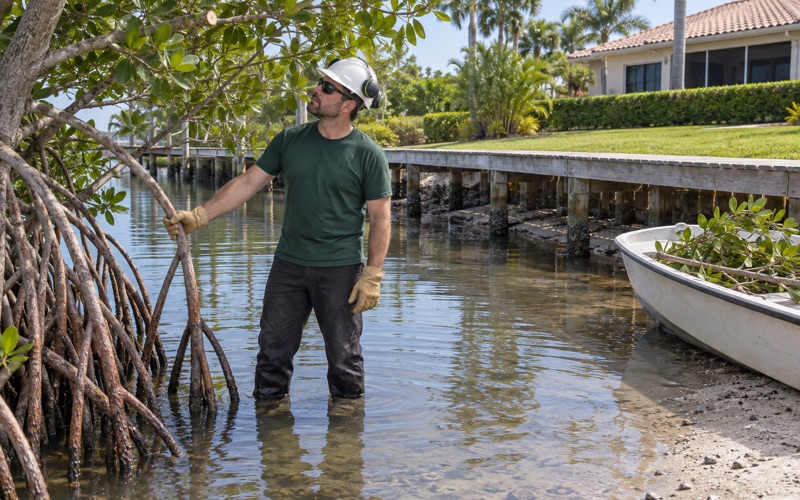
Whatever the statute does for an oak in a front yard, it does nothing for a mangrove: subsection (4) excludes mangroves expressly, and Florida’s Mangrove Trimming and Preservation Act governs instead, protecting white, red and black mangrove. Neither the City of Marco Island nor Collier County holds delegated mangrove authority. The Department of Environmental Protection’s delegation list names seven local governments in the whole state and none of them is here, so a mangrove permit for a shoreline on this island is a state permit, issued out of the department’s South District office in Fort Myers.
The owner’s exemption is narrow and dimensional. On a shoreline of 150 feet or less a riparian owner may trim a fringe of 10 feet or less pretrimmed height, never below 6 feet; a professional mangrove trimmer raises that pretrimmed limit to 24 feet; anything 16 feet or taller is staged at no more than 25 percent of foliage a year; first-time trimming of red mangroves requires 10 days’ written notice; and over 150 feet of shoreline no more than 65 percent may be trimmed under the exemption. Herbicides used to defoliate a mangrove are prohibited outright.
The island sits at the northern end of the Ten Thousand Islands next to Rookery Bay National Estuarine Research Reserve, which protects 110,000 acres of coastal lands and waters and is described as one of the few remaining undisturbed mangrove estuaries in North America. Work at the water’s edge here happens beside a managed state reserve rather than beside open coast, and the standard we hold to on those jobs is the one the state sets. We would rather tell you a shoreline job needs a state permit before it is booked than after a crew is standing on your seawall with a saw.
- 20+ Years on This Coast
- Written Estimate Before Any Cut
- No Topping, No Hurricane Cuts