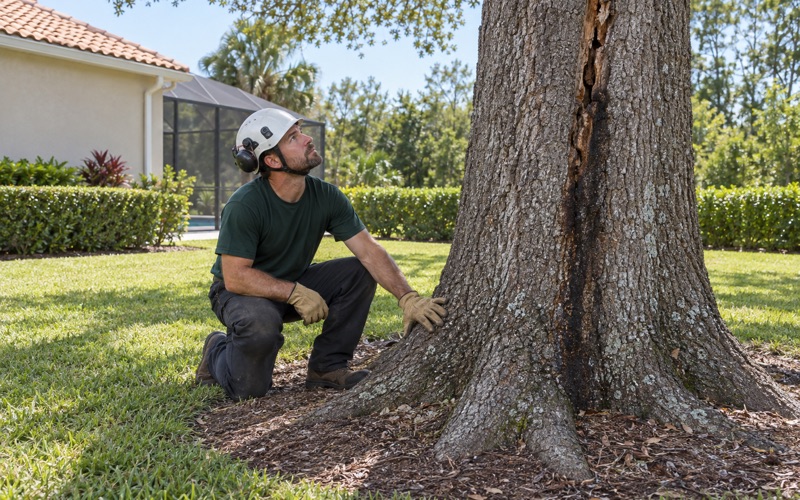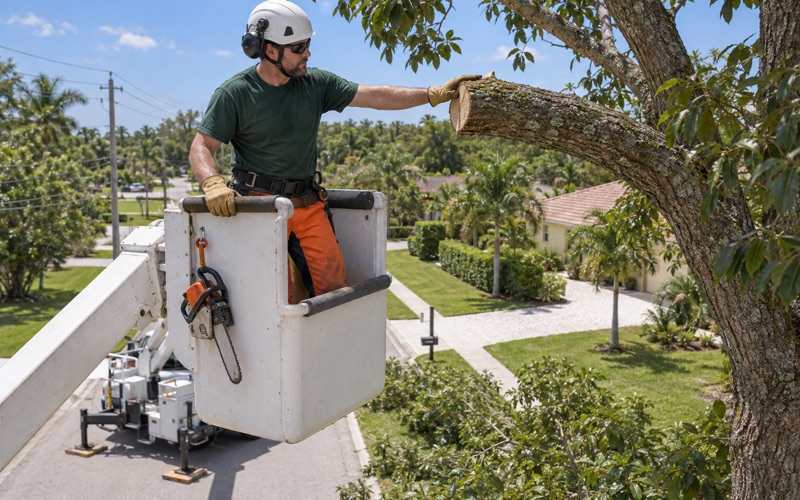
Bonita Springs Tree Removal handles tree removal in Lehigh Acres, and after more than twenty years on this coast we open every job here with a question most crews never ask: whose wire is that over the driveway? Two different electric utilities serve this community, the line between them is not published anywhere a homeowner or a crew can read, and what happens to the wire over your yard follows that line. We would rather settle that before a truck is scheduled than find it out with a saw already running.
The rest of how we work here is the same habit applied to the rest of the job. Nothing is cut before you have a written estimate, and hauling and disposal sit on their own line in it so the cost of moving the wood is visible instead of buried inside one number. When a tree should come down we put the reason in a written condition report before the saw starts, and when it should stay we say that instead, even when the customer has already decided otherwise.
Two electric utilities, one address, and a boundary nobody publishes
LCEC is a not-for-profit electric distribution cooperative serving more than 240,000 customers in Southwest Florida, and on its own About page it names this community with a qualifier: parts of Lehigh Acres. The word parts is theirs, not ours, and the remainder of the community is Florida Power and Light territory. Neither utility publishes the dividing line between them in any form a homeowner or a contractor can consult, so the only way to learn who owns the right of way over a particular tree is to read the electric bill for that particular address.
That uncertainty is not a small administrative detail on a tree job, because the utility’s position decides who is responsible for clearance around the wire, what happens to the wood after a scheduled trim, and what is left lying in the yard after a storm. Where one utility owns a whole town those answers are the same at every address, and a crew can carry them from job to job without checking. Here they are address-specific, and a contractor who assumes is going to be wrong on a predictable share of the streets.
Why the service-drop answer changes with the name on the bill
The two providers differ on exactly the points that decide a job, which is why we never quote one company’s policy to the other company’s customer. LCEC states plainly that it does not maintain trees from the customer service drop, and it publishes no trim cycle and no debris policy at all. Florida Power and Light makes the service drop the customer’s responsibility within 10 feet, publishes a three-year cycle on feeders and a six-year cycle on laterals, removes all resulting tree debris on scheduled clearing, and leaves storm debris where the tree fell.
So two neighbors a few streets apart can get opposite answers to the same question about the same species of tree, and both answers are correct. We ask which utility bills the property before we price clearance work anywhere near a drop or a lateral, because the debris question alone can move what the job costs to finish. Anything inside the customer’s own responsibility is ours to plan around, and the crew works to ANSI A300 standards on the cuts regardless of who owns the conductor above them.
Looking for tree-removal closer to Sanibel? See Tree-Removal in Sanibel.
The district that owns the canal bank behind the lot
Most of Lehigh Acres sits inside the Lehigh Acres Municipal Services Improvement District, established on June 10, 2015 by the Florida Legislature as the successor to the East County Water Control District. It runs the canal and lake network the community is laid out around, and its territory reaches across unincorporated Lee County and part of Hendry County. For a tree crew the important part is the property line: nearly all of the district’s rights of way border residential lots, and it is the resident’s responsibility to know where their land ends and the district’s begins.
Trees as an environmental encroachment
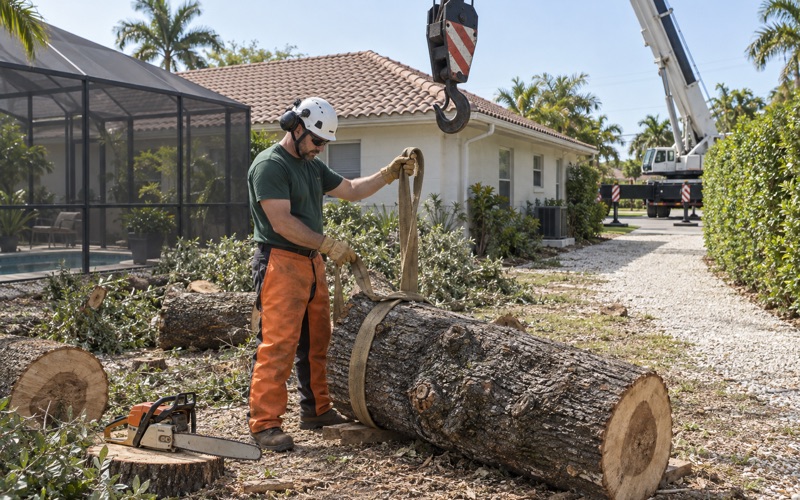
The district defines an encroachment as any obstruction in a right of way, and it names environmental encroachments as trees, flowers, plants, dirt and yard waste that reach district land. It warns that the rising level of encroachments threatens to delay proper maintenance of its waterways and rights of way, which tells a contractor in advance why brush left on the bank becomes a problem. We plan the drop zone, the chipper position and the outrigger pads against the property line rather than the fence, because behind a Lehigh Acres lot those are frequently not the same thing.
Permission to use the bank, and the other districts on the water
The district requires a permit from any person, company, corporation, association or governmental agency that wants to connect to, cross over or under, place structures upon, or otherwise make use of its lands and water management facilities. That requirement reaches new or improved commercial, industrial and multi-family projects and single-family parcels over one acre, and the district is explicit that a permit conveys no property rights beyond what the permit itself specifies. On a job where the wood has to come out across that ground, we say so before the estimate is signed rather than after the equipment arrives.
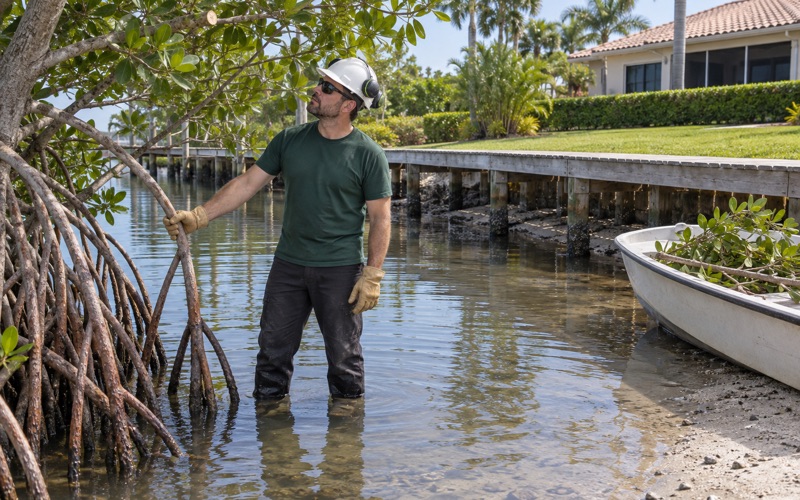
Water is the other reason the back line matters, because the canal system drains toward the Orange River and vegetation dropped into open water becomes a district’s problem rather than the homeowner’s. Lee County runs aquatic weed control through the Lee County Hyacinth Control District and mosquito control through the Lee County Mosquito Control District, both separate legal bodies from the county itself. Standing water in a hollow stump, a cut palm boot or a brush pile nobody hauled is a nuisance complaint on a different track from code enforcement, and it is the cheapest thing on this list to avoid.
Unincorporated Lee County, and the statute that sits on top of it
Lehigh Acres is unincorporated, which means there is no city hall, no mayor, no council, no municipal tree ordinance and no municipal arborist to appeal to. The land use law at every address here is the county’s: the Lee Plan, adopted by Ordinance Number 89-02 as amended, which the county states applies throughout the unincorporated area of Lee County, together with the Lee County Land Development Code. Any page that tells a Lehigh Acres homeowner what the city’s tree ordinance requires is describing a document that does not exist.
Tree work runs against Chapter 14, Article V of that code, Tree Protection, which applies to the unincorporated areas of the county; sections 14-411 and 14-412 carry the criteria a removal is reviewed against. The Lee County Department of Community Development reviews the vegetation removal permit and the notice of clearing on unincorporated land, and its environmental sciences reviewers decide whether a given removal needs a permit at all. The county’s own submittal form, dated May 14, 2021, asks for a detailed site plan on a single-family lot of five acres or more, which a platted Lehigh Acres residential lot never reaches.
The documentation that switches the county permit off
Florida Statutes section 163.045 sits directly on top of the county code here, with no municipal layer in between. Where the property is a single-family detached building on a lot actively used for single-family residential purposes, and the owner holds signed documentation from an ISA-certified arborist or a Florida licensed landscape architect that the tree poses an unacceptable risk, the county may not require a notice, application, permit, fee, mitigation or replanting. We assess risk to the ISA Best Management Practices for Tree Risk Assessment, second edition 2017, so the report says what was found and why.
The statute does not cover everything: attached dwellings, vacant lots, and commercial and agricultural parcels sit outside it, and it does not override a private homeowners association covenant. Florida issues no state tree or arborist contractor license, and the county cannot issue one either: section 163.211 preempts local occupational licensing, and the grandfathered local licenses expired on July 1, 2025. So the questions worth asking any bidder here are about ISA certification and verifiable liability and workers compensation coverage, and nothing on this page will call us a licensed tree service, because there is no such license to hold.
A 1954 plat, a 2000s build-out, and the trees that came with the houses
The community was platted in 1954, after the Chicago businessman Lee Ratner bought 18,000 acres he first called the Lucky Lee Ranch. The plat dates from the 1950s and most of the houses standing on it do not: 49.7 percent of housing units were built between 2000 and 2009, against 16.4 percent built before 1980. That leaves an unusually synchronized planting cohort: the specimen trees that went in with those houses are reaching the size at which they need structural work or need to come out, and they are reaching it on tens of thousands of lots at once.
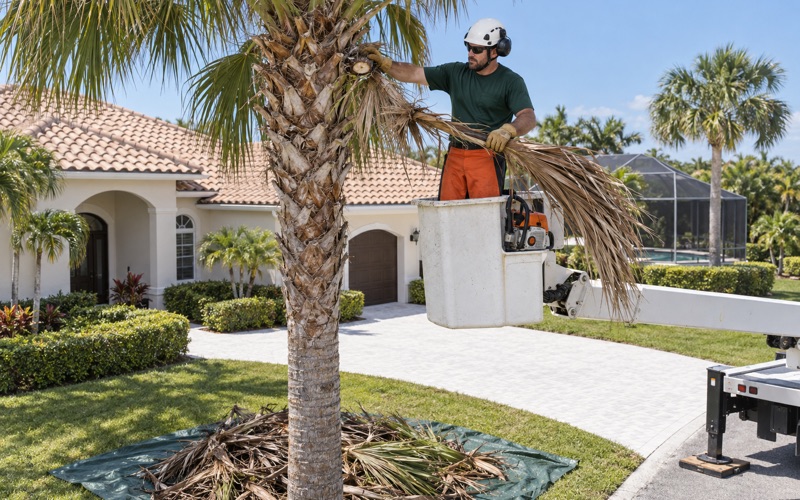
The work here is rarely one dead tree in isolation; a street can show the same overgrown pair lot after lot. We handle palms and hardwoods as the different jobs they are, because a palm has no branch collar to cut to, and the decision on one is read from the trunk and the crown, where Ganoderma butt rot and spear leaf collapse show. We do not top, hat rack or hurricane cut a tree or a palm for anyone, and on a hardwood with co-dominant stems and included bark we price a cable and a reduction before we price a removal.
Root plates in saturated sand
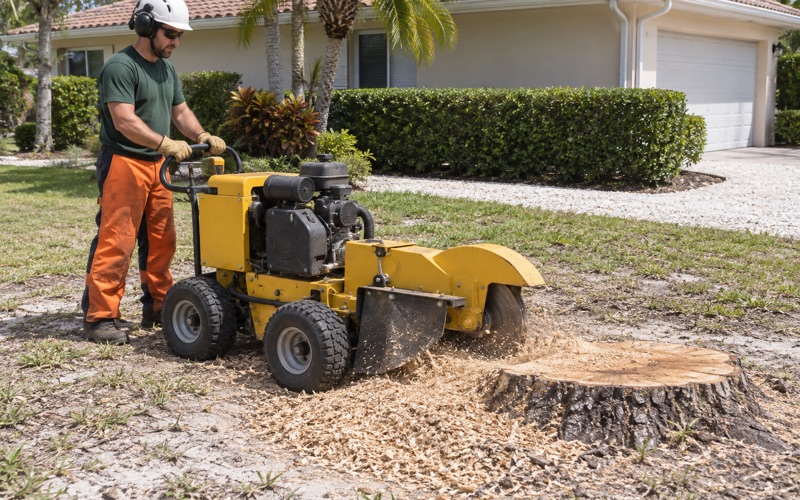
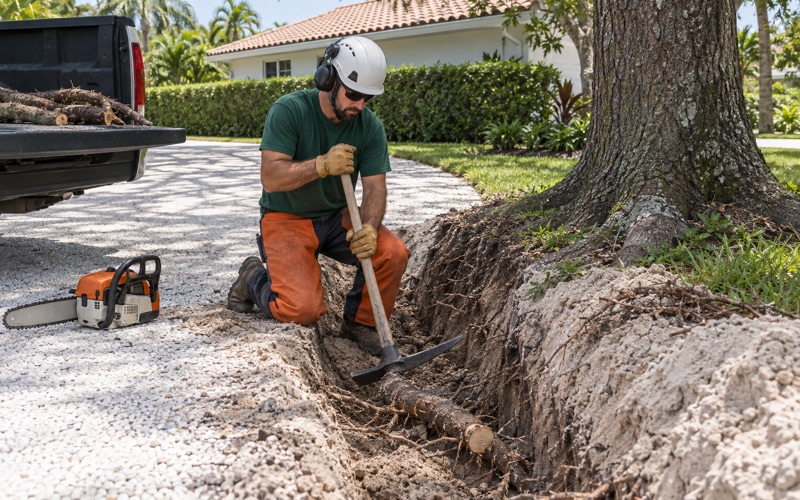
Twenty-plus years on this coast is largely time spent learning what the ground does, and here the limiting layer is hardpan and a seasonal high water table rather than rock near the surface. Roots plate out laterally above that restrictive layer in saturated sand, so a stump grinder meets a wide shallow plate instead of a deep taproot, and the below-grade cut is planned across the whole plate rather than around a stem. It is also why the saturated season is when whole root plates lift, and why we would rather book storm-season work before the season than scramble through it afterward.
Where the wood goes
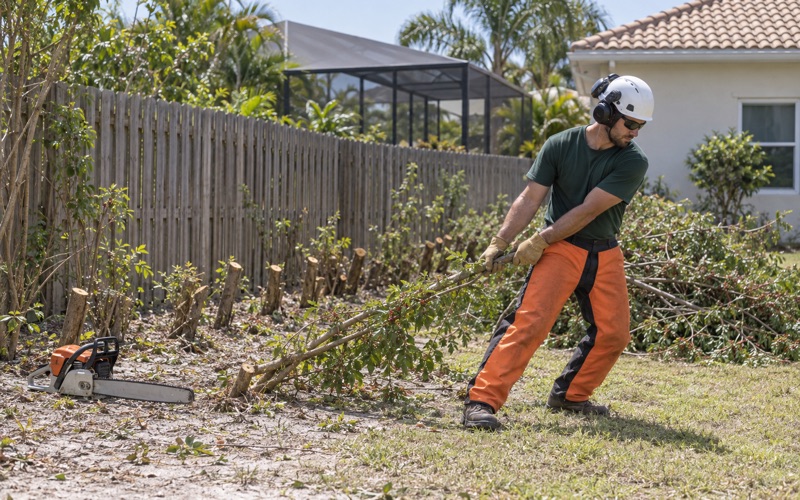
Lee County’s residential yard waste rules take bundles up to 50 pounds and 6 feet long, plus 50 pounds of unbundled palm fronds, which is not what a removal generates. Contractor debris goes over a scale instead: Lee County Solid Waste charges $43.92 per ton for commercial horticulture waste with a $15.00 minimum at the Buckingham horticulture operation on Buckingham Road in Fort Myers, and sells finished mulch back at $10.00 per cubic yard. That is the number behind the hauling and disposal line on our estimate, and it is why the line is separate: tonnage is what a homeowner cannot see coming.
- 20+ Years on This Coast
- Written Estimate Before Any Cut
- No Topping, No Hurricane Cuts