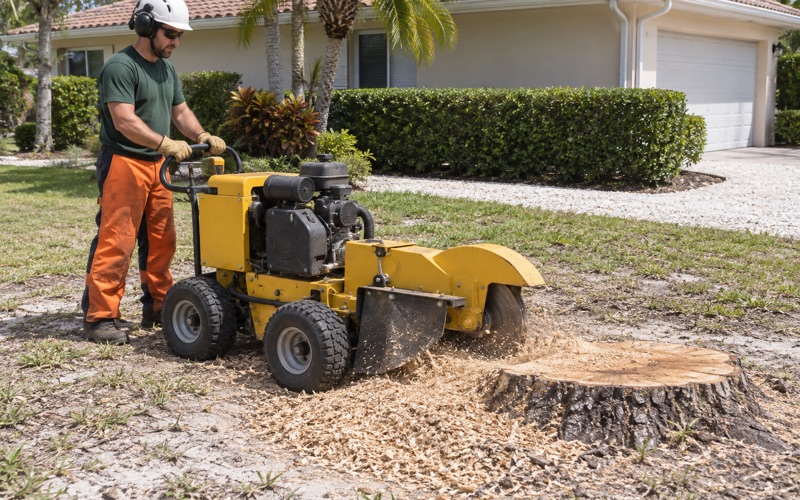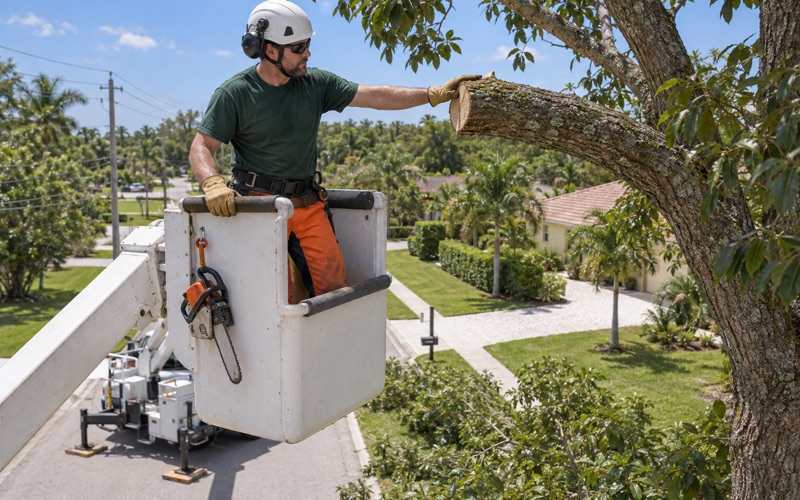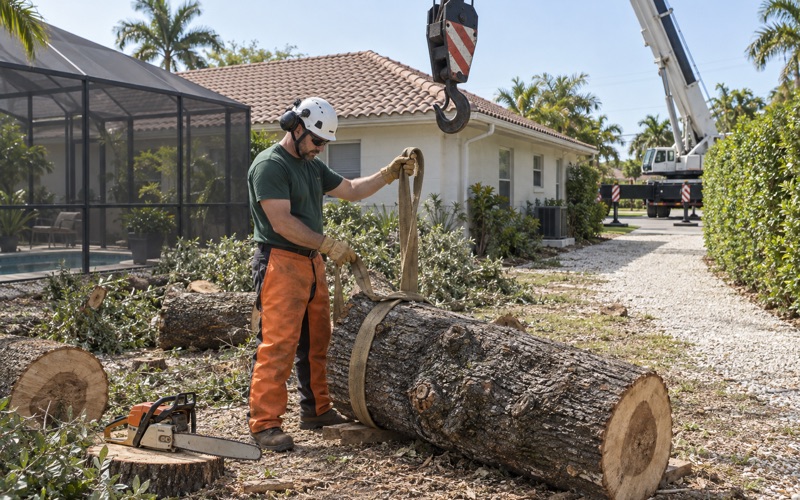
Bonita Springs Tree Removal has been doing tree-removal in Immokalee for more than twenty years, and the work here opens with a question that never comes up on the coast: whose rules apply to the ground the tree is standing on. Every property gets a written estimate before anything is cut, with hauling and disposal priced as their own line so you can see what the wood costs to move. Access is sized to the property, from a narrow-gate machine behind a fence to a crane pick where there is no other way out.
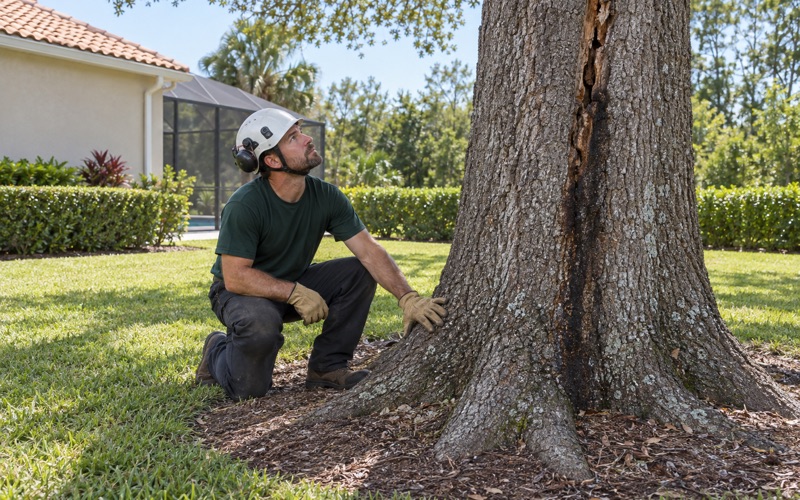
That question matters more than a homeowner would expect, because the answer changes with the parcel rather than with the neighborhood. A removal on one lot runs through a county permit counter, and a removal a few hundred feet away answers to nobody at that counter at all. We tell you which of those you are standing on before we quote, and we put the reason for taking a tree down into a written condition report so the case is on the record before the saw starts.
A county map that marks land the county says it does not regulate
Immokalee is unincorporated Collier County, so there is no city hall, no mayor, no council and no municipal tree ordinance. The Collier County Land Development Code and the county Growth Management Plan are the land-use law for almost everything you can see from the road. The county has treated this place as its own planning problem for a long time: an area planning commission was formed in 1965, separate zoning and subdivision regulations governed here until 1982, and in 1991 the county adopted the first Immokalee Area Master Plan as an element of its comprehensive plan.
The current master plan, amended by Ordinance 2023-58 in November 2023, carries the exception that defines this page. It records that the Seminole Reservation within Immokalee is approximately 600 acres of largely undeveloped land owned by the Seminole Tribal Council, on the east side of First Street south of State Road 29. It then states that the reservation is not controlled or regulated by the Collier County Growth Management Plan or the Land Development Code, and is identified on the Future Land Use Map for illustrative purposes only.
So the county’s own map draws a line around ground the county does not govern. That land was signed into federal trust for the Seminole Tribe by the Bureau of Indian Affairs in 1989, and work on it is authorized through the Tribe rather than through a county vegetation removal permit; county code enforcement does not reach it either. One neighboring authority does cross the line, and it is fire: the Immokalee Fire Control District provides contract fire protection to the reservation and casino inside its boundaries.
For a crew that is not trivia. Pulling a county permit for a parcel the county does not regulate wastes weeks, and starting work without the Tribe’s authorization on land the Tribe holds is worse. We work across Lee, Collier and Hendry counties and give a straight account of how the rules differ across those lines, and this is the sharpest line in our territory, because it is not a difference of degree between two codes but the absence of one of them.
Looking for tree-removal closer to Cape Coral? See Tree-Removal in Cape Coral.
What governs the rest: the master plan and the county code
Everywhere the reservation is not, this is ordinary unincorporated Collier County and the county code is the code. Removal of protected vegetation is authorized by a vegetation removal permit under Land Development Code sections 3.05.01 through 3.05.05 and Chapter 4 of the county Administrative Code, filed through the growth management portal. The fee is $250 up to the first acre and $50 for each additional acre or fraction, capped at $3,000, and the submittal wants an aerial photograph with a generalized vegetation inventory and a site plan showing the location and species of all protected vegetation.
The statute that skips a good deal of this ground
Florida Statutes section 163.045 preempts that permit, along with any notice, application, approval, fee or mitigation requirement, when an owner holds signed documentation from an arborist certified by the International Society of Arboriculture or a Florida licensed landscape architect that the tree poses an unacceptable risk. The catch sits in the statute’s own definition, which confines it to a single-family, detached building on a lot that is actively used for single-family residential purposes. That describes a coastal subdivision far better than it describes this community.
21.1% of the housing units here are mobile homes, renter-occupied units outnumber owner-occupied ones, and the county’s master plan records that approximately one-half of the land within the Immokalee Urban Area is presently zoned and actively used for agriculture. Mobile homes, multifamily buildings, rental parcels held by an owner who is not the person calling us, agricultural ground and vacant lots all fall outside that statute. On those we quote the county permit path rather than the exemption, because on them the county process is not preempted at all.
Farm ground and the storm-debris program
Agricultural ground is treated differently at every gate here, and the difference is money. Collier County’s storm-debris program excludes agricultural land outright, along with lot clearing, routine yard waste, vacant lots and commercial property, which the county defines to include condominiums, apartments, trailer parks, golf courses and cemeteries. Free collection also applies only where disposal is not already inside a contractor’s scope of work or contract price, and federal rules keep debris contractors off private property, so the free program starts at the curb and not at the tree.
Wells, septic tanks and power lines: a rural set of hazards
Water and sewer here come from an independent district rather than a county utility. The Immokalee Water and Sewer District was created by act of the Florida Legislature on July 5, 1978, is described in Chapter 2022-258 of the Laws of Florida, and is governed by a seven-member Board of Commissioners appointed by the Governor, administered independently of any other local governing body. Its lines do not reach every parcel in the planning area, and the county’s own master plan names private wells and septic tanks among the essential services permitted on some of the ground it covers.
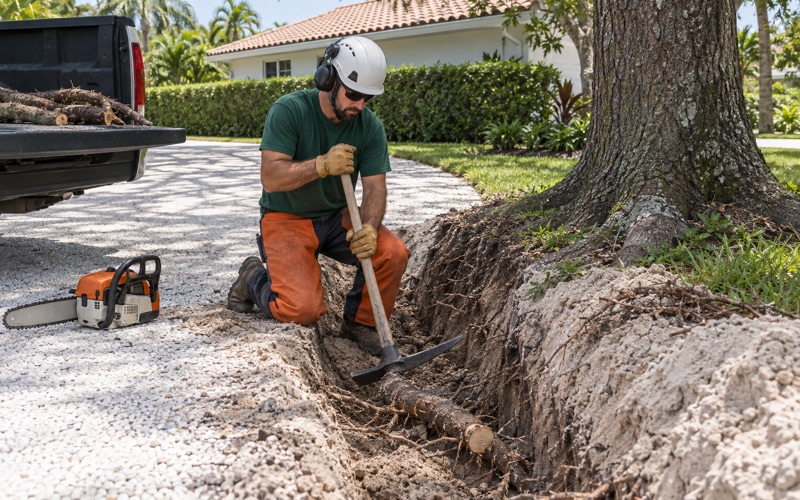
That changes what a root problem looks like on this ground. Roots in a drain field, roots against a well casing pad and roots in a septic lateral are ordinary work out here, and the failure is usually slow, showing up as a wet patch in the yard long before anything leans. When removal is the honest answer we put it in writing, and when the honest answer is root collar excavation with an air spade, directional pruning or leaving the tree where it stands, we say that instead.
Some of that ground carries an extra layer of rule. The master plan’s Lake Trafford and Camp Keais Strand System Overlay identifies wetlands that require greater protection measures than wetlands elsewhere in the Immokalee Urban Designated Area, and limits essential services inside it to those necessary for public safety and those serving permitted uses, private wells and septic tanks among them. The added protections do not apply to land inside the overlay that had been legally cleared of native vegetation when the plan was adopted, but they do apply to new development and redevelopment.
Electric service is another authority again: Lee County Electric Cooperative names this community in its own service list and states that under OSHA and ANSI standards only line clearance qualified arborists may work within ten feet of electric lines. The cooperative offers a free site visit and consultation before private tree work inside that ten-foot envelope, and we ask for it rather than working around it. On rented and mobile-home parcels the service drop is often the only wire between the tree and the meter.
The soil series that shares this name, and where the wood goes
The ground under all of this carries a name a soil scientist gave it. The Immokalee series is a sandy, siliceous, hyperthermic Arenic Alaquod: dark fine sand at the surface over a thick gray-to-white sand horizon, with the cemented spodic layer sitting 76 to 127 centimeters down, roughly 30 to 50 inches, and a loamy fine sand below that. There is no limestone in that profile, which is the part that matters to a crew used to cutting over the Boca series limestone nearer the coast.
The seasonal high water table sits 15 to 46 centimeters down, roughly 6 to 18 inches, for one to four months of the year, and 46 to 107 centimeters down for two to ten months, dropping below 60 inches only in dry periods. Permeability is rapid or very rapid in the surface sands and moderate in the spodic horizon. A root plate in saturated sand fails by tipping rather than by shearing over rock, which is why we read lean, root collar and soil heave here before we read the canopy.
One caution belongs on the record with that description. The series carries this community’s name, but its type location is in Okeechobee County, about 7.0 miles north of the town of Okeechobee, and the series was established in 1945 in the Everglades Project Area. The native vegetation the soil description lists is flatwoods rather than shoreline: longleaf and slash pine over saw palmetto, gallberry, wax myrtle and pineland threeawn, with cypress, red maple and sweetbay in the depressions, while disturbed and previously farmed ground carries Brazilian pepper, melaleuca, Australian pine and earleaf acacia.
Palms, dooryard citrus and the cuts we will not make
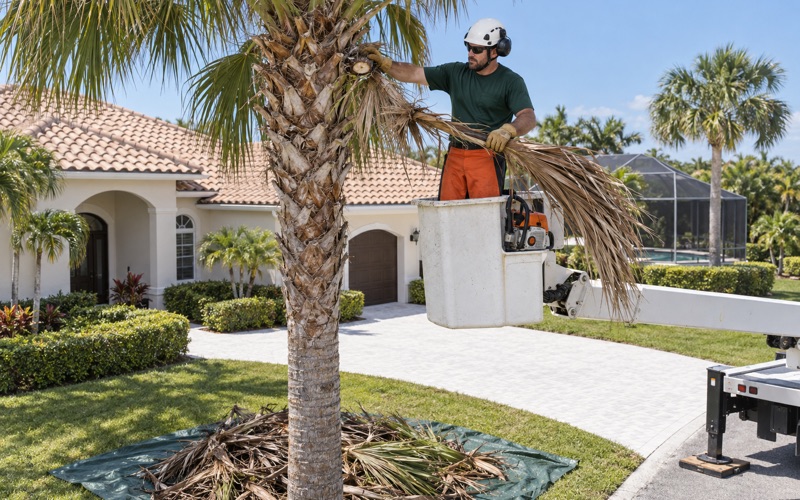
Palms and hardwoods are different jobs and we crew them that way, because a palm has no branch collar to cut to and no wound response like a hardwood’s. That governs what we do and do not do: no topping, no hat racking and no hurricane cuts, on any tree or any palm, whoever asks for them. On palms we look for Ganoderma butt rot, the spear leaf collapse and pencil-pointing that read as decline, and we prune to the nine and three clock rule rather than stripping a frond skirt off a healthy trunk.
Dooryard citrus comes up constantly out here, and the regulation is narrower than the folklore around it. Florida sits under a statewide quarantine for citrus canker, sweet orange scab, citrus greening disease and the Asian citrus psyllid, and parts of Collier County carry additional citrus black spot restrictions under which fruit, trees and plant material grown inside a residential quarantine area may not be moved outside it. Nothing the state publishes requires you to take a residential citrus tree down, so we will tell you what may not leave the property rather than talk you into a removal.
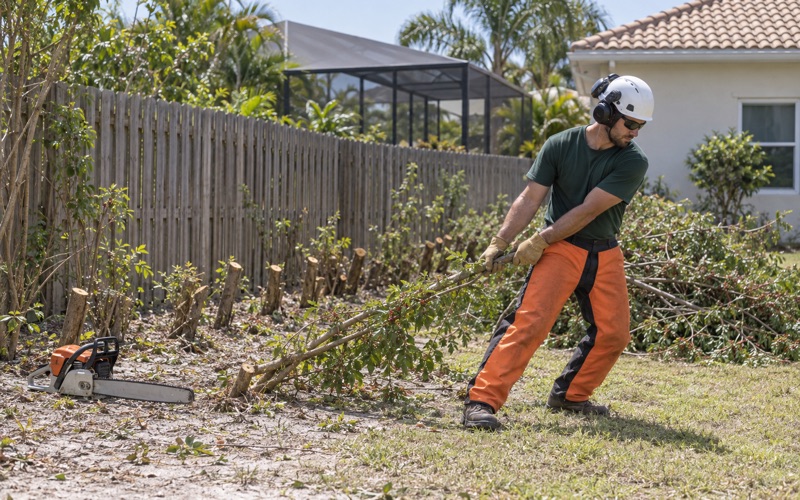
Where the wood goes is a local question too. The Immokalee Transfer Station at 700 Stockade Road is one of only two Collier facilities that accepts commercial yard waste, open Monday through Saturday in a morning and an afternoon window, and the county charges by the ton for horticultural waste and biomass and refuses mixed loads. The curbside program is a household program, capped at ten bundles, paper bags and containers per collection, with nothing longer than four feet and no branch thicker than four inches, and no part of a whole tree fits inside it.
- 20+ Years on This Coast
- Written Estimate Before Any Cut
- No Topping, No Hurricane Cuts