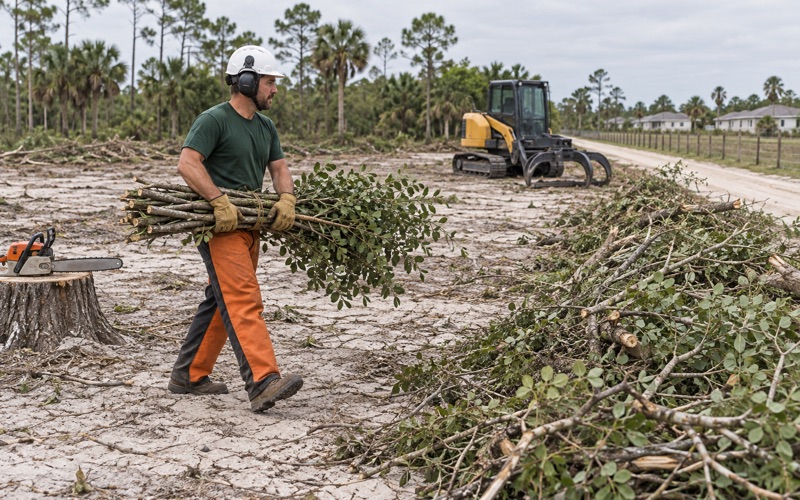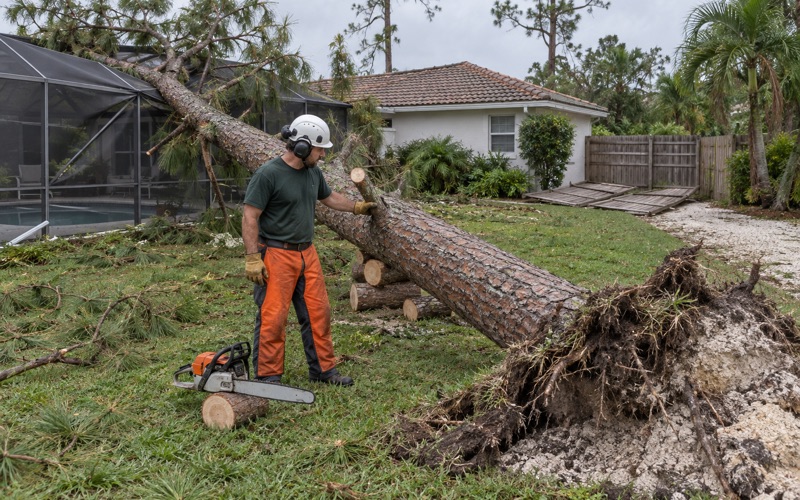
Bonita Springs Tree Removal has handled tree removal in Fort Myers for more than twenty years, and the first thing we tell a property owner here is that the credentials question is simpler than it looks and stranger than it sounds. Florida issues no state tree or arborist contractor license of any kind, so nobody cutting on your lot holds one. What a company can hold is International Society of Arboriculture certification, verifiable general liability coverage and workers’ compensation, and those are the three things worth asking to see before a saw comes off the truck.
Fort Myers is an incorporated city and the seat of Lee County, so a tree question at a city address is answered inside city hall rather than at the county offices that happen to sit within the same city limits. It is also its own municipality, separate from Fort Myers Beach and from North Fort Myers, and each of those places runs on rules of its own. We price a removal here against the city’s own documents, with hauling and disposal carried as their own line so the cost of moving wood is never buried inside the cost of cutting it.
A city specification that names a credential the state does not issue
The clearest example we know of sits in the City of Fort Myers technical specifications, in Section 02110 Site Clearing. After setting out how contractors are to protect trees on city work, the document instructs that any tree and shrub repair be carried out by a Certified Arborist holding a state license, within twenty-four hours of the damage occurring, and no such credential exists to hold. Florida issues no tree or arborist contractor license, and Florida Statutes section 163.211 preempts local occupational licensing, so the city has no authority to create one either.
That is not a scandal, and it is not a reason to distrust the city’s specification. It is a drafting defect in one sentence of a document that is otherwise a careful, useful statement of how tree work should be done. Read the requirement the way it was plainly meant and it says something sensible: send a certified arborist, and send one within a day. The gap between the wording and the reality is worth knowing anyway, because it tells a property owner exactly which question to ask.
What the terminal qualification in this trade actually is
International Society of Arboriculture certification is the terminal credential in this work. It is earned by examination and kept current through continuing education rather than issued by any state agency, and it is what the city’s specification is really reaching for. The standards that govern the cuts themselves are ANSI A300 for the work and the ISA Best Management Practices Tree Risk Assessment Second Edition 2017 for the separate question of whether a tree is a hazard at all.
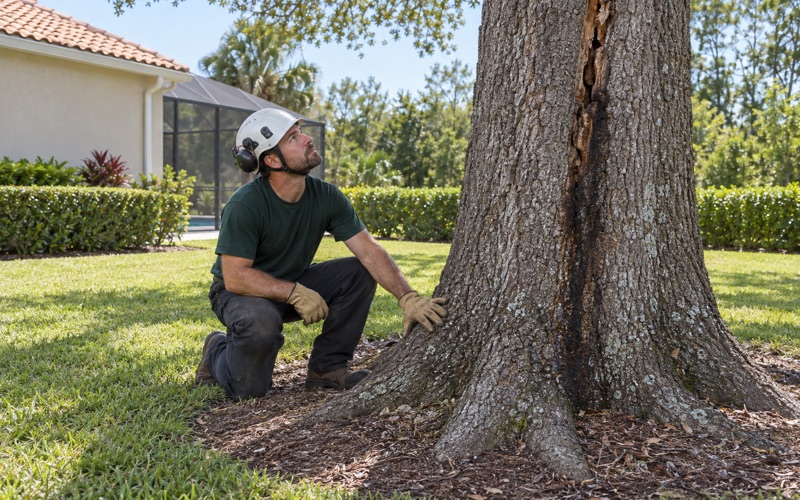
Because there is no state registry for a homeowner to check, the burden of proof falls on the contractor. We put a written condition report on any tree we recommend taking down, so the reason is on the record before the saw starts, and the same report says so plainly when pruning or a cable is the honest answer instead of a removal. Twenty years of work on this coast is not a credential either, but it is why we read a city’s own documents before we price against them.
Looking for tree-removal closer to Lehigh Acres? See Lehigh Acres Tree-Removal.
Climbing spurs, root thresholds and what a written specification is for
Section 02110 is worth more to a private property owner than its title suggests. It is the city’s own account of what careful clearing looks like, written for contractors working on city projects, and nothing stops a homeowner from holding a residential crew to the same lines. Two of its rules are the ones we see broken most often on other companies’ work. Both are written in plain language, and both are checkable from the ground by someone with no arboricultural training at all.
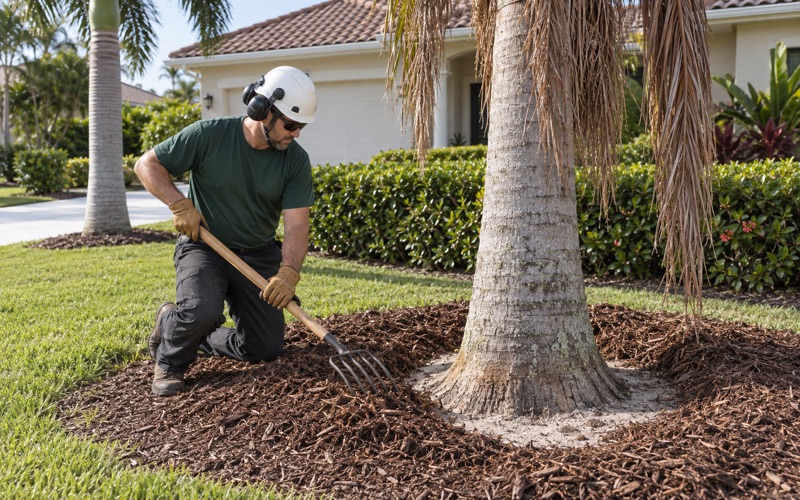
The first is flat: the use of axes or climbing spurs for trimming will not be permitted, and climbing ropes are to be provided instead. The second bars fastening ropes, cables or guy wires to trees without permission. Spurs leave a column of puncture wounds up a trunk that is meant to stay standing, and on a palm they cut tissue that never closes, because a palm has no cambium and no ability to compartmentalize a wound. We do not use them on a tree that is staying, on any job, city contract or not.
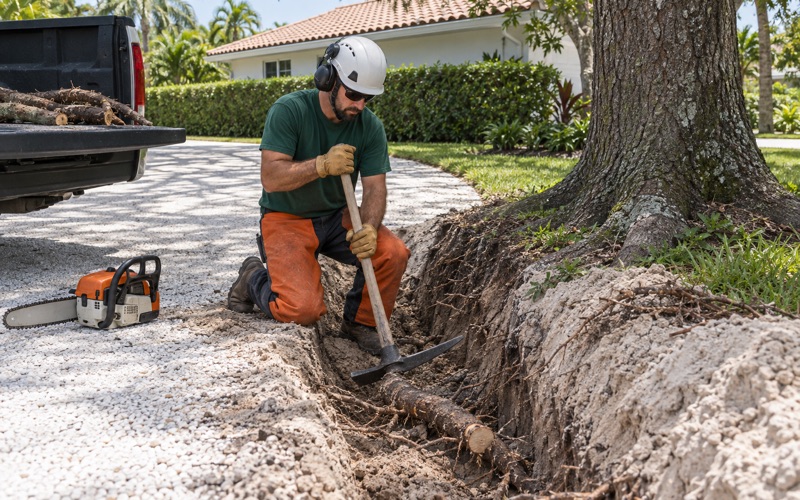
The root rules are just as specific, and they matter on the far more common residential situation where the tree coming out stands a few feet from one that is staying. The specification says not to disturb or cut roots unnecessarily, not to cut roots one and a half inches and larger without approval, not to run wheeled or tracked equipment inside the drip line, and not to pile excavated material within the drip line or against a trunk. Exposed roots are to be backfilled immediately once work in the vicinity is finished.
Grubbing with a number attached
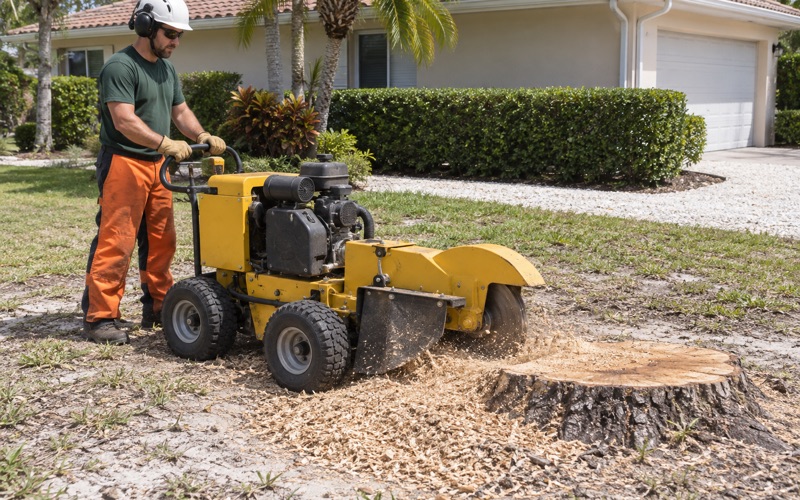
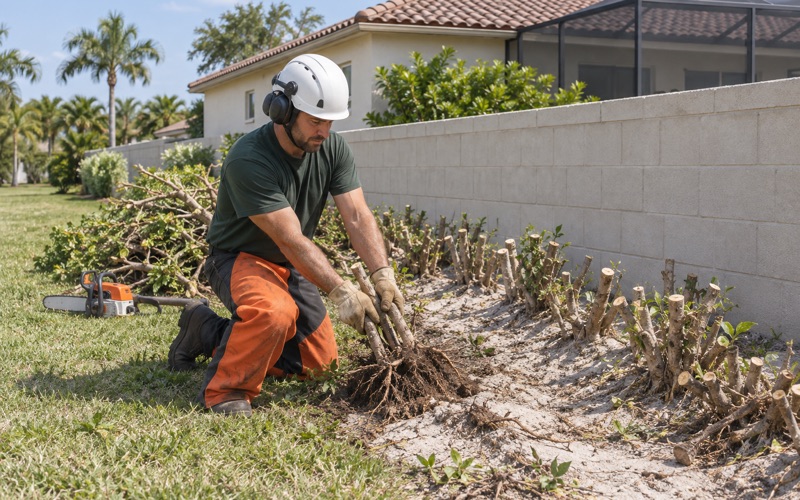
The same document defines grubbing as the removal and disposal of all stumps, buried logs, roots larger than one and a half inches, matted roots and organic materials. That is a stated root diameter for what has to come out, which is a great deal more useful than an instruction to grind the stump. When we quote a grind we say how far below grade the cut runs and where the spoil goes, because on this ground those two answers are connected.
Much of the developed core sits on fill rather than an intact natural profile. The Matlacha soil series, established in Lee County in 1982, describes twenty to forty-eight inches of material produced by dredge and fill operations over sandy marine sediments, somewhat poorly drained, with a water table between eighteen and forty-two inches. Where that fill was placed, shell fragments and limestone pieces turn up in the grinding zone. On the flatwoods soils, Myakka fine sand puts its spodic hardpan around twenty inches down and carries a water table under eighteen inches for one to four months in most years, which is part of why a root plate in saturated ground has so little to hold.
The four-foot, four-inch curbside rule and the exception for palm fronds
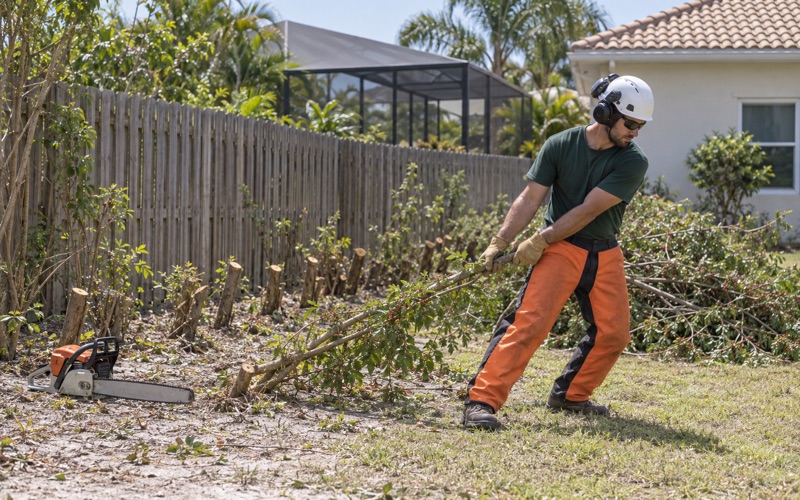
The City of Fort Myers Solid Waste Division collects yard waste itself, once a week, with no franchise hauler standing between the resident and city hall. The allowance is generous at the top end: the city collects piles up to ten cubic yards as part of ordinary weekly service, and piles larger than ten cubic yards require an additional fee. Ten cubic yards is a real volume, and most trims fit comfortably inside it. A ninety-six gallon horticulture cart for trimmings and clippings is available from the city for two dollars and seventy-five cents a month.
The size rule at the other end is where the door shuts. Pieces should be no longer than four feet in length and no larger than four inches in diameter, except palm fronds, and a four-inch cap sits far below any section of a removal trunk at any price. What the ten-cubic-yard allowance actually buys a homeowner is brush, not logs. Trunk wood and stumps leave on our truck for the county horticultural waste gate, which is priced per ton, and that haul is its own line on the estimate rather than a number folded into the cutting.
Palm fronds are the written exception
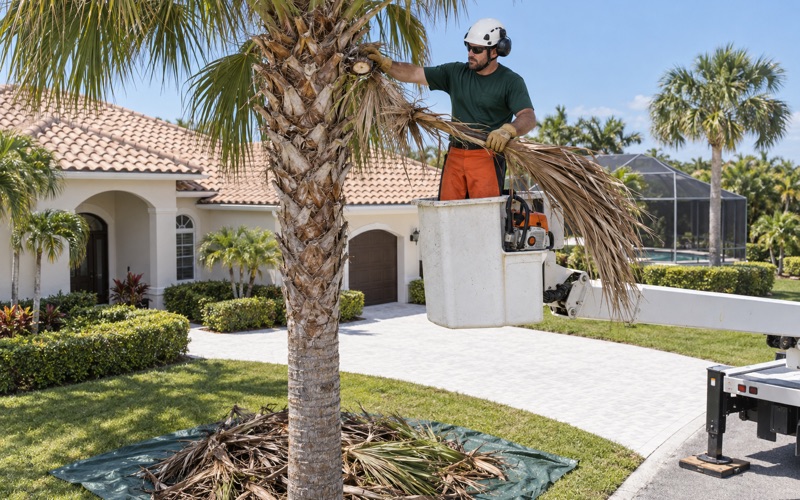
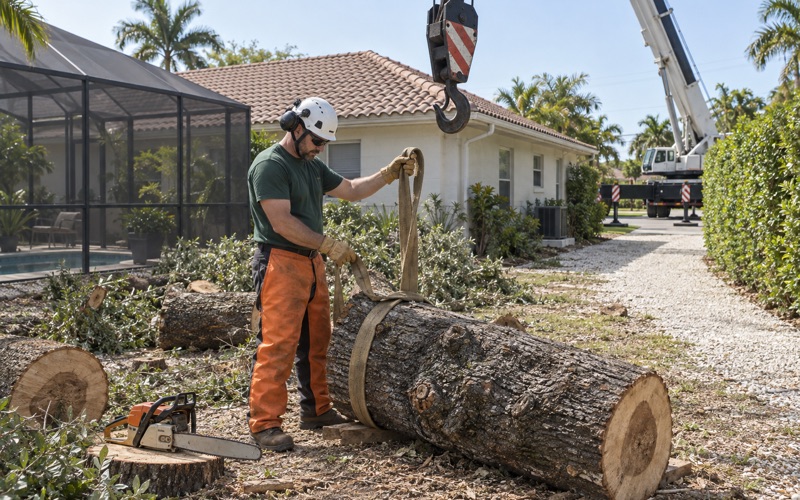
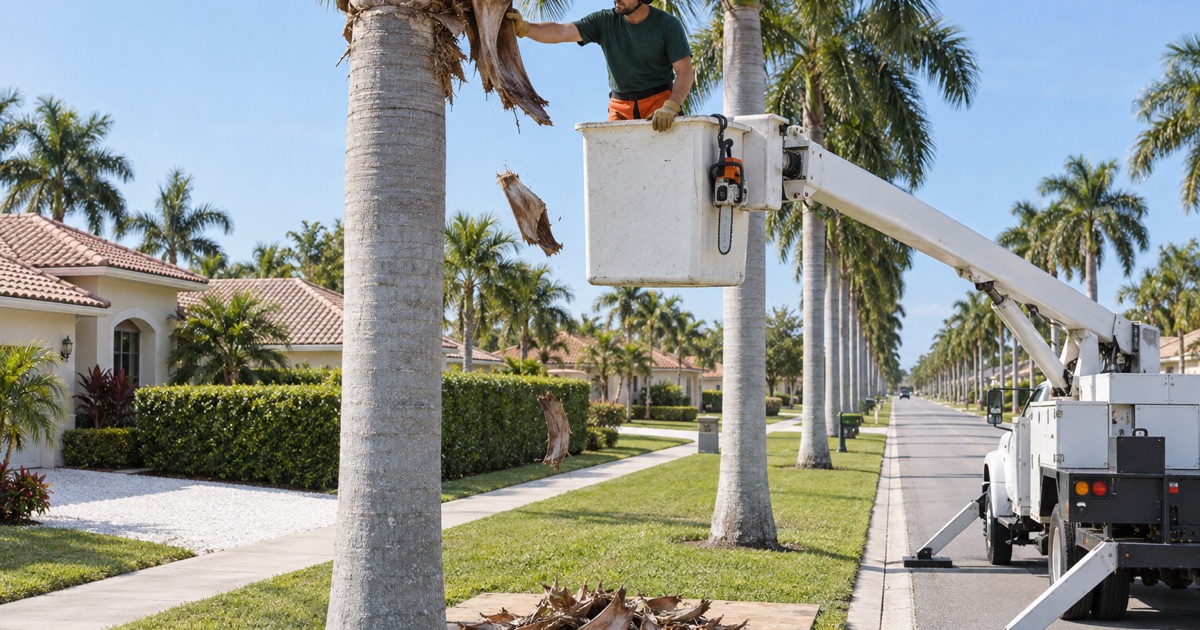
That exception for palm fronds is the city’s own wording, not an interpretation we are offering, and on a street of mature palms it decides whether a job ends in a curbside pile or a truckload. It is also one of the few places in the local rules that treats palms and hardwoods as the different jobs they are. A royal palm has no branch collar to cut to, no cambium, a trunk diameter fixed for life and a single growing point, so a mature one on a boulevard is a crane-and-cut job rather than a climb-and-drop job.
One more feature of these rules is unusual, and it is a negative finding rather than a loophole: nowhere in the city’s yard waste material is there a sentence addressing debris generated by a hired tree service. That silence grants nobody anything. The four-inch cap still stops trunk wood, and the city’s code enforcement guide separately requires yard materials to be stacked in compact piles within property lines, without obstructing pedestrians or vehicles.
Who signs off, and what the city still governs
Florida Statutes section 163.045 reaches Fort Myers exactly as it reaches every local government in the state. For a single-family detached home on a lot in active residential use, the city may not require notice, application, approval, permit, fee or mitigation to prune, trim or remove a tree where the owner holds signed documentation from an arborist certified by the International Society of Arboriculture, or from a Florida licensed landscape architect, that the tree presents an unacceptable risk. That documentation is a professional judgment rather than a form, and preparing it properly is part of the removal, not an errand afterward.
What Chapter 138 still covers
What the statute does not reach, the city still governs. Chapter 138, titled Vegetation, sits in Subpart B of the city’s Land Development Code and continues to apply to commercial sites, multifamily and attached dwellings, vacant lots and required landscape material. We check which of those a property actually is before we say anything about what it needs, because a rule written for a house does not carry across to a duplex or a shopping center.
Complaints about a job in progress land with the City of Fort Myers Code Enforcement Division on Hendry Street, where officers are assigned to specific wards and complaints are generally investigated within two hours of receipt. Citations carry fines from one hundred to five hundred dollars, and an unpaid fine becomes a lien on the property. A cleared lot also has to stay cut, since weeds, grass and underbrush must be kept to no more than twelve inches in height on any property inside the city, which turns a rough lot into a code matter within weeks of a removal.
Overhead conductors above most city trees belong to Florida Power and Light rather than to the regional electric cooperative, which does not list this city in its own service area. A stump grind near a water main or a force main is a City of Fort Myers Public Works question, because the city runs its own water treatment plant and its own wastewater treatment division rather than buying the service from a district. Knowing which body owns the conflict is half of scheduling a removal without a shutdown.
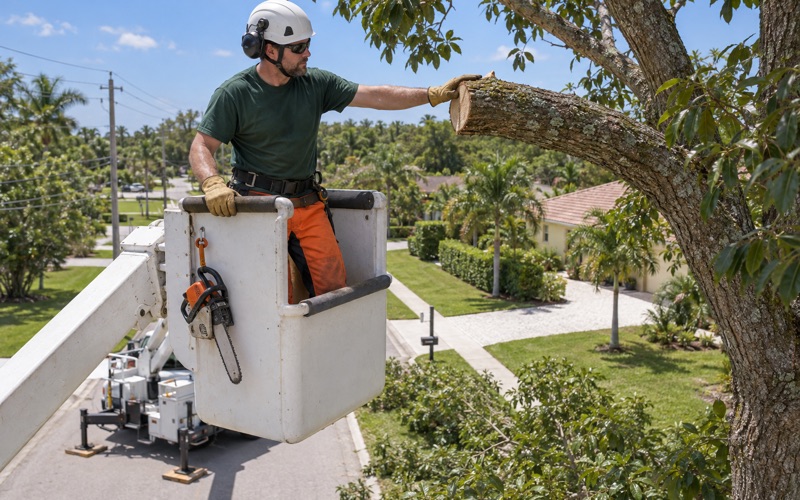
None of this is a reason to be nervous about taking a tree down here; it is a reason to want the estimate in writing before anything is cut. We work across Lee, Collier and Hendry counties and give a straight account of how the rules change at each of those lines, we size access to the property from a narrow-gate machine in a fenced back yard to a crane pick over a pool cage, and we book storm-season work before the season rather than scrambling after it. Owners who are not in town for the visit get written findings and photographs, so the inspection still means something when nobody is standing in the yard. What we will not do, whoever asks for it, is top a tree, hat rack it, or put a hurricane cut on a palm.
- 20+ Years on This Coast
- Written Estimate Before Any Cut
- No Topping, No Hurricane Cuts