Bonita Springs Tree Removal has handled tree-removal in Fort Myers Beach for more than twenty years, and the first thing we say to a new client here is that this is not Fort Myers. The Town of Fort Myers Beach is its own incorporated municipality with its own Land Development Code, its own Chapter 14, and its own permitting office. A permit answer that came from the county, or from the mainland city with the similar name, settles nothing on a lot inside these town limits.
That distinction runs through the whole job. We put a written estimate in front of you before anything is cut, with hauling and disposal carried as their own line so the cost of moving wood off a barrier island is visible rather than buried in a lump sum. Behind any tree we recommend taking down there is a written condition report, which on a lot where the tree may be protected by ordinance is the difference between a removal that is defensible and one that becomes a code case.
A tree code that can switch itself off for thirty days
The Town’s tree rules sit in Chapter 14, Article V of the Land Development Code, and one section in it changes how we schedule storm work. Section 14-378, Suspension of article during emergency conditions, provides that upon the declaration of a state of emergency under Florida Statutes chapter 252 the director may suspend enforcement of the article’s requirements for a period of thirty days, to expedite the removal of damaged and destroyed trees in the interest of public safety. A municipal tree code with an emergency valve written into it, bounded in days and exercised by a named officer.
Read the verb before relying on it. The director may suspend, which makes it discretionary rather than automatic, and no declaration switches it on by itself. We do not tell a client the article is suspended and we do not work as though it is; we ask the Town whether the director has invoked it, and we say plainly that the answer changes what paperwork a removal needs that week.
The damaged-tree exemption is narrower than it reads
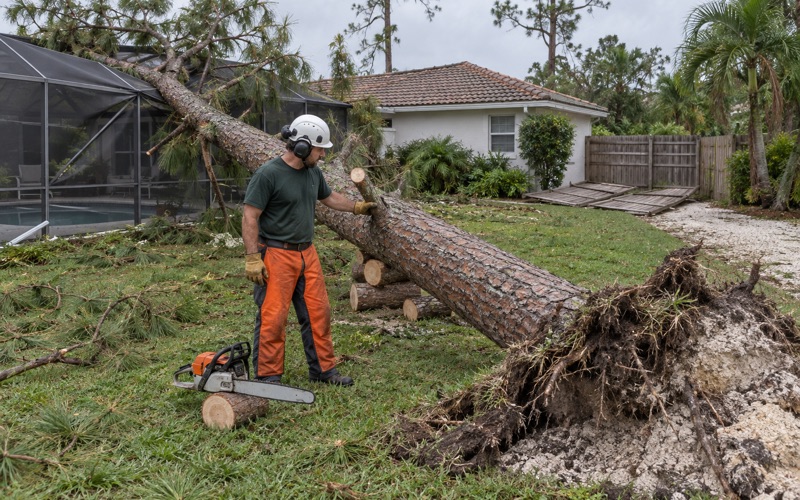
Sec. 14-376(a)(2) exempts removal of a protected tree that is dead, or which has been destroyed or damaged by natural causes beyond saving, or which is a hazard as the result of an act of God and constitutes an immediate peril to life and property. The conjunctions carry the weight. Dead stands on its own; damaged does not, because it has to be damaged beyond saving; and hazardous does not either, because the hazard has to arise from an act of God and be an immediate peril at the same time.
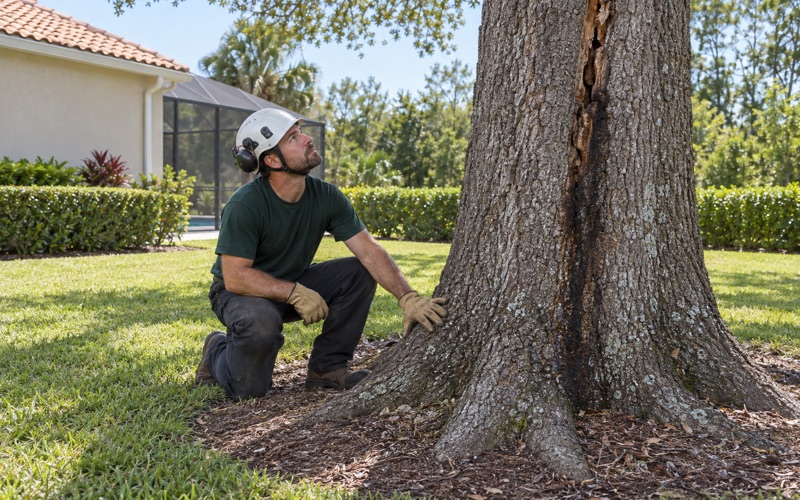
A leaning tree that nobody has yet judged beyond saving sits outside that exemption, whatever the weather did around it. This is where the written condition report earns its place: the assessment, the photographs and the reasoning are on the record before the saw starts, worked up against the ISA Best Management Practices Tree Risk Assessment approach and the pruning standards in ANSI A300 rather than a verbal opinion given in a driveway.
The duty stays with the owner
Sec. 14-379 states that nothing in the article imposes liability on the Town or its officers, nor relieves an owner or occupant of the duty to keep trees and shrubs on the property in a safe condition. That is the practical reason seasonal and second-home clients get written findings and photographs from us: an inspection that exists only in somebody’s memory is no help when nobody is standing in the yard.
Looking for tree-removal closer to Naples? See Tree-Removal Services in Naples.
A separate article for mangroves, and a permit the Town does not issue
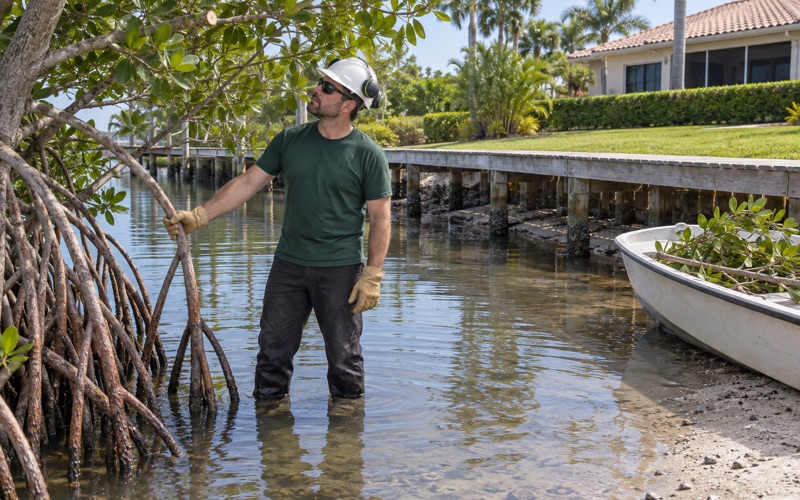
Immediately after the tree article, Chapter 14 carries Article VI, titled Mangrove Enforcement, at Secs. 14-451 through 14-456. Its stated purpose is to establish enforcement procedures and restoration standards for violations of the state department of environmental protection’s mangrove protection rules, and to supplement and enhance that department’s own enforcement mechanisms. The Town is enforcing a state program here rather than running one of its own, and that is worth getting straight before anyone touches a mangrove on this island.
The permit is a state permit
Section 14-455 puts it directly: no person shall alter any mangrove tree located in the incorporated area without first obtaining a permit, where applicable, from the state department of environmental protection. The article’s own citation still points at the superseded chapter 17-321 numbering in the Florida Administrative Code, while the governing law today is the Mangrove Trimming and Preservation Act at Florida Statutes 403.9321 through 403.9333, which is also where the professional mangrove trimmer designation comes from. We will tell you when a job belongs to that program and has to go to the state first.
What an unlawful alteration costs
The enforcement side is not gentle. Sec. 14-453(c) makes each mangrove altered a separate violation, and Sec. 14-454(b)(1) sets restoration at three replacement mangroves for every one altered in violation, container grown, no less than one year old and 24 inches in height, planted at a minimum density of three feet on center, with eighty percent survivability guaranteed for no less than five years.
Sec. 14-456 then resolves any conflict with another lawfully adopted ordinance by applying the most restrictive requirement, and all three mangroves also appear on the Town’s own protected tree list. So a black mangrove on a shoreline here sits under a state permit program, a Town enforcement article and a Town protected-species list at once. Our recommendation there is usually to cut nothing on the water side and price the upland work separately.
Which trees are protected, and how the thresholds run
A tree has a legal definition on this island, with three thresholds inside it. The Town’s own Vegetation Removal Permit Application states it as a living, woody, self-supporting plant, ten feet or more in height, having one or more well-defined main stems or trunks, and any one stem or trunk four inches in diameter at breast height. Sec. 14-374 declares the palms on the protected list to be trees for the article’s purposes, which settles by ordinance an argument this trade otherwise has botanically.
The list is a list a crew can actually read
Sec. 14-380(c) names the protected species outright: the three mangroves, sea grape, pigeon plum, gumbo limbo, buttonwood, black olive, cabbage palm, coconut palm, Florida royal palm, silver palm, live oak, laurel oak, South Florida slash pine, West Indian mahogany, strangler fig, mastic, wild tamarind, Jamaica dogwood, and pond and bald cypress. Sec. 14-380(b) draws the boundary: other species may be removed without a permit, but only in a manner that does not disturb surrounding protected trees or the indigenous vegetation the article protects.
Sec. 14-382(c) allows the removal of up to three protected trees in any one-year period on a lot lawfully used as a single-family residence or mobile home, with no permit required.
Sec. 14-376(b) then takes that back for one class of tree, because the exemptions do not apply to any tree cited in the Florida champion tree register published by the Florida Native Plant Society. A rights-of-way crew, a utility crew, a surveyor and a homeowner all lose their exemption against the same register.
Numbers a bid has to carry
For three protected trees or fewer, Sec. 14-412(c)(2) substitutes an on-site examination by the director’s designee for the tree location map; above five, no removal permit issues until a site plan for the parcel has been reviewed and approved. The Town’s application sets site inspection at seven to ten working days once requested, and prints a sixty-dollar re-inspection fee where tree protection barricades are not in compliance at that inspection.
Sec. 14-383 fixes the barriers themselves in feet: at or greater than a six-foot radius around all mangroves and protected cabbage palms, the full dripline of protected native pines, and two-thirds of the dripline of every other protected species, with landscaping inside the barrier done by hand labor. Those are line items on an estimate, not aspirations.
One number, two governments
Both codes have to be named every time, which is why we write citations out in full. In the Town of Fort Myers Beach code, Sec. 14-377 is Indigenous vegetation.
In the Lee County Land Development Code, which has its own Chapter 14, Article V also titled Tree Protection, that same number is Exemptions from article, a completely different provision. Same chapter, same article title, same number, two governments and two texts.
Rebuilding, the 50% rule, and what the published numbers say
Much of the tree work we quote here now sits on a property under repair or rebuild, which puts a second set of rules alongside the tree code. The Town’s Building Services FAQ defines substantial improvement and substantial damage as any combination of repair, reconstruction, rehabilitation, addition or other improvement whose cumulative cost equals or exceeds fifty percent of the pre-damaged market value of the structure, and crossing that line means the entire building must be elevated to or above the base flood elevation and made fully flood compliant.
Market value comes from two places only: the Lee County Property Appraiser’s assessment of market value for the structure, or an independent appraisal prepared and certified by a property appraiser licensed in the State of Florida. Replacement cost may not be substituted for either. FEMA recognized the county property appraiser as the authority to assess real property values in a retraction letter the Town received on February 17, 2023, two days after its initial letter.
Where a tree job sits in that
We do not answer the 50% question in either direction. The rule as the Town writes it counts improvements to a building, and whether ordinary site work such as a removal enters the cumulative total is a question for the Town’s Building Services on your specific address rather than for a tree crew. What the same FAQ does say is that a Repair Improvement Cost Form is required even where the Florida Building Code needs no permit, so the time to ask is before the work, not after it.
What the storm figures support, and what they do not
The National Hurricane Center’s report on Hurricane Ian publishes inundation of ten to fifteen feet above ground level on Fort Myers Beach and Estero Island from the September 28, 2022 landfall. FEMA’s May 2023 release for that disaster records $6,230,192 toward debris removal here and itemizes what came off roads and public property, including 81,303 cubic yards of construction and demolition debris against 3,819 cubic yards of vegetative debris.
That reimbursed stream was overwhelmingly building material and sand, and it carries no canopy-loss figure at all. Neither does the hurricane report. We quote those numbers as published and stop there, because delayed mortality after salt inundation shows up tree by tree over following seasons and has to be assessed the same way, not projected across a street from a debris total.
Ground, access and where the wood goes
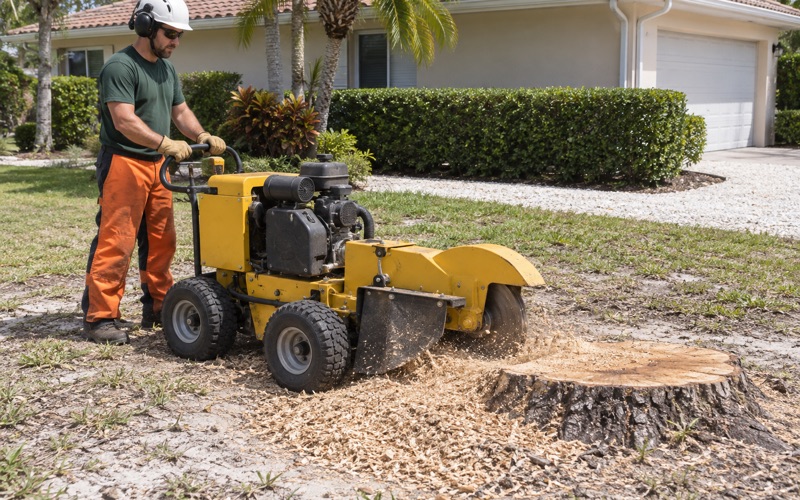
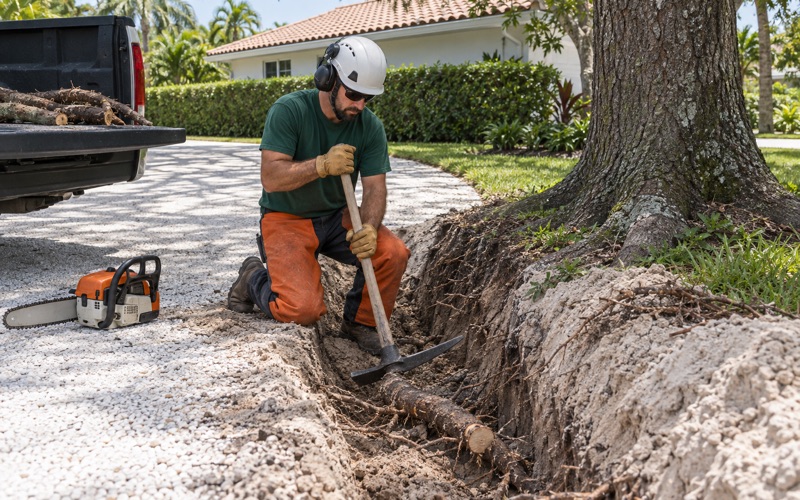
Under a barrier-island lot there is no rock within reach. There is marine sand and shell that offers a root plate almost no purchase, a water table sitting close to grade for months at a time, and sulfide-bearing muck at the mangrove edge that is not machine ground at all. Twenty years on this coast is mostly twenty years of reading that ground before a stump grinder or a crane outrigger is set down on it.
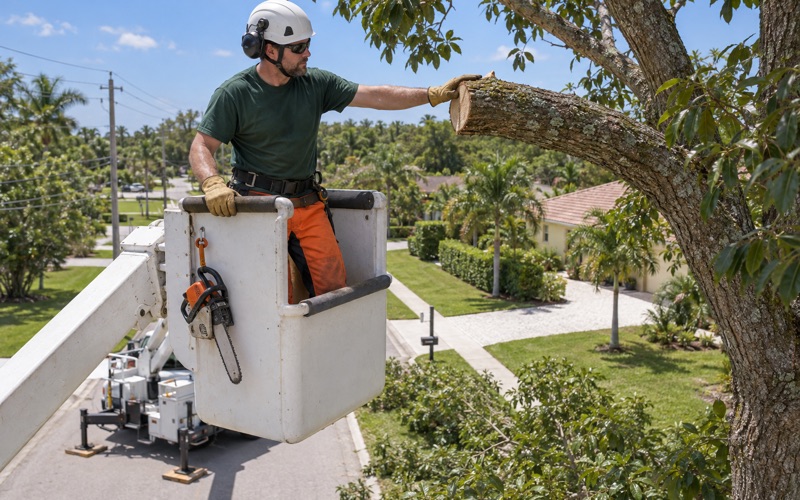
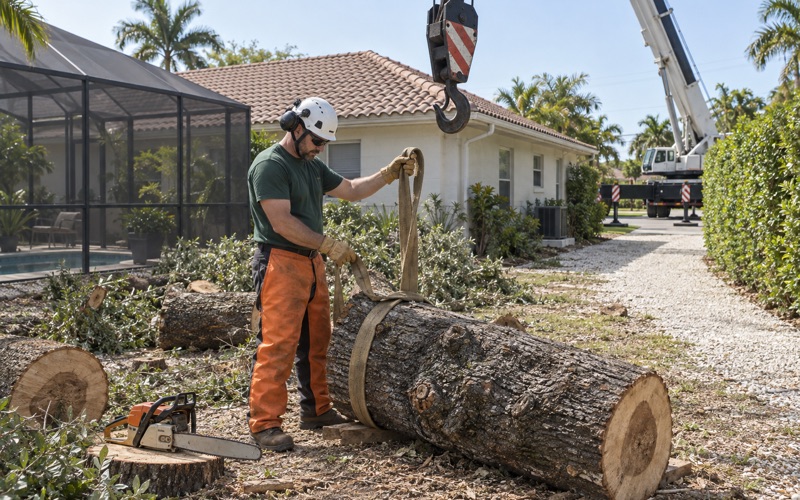
No disposal, transfer or horticulture gate of any kind sits on Estero Island, so every load we cut crosses the bridge. Lee County’s current rate for horticultural material at Buckingham Horticulture is $43.92 per ton with a fifteen-dollar minimum, and that haul is exactly why our estimates price disposal on its own line. Access we size to the property, from a narrow-gate machine in a fenced back yard to a crane pick over a pool cage.
- 20+ Years on This Coast
- Written Estimate Before Any Cut
- No Topping, No Hurricane Cuts