Bonita Springs Tree Removal handles tree removal in Florida Gulf Coast University as institutional work, and after twenty-plus years on this coast we open every job here with the same question: who actually controls the vegetation on this ground? Across most unincorporated land in Lee County the answer is a county code and a permit counter. On this campus it is neither, and quoting the work as though it were is the quickest way to have a removal stopped halfway through.
That changes how we quote. Every job on this ground gets a written estimate before anything is cut, and the scope is written against the documents that actually control the site rather than against a template. We work across Lee, Collier and Hendry counties and give a straight account of how the rules differ across those lines, and the line drawn around this campus is the sharpest one we cross.
State land, a state statute, and who signs the work off
Florida Gulf Coast University is a public university in the State University System of Florida, and the ground this page covers is state land held by that institution rather than a city’s territory. The Florida Gulf Coast University CDP is a census designated place, a statistical area of 2.411 square miles: unincorporated, with no mayor, no council, no city hall and no ordinances of its own. The governing body is the FGCU Board of Trustees, thirteen members, six appointed by the Governor and five by the Board of Governors of the State University System.
The statute that decides who reviews campus development
Campus development in Florida runs on Florida Statutes section 1013.30. Each university board of trustees adopts a campus master plan and drafts a campus development agreement for each host local government, and subsection (18) provides that once that agreement is executed, all campus development may proceed without further review by the host local government if it is consistent with the adopted campus master plan and the associated agreement. That is not a strained reading: the University’s own Campus Master Plan 2020-2030 cites section 1013.30 by name in Policies 902.2.2, 903.1.7 and 1401.1.4.
Lee County coordinates here, it does not permit here
Lee County Community Development handles planning, zoning, permitting, plan review, inspections and code enforcement for the unincorporated areas of Lee County, and its vegetation removal permit is issued under the Tree Protection section of the Land Development Code, Chapter 14. That is the county’s authority over unincorporated ground in general. On this campus the master plan instead directs the University to provide updated capital improvement projections annually to Lee County and off-campus service providers, which is coordination with a host government rather than an application to one.
The practical consequence is that nobody should price a tree on this campus by looking up a county permit fee. Whether a particular piece of work sits inside or outside the executed campus development agreement is a question answered against that agreement, and the agreement is a document the University holds rather than something a contractor can assume from the outside. We would rather ask the facilities office and be told than write a number built on the wrong authority.
Looking for tree-removal closer to Fort Myers Beach? See Tree-Removal in Fort Myers Beach.
The 1994 permits that actually govern the vegetation
Before that first conceptual permit, the site underwent a detailed analysis of its existing environmental conditions: vegetation mapping from newly flown aerial photography, on-site flagging of jurisdictional wetland boundaries, binding jurisdictional determinations, surveying of the jurisdictional lines, and wildlife surveys. That work fed the 1995 Campus Master Plan and was folded into a U.S. Army Corps of Engineers dredge and fill permit application and a South Florida Water Management District conceptual permit application, both filed in February 1994. Those permits have since been granted.
Then comes the sentence that settles the question, in the University’s own words: “The USACOE and SFWMD permits define the way in which the campus must be developed and the natural environment maintained.” So the controlling documents on this ground are a federal wetland permit and a water management district permit, and most of the conservation policies simply reference what those two already define.
The removals here are mostly of the wrong plants
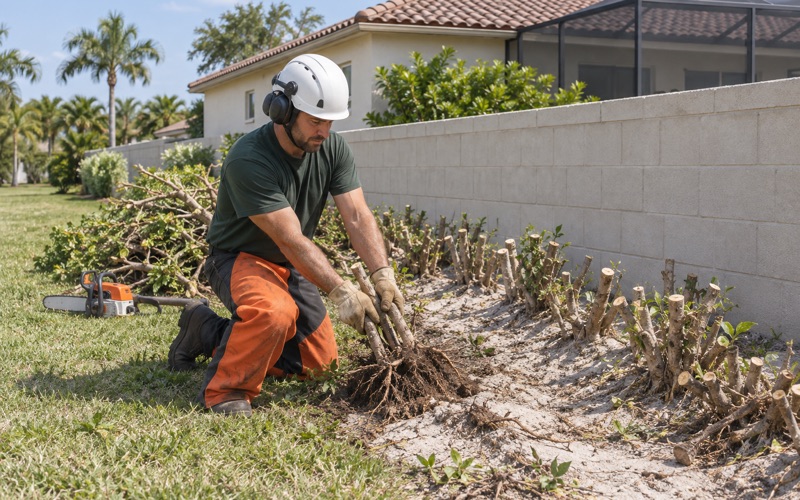
The Conservation Element is specific about what comes out. Policy 1301.3.4 preserves and restores campus wetland areas and adjacent upland buffers as wildlife habitat by removal of exotic vegetation and maintaining them free of exotic infestation, and Policy 1301.3.9 states the intent to remove from campus grounds all non-native or exotic invasive plants, identified as Noxious Weeds by the FDACS Division of Plant Industry or as Prohibited Plants by the FDEP Bureau of Invasive Plant Management. Brazilian pepper, melaleuca and Old World climbing fern are the standing targets.
Policy 1301.3.8 requires native species in restoration and enhancement plantings, so a replacement list drawn from a nursery’s fast movers is the wrong list here. The working vocabulary on this ground is exotic removal, invasive control, preserve delineation and permitted mitigation, not curb appeal, and a scope written in residential terms has to be translated before anyone can act on it. We would rather write it in the right terms the first time.
Debris has nowhere convenient to go
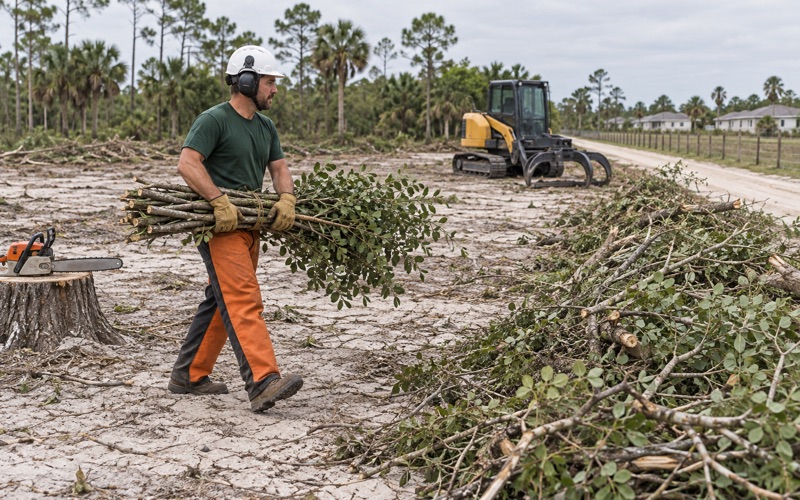
Policy 1301.3.13 requires preservation and restoration areas to be delineated by signage or other physical indicators, and Policy 1301.2.6(c) names, in the University’s own stormwater best-management list, the need to regularly collect and properly dispose of yard debris and the allowable uses of the preserve areas. A preserve is not a chip pile and not somewhere to leave brush overnight. That is exactly why our estimates carry hauling and disposal on their own line, at the horticultural waste gate rate, rather than folded into a single number.
Ground that is under water for months of the year
Sampled against the SSURGO soil survey for Lee County, the census internal point for this place falls in map unit 49, Felda fine sand, depressional, with the Felda component at 85 to 90 percent. The survey rates it very poorly drained, hydric yes, hydrologic group A/D, ponding frequency 98, runoff negligible. The series description puts the seasonal high water table within 12 inches of the surface for two to six months during most years, and ponding at up to 24 inches in depressional areas more than six months each year.
That is a different problem from the one we solve closer to the coast, where sand over hardpan and the limestone of the Boca series set the limits on a stump grinder. No limestone is described in the Felda profile within 203 centimeters, which is one of the things separating it from Boca and Isles. The constraint here is not rock and it is not depth. For a good part of the year the ground itself is the obstacle.
Rutting is a compliance problem before it is an equipment problem
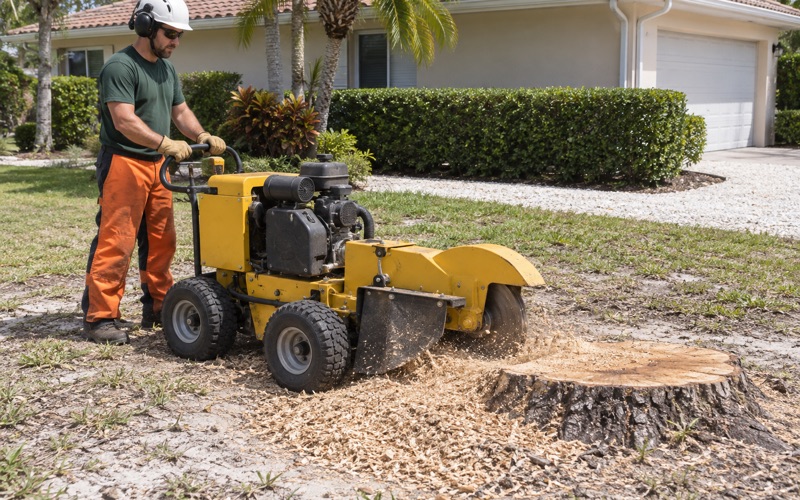
A tracked chipper, a stump grinder or a bucket truck standing on hydric soil inside a permitted wetland system does not simply leave ruts to rake out afterwards. It leaves them in ground the University monitors and reports on for compliance with the Army Corps of Engineers, the Department of Environmental Protection and the South Florida Water Management District. So we size access to the ground rather than to the machine we would prefer to bring, and we state in the estimate which approach the price assumes.
Everything under this landscape belongs to somebody
The master plan puts electric service with Florida Power & Light and establishes easements for FPL underground cables coordinated with other utilities. Potable water and sanitary sewer come from the Lee County Department of Public Works, Lee County Utilities, under a formal service agreement, while chilled water is produced on campus at a central energy plant in the South Village District. Underground primary electric, chilled-water mains and a permitted surface water management system together make the locate ticket a real piece of the schedule here, not a formality.
The weather products covering this ground are their own detail. The point sits in public forecast zone FLZ265, Inland Lee, which is also its fire weather zone, while Coastal Lee is the separate FLZ165 with the boundary a short drive west. A wind advisory or a red flag warning can be issued for one zone and not the other.
An institutional job, not a residential one
The Census read on this place is blunt. Total population is 4,836, and 4,376 of those people, 90.5 percent, live in group quarters. There are 109 housing units, every one of them renter-occupied, none owner-occupied and none vacant; 71 sit in buildings of ten units or more, and even the 38 one-unit detached homes are rented. Owner-occupied single-family detached housing here is zero, so a sales pitch written for a homeowner’s back yard would be describing somewhere else.
The buyer on this ground is a facilities department with a purchase order, and it already has a crew. The FGCU Physical Plant Grounds Department describes daily services that include campus litter removal and inspection of the entire campus for immediate landscape and irrigation issues; it runs invasive eradication, and it manages the wetlands for that federal, state and district compliance. Of the landscaped acreage only 20 acres are under irrigation, with the remainder landscaped in natural, indigenous plant material. Work is requested through the Work Management Center.
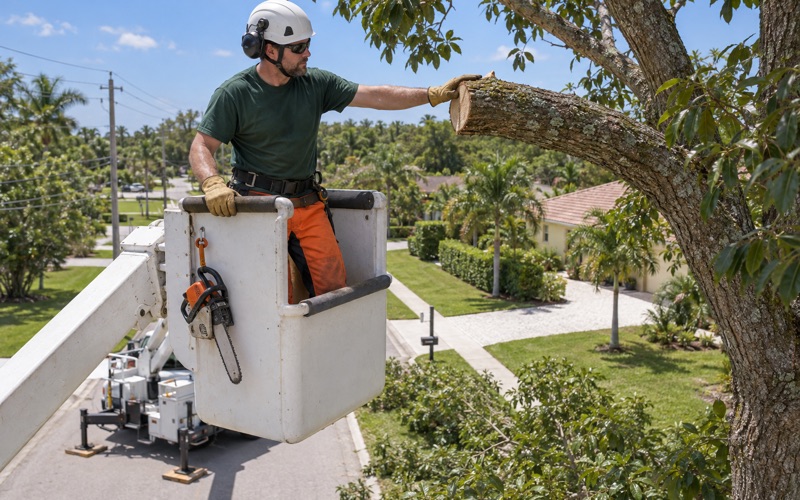
It also moves trees rather than buying removals. The department runs what it calls a Tree Orphanage, relocating trees out of construction zones, and by its own count it has transplanted 116 sabal palms, 8 live oaks and 2 cypress trees from building sites to other parts of campus. Any contractor who reads a permitted campus of more than 800 acres as an easy removal sale has misread it. Whether the University brings in outside crews for large-tree rigging, crane work or post-storm clearance is its own decision, and we do not presume it either way.
Where an outside crew actually earns its place
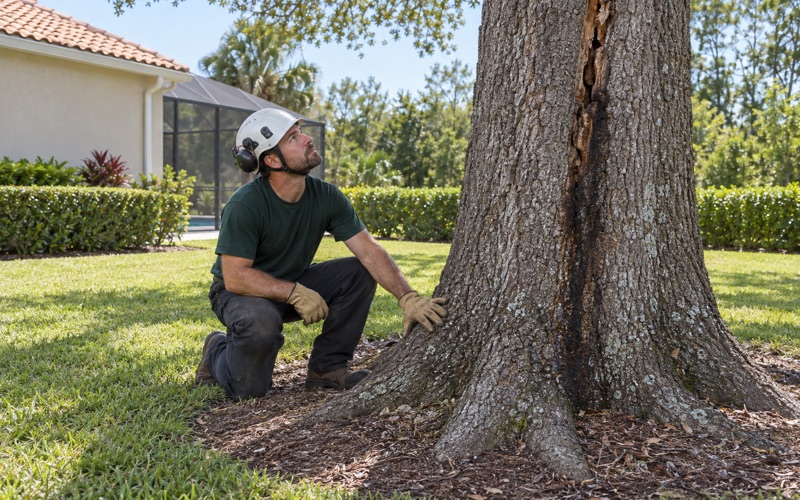
Where we are useful on a site like this is the tree whose removal is genuinely contested. We write a condition report on any tree we recommend taking down, so the reasoning is on the record before the saw starts, and we give a straight answer when the honest recommendation is a directional prune, a root collar excavation or a cable instead of a removal. We work to ANSI A300, and we assess risk against the ISA Best Management Practices for Tree Risk Assessment, Second Edition 2017.
Palms and hardwoods are two different jobs
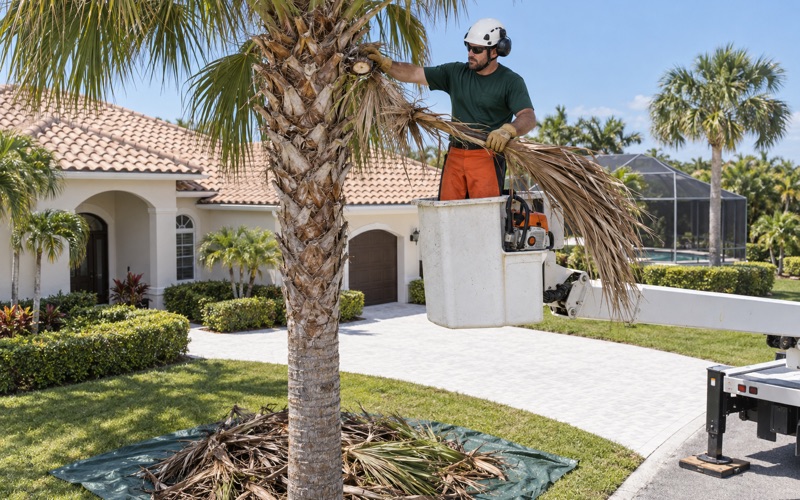
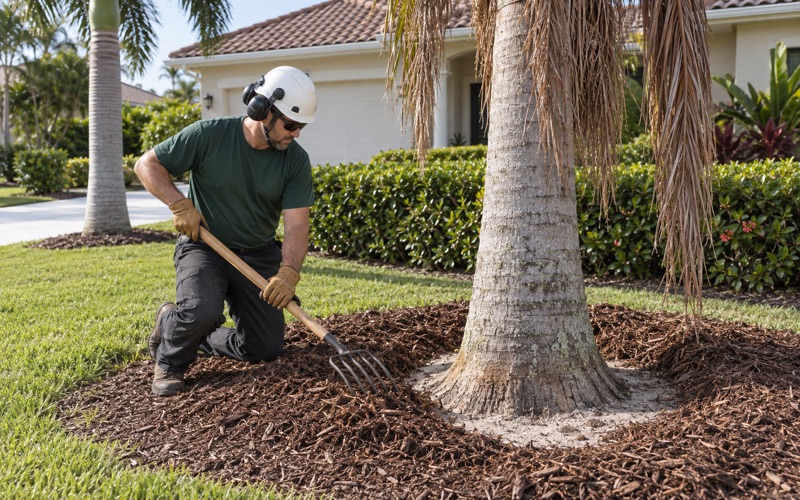
A palm has no branch collar to cut to, and our crews do not treat one as a small hardwood. On this coast the questions that decide a sabal palm’s future are Ganoderma butt rot and the conk of Ganoderma zonatum, lethal bronzing, and a collapsed spear leaf, conditions where removal is the only remaining answer and pruning changes nothing. We do not top, hat rack or hurricane-cut anything, palm or hardwood, whoever asks for it, and pencil-pointing a trunk is not something we sell.
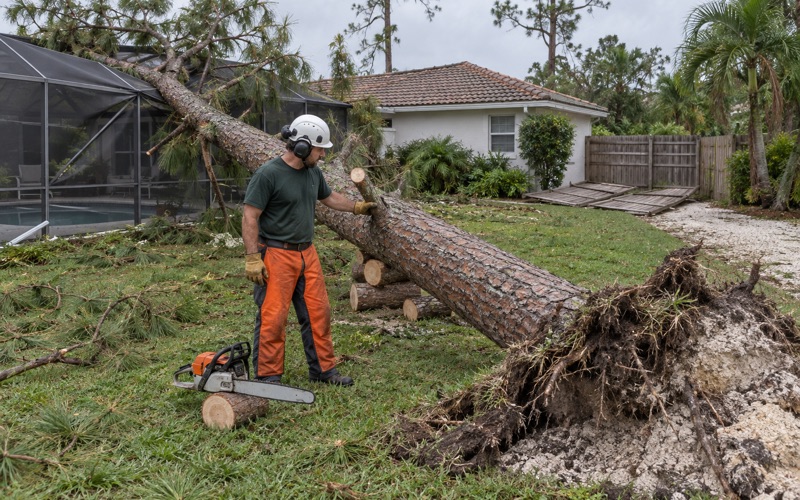
Bald cypress, pine flatwoods and oak hammocks are part of what this campus is, and the cypress domes and freshwater marshes sit inside the same permitted system as the buildings. Work anywhere near them is better booked before storm season than scrambled after it, and we keep watching afterwards for the delayed mortality that shows up in trees which looked survivable in the first week.
- 20+ Years on This Coast
- Written Estimate Before Any Cut
- No Topping, No Hurricane Cuts