Bonita Springs Tree Removal has handled tree removal in Estero for more than twenty years, and on a village address the first thing we settle is rarely the tree itself. It is which rulebook the property falls under, because that answer decides whether anyone needs authorization at all before a saw comes out. We put the work in writing first, with hauling and disposal broken out as their own line, so the cost of moving the wood is visible instead of buried inside one number at the bottom.
That written estimate travels with a written condition report on any tree we recommend taking down, so the reasoning sits on the record before the cut rather than being reconstructed afterward. Palms and hardwoods are quoted as the different jobs they are; a sabal palmetto has no branch collar to cut back to, and a laurel oak carrying co-dominant stems and included bark is a rigging problem rather than a pruning one. We do not top, hat rack or hurricane cut anything, whoever asks for it.
A village younger than the code that governs it
Estero has been a municipality only since the last calendar date of 2014. The Legislature created its charter as chapter 2014-249, Laws of Florida, from CS/CS/HB 1373, signed by the Governor on 12 May 2014, and made it effective only on approval by a majority of the qualified electors residing inside the proposed corporate limits. The referendum passed that November and the Village incorporated on 31 December 2014. Nothing about tree work changed that day, because a new municipality does not arrive holding a land development code of its own.
For its first several years the Village legislated on top of provisions it had carried forward from Lee County, amending them one at a time; Village Ordinance 2019-19 is titled, plainly, Amending Special Events Permitting Provision of Lee County Code. Its own Land Development Code was not adopted until 27 January 2021. Anything you read about tree rules in Estero that predates that adoption may actually be describing the county land development code at section 14-411, which is a different document with different thresholds.
The other Estero in the search results
There is a second trap in the research, and it is worse than a stale date. A barrier island out on the coast carries the same name and is occupied by a separate incorporated town with its own government and its own ordinances. Storm reporting, damage counts and inundation figures published under that name describe the island, not this mainland village on the Estero River. We have met owners priced for a catastrophe that was measured somewhere else, on ground that behaves nothing like theirs.
We work across Lee, Collier and Hendry counties, and the differences between them are not cosmetic. What is exempt on one side of a county line can be a permit application on the other, and the departments that answer the phone are not the same departments. Part of what you are buying from a crew that works this coast is a straight account of which line your property falls on before the schedule is set.
Looking for tree-removal closer to Naples Park? See Tree-Removal Services in Naples Park.
A local code written to a standard the law has since replaced
The Village code states the residential arborist exemption in the wording the statute used before 2022: documentation that the tree presents a danger to persons or property. That phrasing was current when the code was adopted on 27 January 2021, and it is not current now. Chapter 2022-121, effective 1 July 2022, replaced it in Florida Statutes section 163.045 with a defined standard, under which the tree must pose an unacceptable risk. The local text was simply written first.
The definition is not rhetorical. It asks whether removal is the only means of practically mitigating the risk below moderate, and it points at the ISA Best Management Practices Tree Risk Assessment Second Edition 2017 for how that judgment is made. A note saying a tree looks dangerous satisfies nothing. The documentation the statute contemplates is signed by an ISA-certified arborist or a Florida licensed landscape architect and has to reach that conclusion on its own terms.
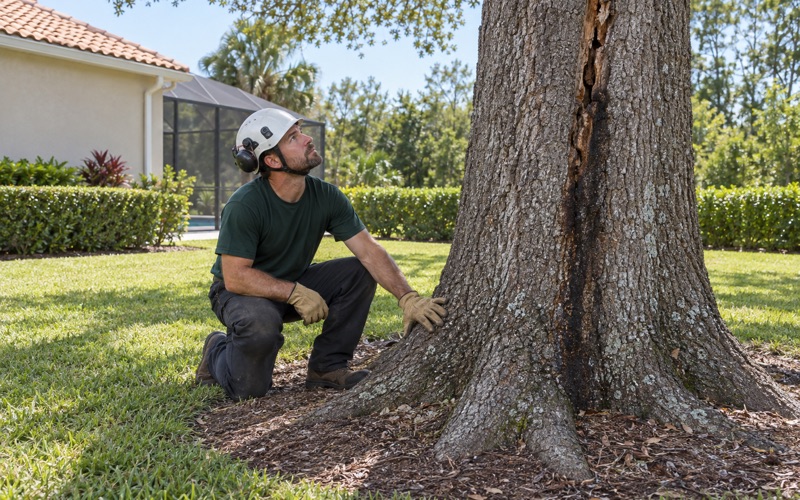
Our written condition report is not that document, and we say so rather than let anyone assume otherwise. It records what we found on the ground, whether that is decay opened up by a root collar excavation, a Ganoderma zonatum conk at the base of a palm, or a union that has already cracked. Often it records the opposite of a removal, that directional pruning or a cable is the honest answer and the tree stays standing.
Whether the exemption reaches your lot at all
The statute defines residential property narrowly, as a single-family detached building on a lot actively used for single-family residential purposes. In Estero that describes 12,115 of 26,937 housing units by structure type (ACS 2024 5-year, B25024). The other side of that ledger, 3,634 attached single-family units, 8,712 units in buildings of two or more, and 2,447 mobile homes, sits outside the exemption entirely, along with common tracts, vacant lots and every commercial parcel.
The statute also binds the Village rather than a private covenant, so a community’s own architectural rules can still say something different, and the two questions are answered separately. The test turns on the building, not on the tree, which is why we ask what is standing on the lot before we say anything about what is standing over it. A duplex and a detached house on the same street can carry identical oaks and reach two different answers.
What the Community Development Department still asks for
Where the exemption does not reach, the Village process is the live one, and the Village publishes it. Authorization for tree removal is handled by the Community Development Department, which posts an Application for Vegetation Removal in its building permit document library. The Land Development Code prohibits deliberately cutting down, destroying, removing, relocating, defoliating or otherwise damaging a tree worthy of preservation without first obtaining a tree removal permit under section 2-505.D, the Tree Removal/Vegetation Permit.
On a site being cleared, the code carries the machinery that goes with that permit. Trees worthy of preservation and other protected trees are marked and barricaded before land clearing begins, and a preserved tree destroyed during construction has to be replaced with the same species at equivalent dbh caliper before a certificate of occupancy or compliance issues. That is a schedule item rather than a formality, and protecting a tree costs less than replacing one at that size.
Common ground answers to a district, not a homeowner
Much of the Village sits inside community development districts organized under chapter 190, Florida Statutes, independent special-purpose governments that own and maintain the drainage, lakes, roadways, landscaping and preserve tracts inside a master-planned community. Two of the largest carry a name from somewhere else: the Brooks of Bonita Springs Community Development District at approximately 1,249 acres, and Brooks of Bonita Springs II at approximately 1,223 acres, both described by the districts themselves as lying within the boundaries of the Village of Estero.
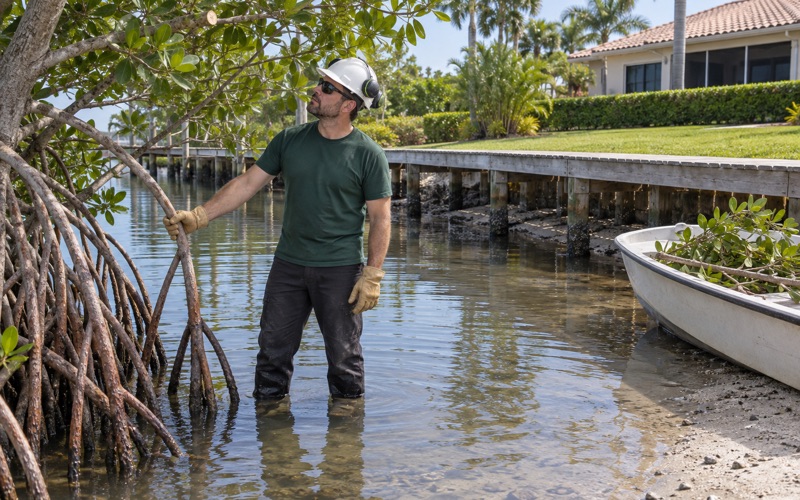
So a tree standing on common ground in one of those communities is not the homeowner’s to authorize, and not the association president’s either; the decision belongs to a district board and its manager. Tidal frontage adds another party again. Mangroves are trimmed under the Mangrove Trimming and Preservation Act, and because the Village holds none of the delegated authority the state grants a handful of local governments, that permit comes from the Department of Environmental Protection’s South District.
Ground that decides the machine, and where the wood goes
Two soil series inside one village say opposite things to a stump grinder. The soil survey for Lee County puts the Village’s own center point in Immokalee sand, a poorly drained spodosol whose cemented spodic horizon sits between 35 and 54 inches down, with a seasonal high water table within 6 to 18 inches of the surface for one to four months in most years. There is no rock within reach there; saturation and that hardpan are the entire problem.
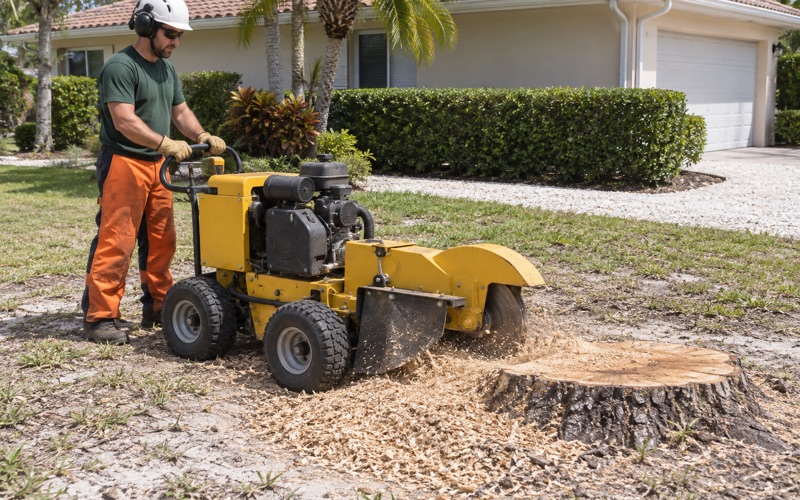
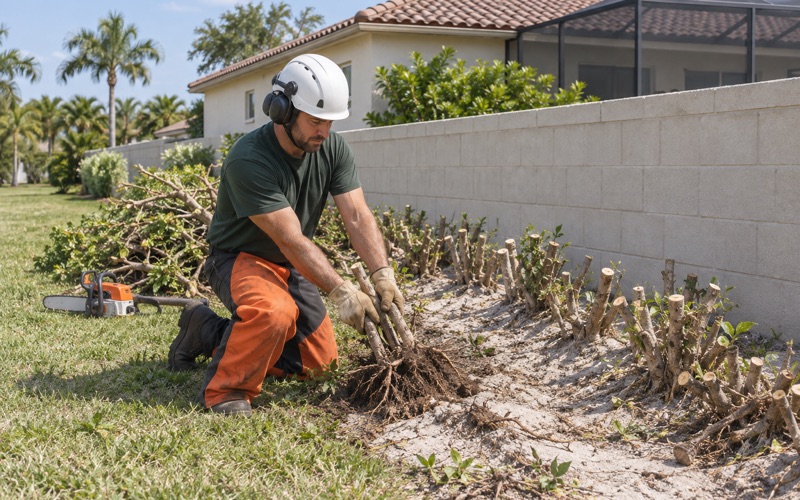
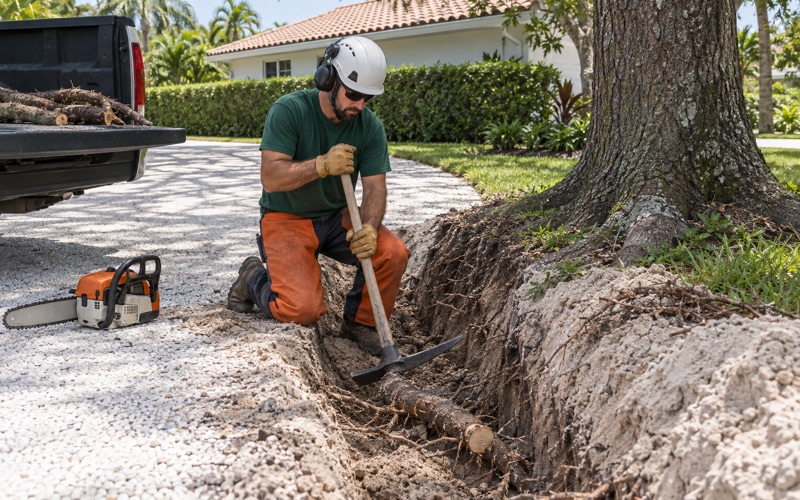
About a mile northwest the map unit is Cocoa fine sand, moderately well drained, where depth to limestone runs 20 to 40 inches and the typical profile meets rock at 38. On that ground a stump grinder below-grade cut can be into limestone inside the stump’s own root plate, which means different teeth, a different pace and a different price. We tell you which soil an address sits on before quoting a grind, or we tell you we do not know yet and go find out.
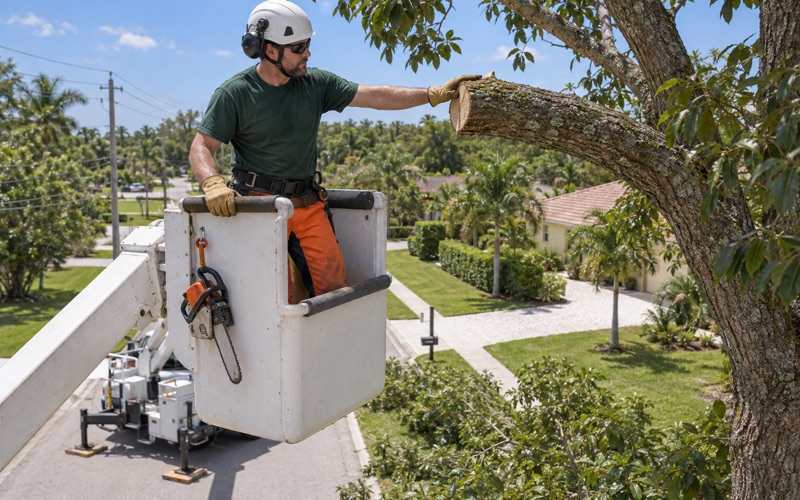
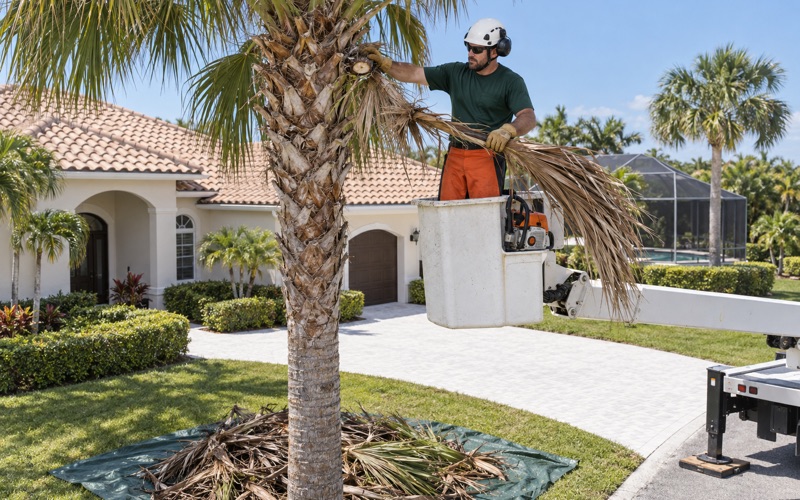
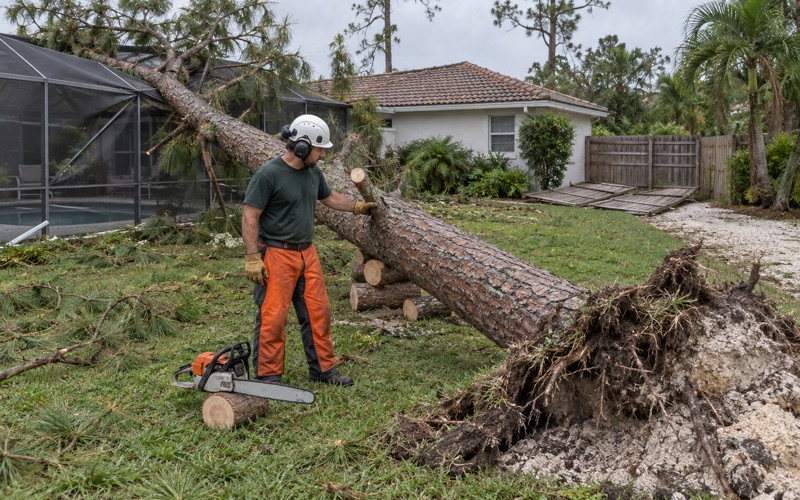
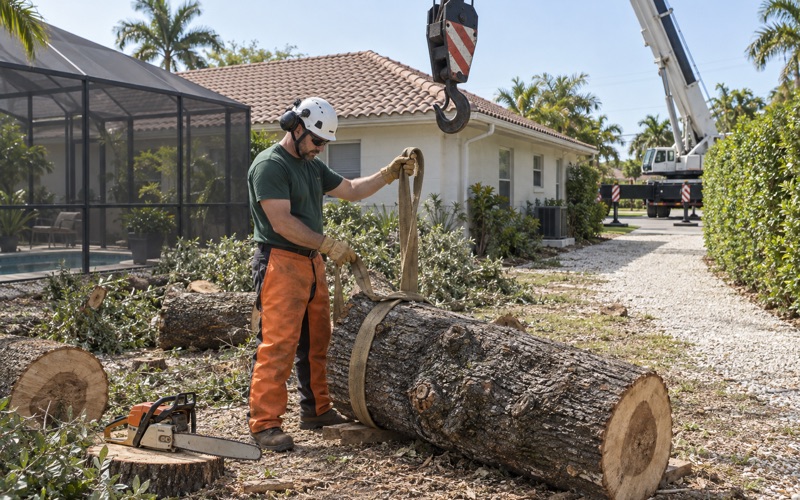
Access is sized to the property in the same spirit. A narrow-gate machine reaches a fenced back yard that no truck will ever enter, and a crane pick is the right call where the drop zone is a pool cage and a paver deck. Palms come down as palms, without a self-cleaning species left carrying a frond skirt full of weight, and without a pencil-pointing crown being treated as a pruning question when it is a health question.
What the curb will and will not take
Estero is served on the Lee County Solid Waste residential schedule, which allows one curbside yard waste collection each week. Material goes out in a container of 50 pounds or less, or tied into bundles no heavier than 50 pounds and no longer than 6 feet; up to 50 pounds of unbundled palm fronds may be set at the curb, and the county states outright that fencing and ornamental wood borders are not yard waste. A single mature oak exceeds that allowance many times over.
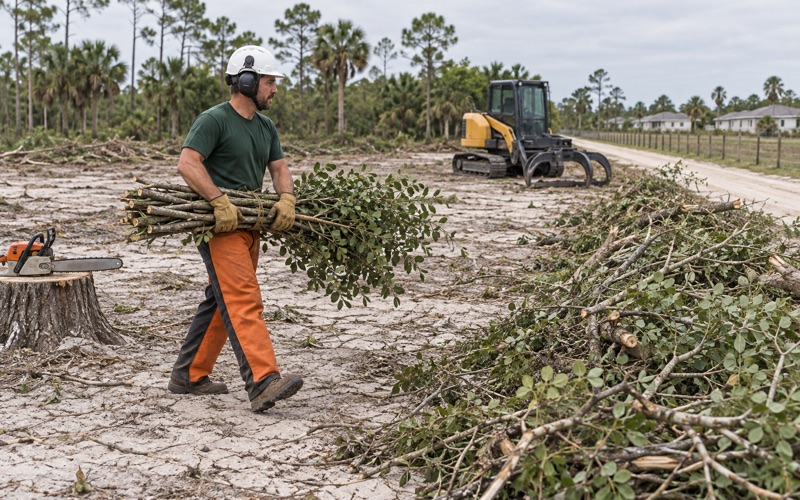
Removal debris therefore goes to the gate instead, where the Lee County horticultural rate for FY26 is $43.92 per ton with a $15 minimum, and that is the line we show you rather than folding it into a lump sum. For the 7,572 units here held for seasonal, recreational or occasional use, we send written findings and photographs so an inspection still means something when the owner is a few states away, and we book storm-season work before the season rather than scrambling into it afterward.
- 20+ Years on This Coast
- Written Estimate Before Any Cut
- No Topping, No Hurricane Cuts