Bonita Springs Tree Removal handles emergency tree removal and storm damage work in Bonita Springs, FL, with twenty-plus years on this coast, serving surrounding cities including Estero, Naples Park, Florida Gulf Coast University, Fort Myers Beach and Naples. After a storm the job is triage first and cutting second, and we say where you sit in the order rather than promising a time nobody can keep.
Most of what we do about storms happens before them. Canopy reduction, deadwood removal and hazard takedowns get booked in spring and early summer, so the pre-season list and the emergency list stay separate instead of every customer in the city competing for one crew in the week a system enters the Gulf.
When the wind does drop, the useful work is reading what changed. A lifted root plate, a cracked union, a hanging limb and a tree that took salt water over its roots are four different problems on four different clocks, and only one of them looks like an emergency from the driveway.
When a Tree Comes Down on Something
Trees on Roofs, Lanais and Pool Cages
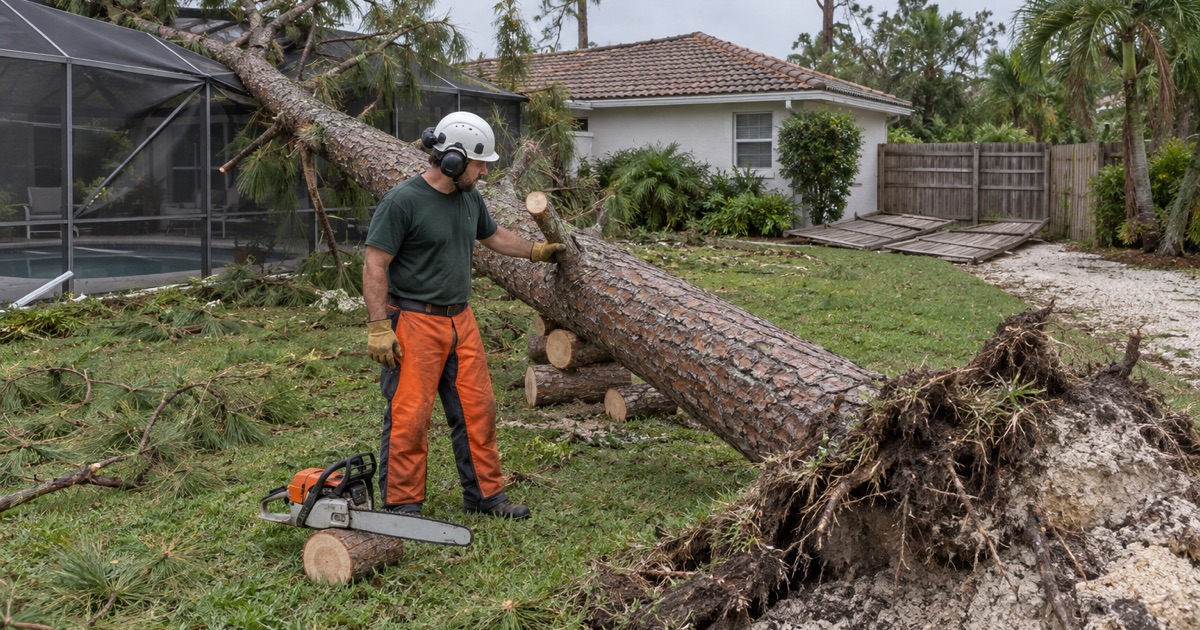
A tree lying on a structure is holding load, and the order in which it comes apart decides whether the damage stays where it is or gets worse. We rig and take weight off in sections rather than cutting the trunk and letting the rest drop, which is what turns a damaged truss into a collapsed one. Pool cages are their own problem here, since aluminum screen framing gives no support at all and the only safe route is often a crane pick over the top.
Power Lines and Who Goes First
Anything touching an energized conductor is a utility call, and it stays that way until the line is confirmed de-energized or the utility clears the site. Wet wood conducts, and a fallen conductor can energize a fence, a gate or standing water well away from the tree itself, which is why the safe distance is much larger than most people assume. We will take the tree apart afterward, and we will not be the ones who touch it first, whatever the hour.
Blocked Access, Driveways and Egress
A tree across the only way in or out ranks with a tree on a house, because it stops everybody else’s response as well as yours. Those jobs are usually a fast clear-and-return: enough cut and dragged to open the drive safely now, with the full removal and cleanup scheduled properly afterward. Saying which part is happening today and which part is happening next week is how a storm job stays a job rather than becoming an argument.
Reading the Damage After the Wind Drops
Lifted Root Plates and Fresh Mounds
The single most useful thing to look at on a leaning tree is the soil on the opposite side of the trunk. Fresh heaving there means the root plate has rotated and the anchorage has already partly failed, and that tree is not going to settle back. A long-standing lean with a top that has grown back toward vertical is a different reading entirely, and on sand with a shallow spodic layer the distinction matters more than the angle does.
Cracked Unions, Hangers and Wind-Loaded Limbs
After a blow the dangerous material is often still in the crown rather than on the ground. A limb torn part-way through a co-dominant union, a hanger caught in the canopy, and a branch that has been levered but not broken all sit there quietly until the next gust or the next person walks under them. We inspect the crown properly rather than clearing what fell and calling the property safe, because the second failure is the one that reaches somebody.
Salt Inundation and Delayed Mortality
Surge water standing over a root zone kills slowly and out of order, so a tree can hold green canopy for a season or two and then decline for no reason the owner can see. The federal report on Hurricane Ian records maximum inundation of eight to twelve feet above ground level in Estero, Bonita Beach, Bonita Springs and North Naples, with inland high water marks of five to seven feet. On lots inside that footprint we inspect for delayed decline rather than assuming a tree that leafed out survived.
Debris, Permits and What the County Will Take
Dead Is Free, Damaged Is a Permit
The City of Bonita Springs publishes a standing hurricane document, and the rule it sets is shorter than most people expect. If a code-required tree was destroyed or is dead, removal without a permit is authorized and the owner should document it for verification; if a required tree has been damaged but is not dead, a tree removal permit is required. That is the opposite of what most homeowners assume after a storm, and it is worth knowing before the saw comes out.
The Contract Clause on Debris Eligibility
County storm debris collection is not simply a matter of piling material at the right of way. Collier County’s eligibility turns on the contract itself, stating that a pile qualifies only where disposal is not included in the contractor’s scope of work or contract price, and that property owners may be asked to provide documentation showing it. We can write a drop-only line into a storm estimate for exactly that reason, so the paperwork matches what you intend to do with the pile.
Hauling, Gate Rates and Clean Loads
Where material does leave on our trailer it is weighed at the gate, and a clean horticultural load prices below a mixed one, which after a storm is harder than it sounds because fencing, screen framing and roofing debris end up tangled through everything. Keeping the loads separated is worth real money on a large clearance. The disposal rate goes on the estimate as its own line, so you can see what the wood costs to move rather than finding it folded into an emergency price.
- 20+ Years on This Coast
- Written Estimate Before Any Cut
- No Topping, No Hurricane Cuts