Bonita Springs Tree Removal has handled tree removal in Cypress Lake for more than twenty years, and two things about this community change how we quote the work. The first is that the ground under it is not natural soil, which changes how a stump grinder behaves and what a root plate is anchored in. The second is that whether you need a permit at all depends on the kind of home you own rather than on the tree you want gone.
Cypress Lake is unincorporated Lee County, so there is no city hall, no council and no municipal tree ordinance of its own to consult; the Lee County Board of County Commissioners is the only general-purpose government this place has. Every job we take starts with a written estimate, with hauling and disposal priced on their own line so you can see what moving the wood actually costs. That estimate is built from a site visit rather than a phone description, because on this ground a machine sized for a clean sandy lot can struggle two streets over.
Up to four feet of imported fill over a buried natural surface
The soil survey for Lee County maps the ground at the center of Cypress Lake as the Matlacha-Urban land complex, and Matlacha is not a natural profile at all. Its official series description gives the parent material as 20 to 48 inches of material produced by dredge and fill operations over sandy marine sediments, which is a technical way of saying somebody trucked this ground in. Underneath it sits the surface that was here before, preserved as a buried dark gray horizon at roughly 36 to 41 inches down.
Shell and rock fragments the whole depth of the cut
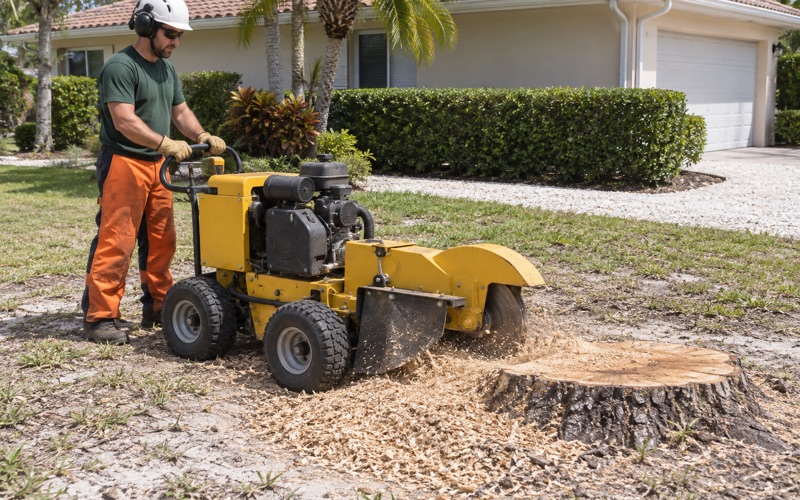
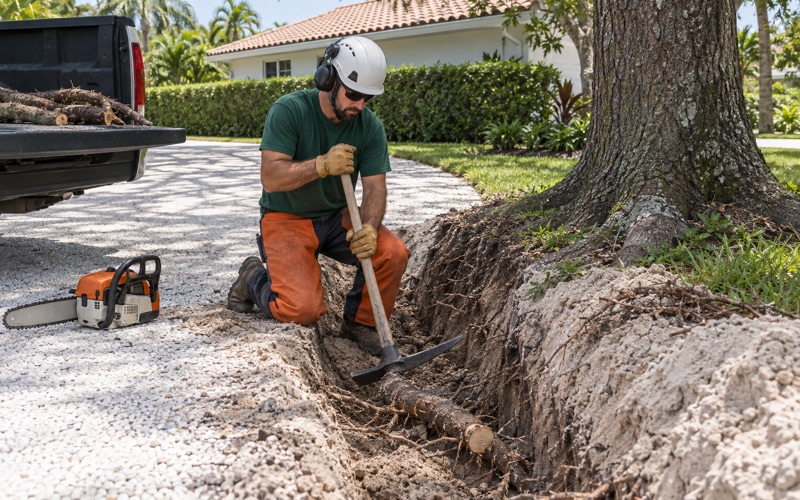
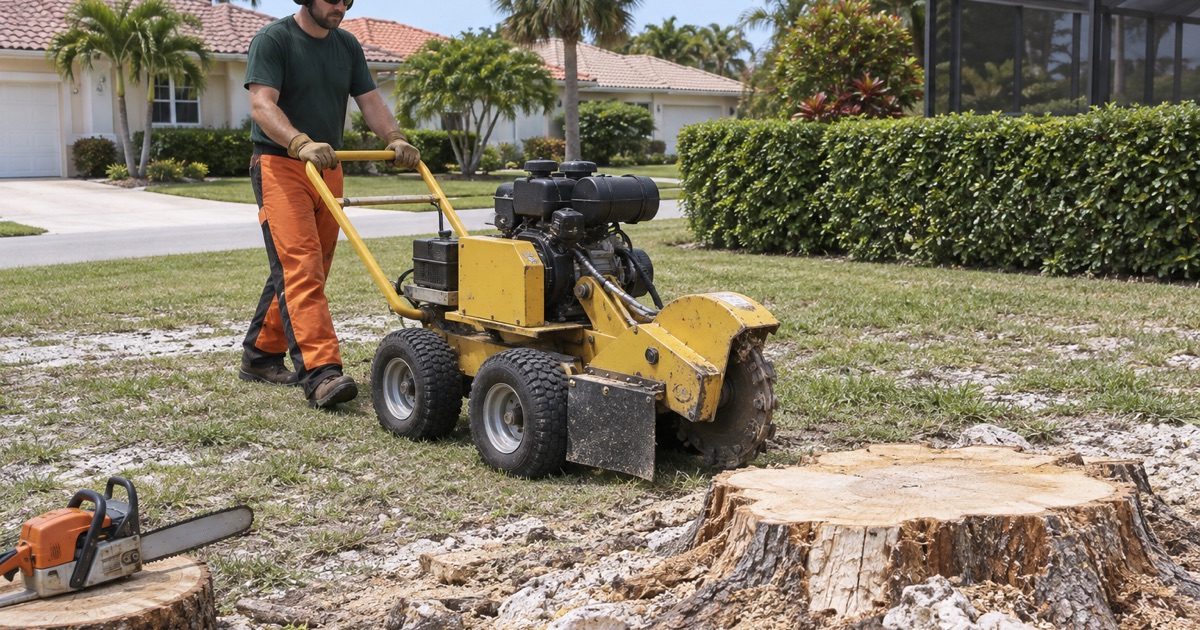
The fill is described as gravelly fine sand carrying shell and limestone fragments from the surface down through 36 inches, which is most of the working depth of a stump grinder. Teeth cutting through that are working in abrasive material rather than clean sand, and they dull faster and throw harder debris than the same machine would two counties inland. We price grinding here on what the ground actually is, and we tell you before we start whether a below-grade cut is going to take one pass or several.
Root plates developed in fill, not in native horizons
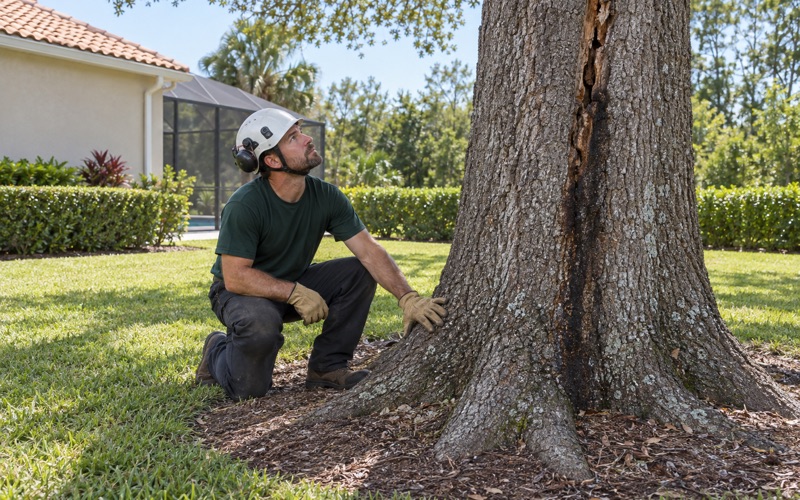
A tree growing in imported fill has built its root plate in trucked material rather than in the horizons a textbook assumes, and the seasonal high water table here sits inside that fill for part of the year, commonly at 24 to 36 inches below the surface for two to four months. Roots that meet the buried interface tend to turn and run rather than push through it. That is why we look at the root collar before quoting a removal, and why an air spade and a root collar excavation are sometimes the honest first step.
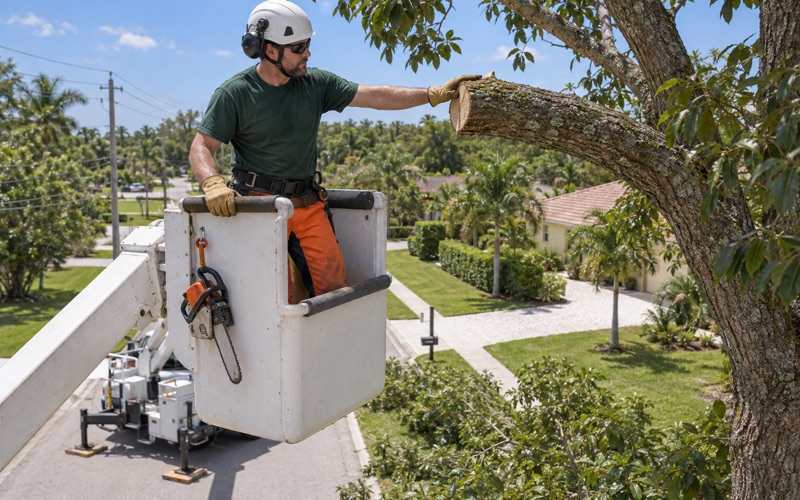
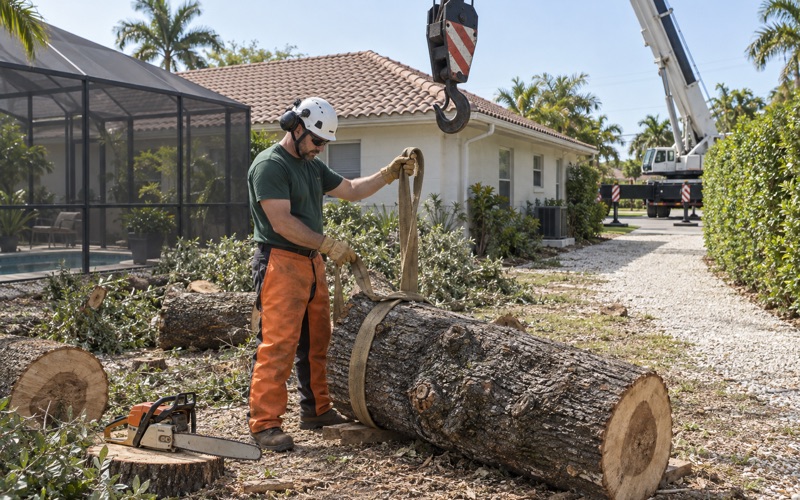
None of that shows on a spec sheet, and none of it is guesswork on our part. Twenty years of work along this coast, where the ground is sand and hardpan rather than soil over rock, is what teaches a crew to read a lot before choosing equipment for it. Access here is sized to the property as much as to the tree, from a narrow-gate machine that fits a fenced back yard to a crane pick over a pool cage.
Looking for tree-removal closer to Punta Rassa? See Tree-Removal in Punta Rassa.
Why an ordinary lot here sits outside the county’s own threshold
Lee County Community Development handles planning, zoning, permitting, plan review, inspections and code enforcement for unincorporated areas, and its vegetation removal permit is issued under the tree protection section of the Lee County Land Development Code, Chapter 14. The county’s own informational guide states that a permit is required for the removal of native vegetation and trees under that chapter, and then names exactly when. For single-family residential property, the trigger is clearing on five acres or more within unincorporated Lee County.
Cypress Lake is a built-out suburban community of a little under four square miles, and an ordinary residential lot here is a small fraction of an acre. The county’s own threshold is therefore never reached on a normal detached lot, which means the common vendor line that you need a permit to remove a tree in Lee County is simply wrong for the typical address in this community. Florida Statutes section 163.045 sits behind that as a state preemption for single-family detached homes, but here the county threshold answers the question first.
Checking which government you are actually under
A great many people here give their address as Fort Myers, because that is what the mail says. The incorporated City of Fort Myers is a separate government with its own code and its own yard waste rules, and none of it applies to an unincorporated address in this community. Before we quote anything that touches a permit, we confirm which jurisdiction the parcel actually sits in, because getting that wrong changes the rules, the forms and the office you are dealing with.
What we do instead of quoting a permit you do not need
We will not bill for a permit application that the county does not require, and we will say so on the estimate. Where a permit genuinely is required, applications go through the county’s eConnect Citizen Access Portal and vegetation questions are handled by Development Services staff, so there is a real office and a real process behind the answer. Working across Lee, Collier and Hendry counties keeps us honest about how differently these lines are drawn, because a rule that governs one address does not travel across a county boundary.
Attached and detached at near parity, and who signs when the ground is shared
The same county guide states that a vegetation removal permit is required when clearing trees from multi-family properties and common elements, and that is where this community turns the answer around. Of 9,380 housing units here, 2,049 are one-unit detached and 1,454 are one-unit attached, with owner-occupied detached at 1,520 and owner-occupied attached at 1,206 in the American Community Survey five-year estimates. Another 4,555 units sit in buildings of two or more. The permit question therefore turns on the structure and on who owns the ground, not on the tree.
In practice that produces two identical trees fifty feet apart with two different answers. One stands in a villa courtyard on a common element and needs a permit before it comes down; the other stands on a detached lot below the county’s acreage trigger and does not. We ask for the plat status and the association documents early, because the paperwork that governs the second tree is nothing like the paperwork that governs the first.
That near parity is the reason a single blanket answer fails here. A page or a vendor that tells every caller in this community the same thing about permits will be wrong for a large share of them, because attached units, multi-family parcels and association-held ground make up the majority of the housing stock. We would rather ask two questions up front than give one confident answer that turns out to apply to somebody else’s address.
Association covenants are a separate layer again
Florida Statutes section 163.045 binds a local government, not a private association, so a condominium or homeowners association covenant can still require its own approval on ground the county would leave alone. That is a signature question rather than a permit question, and it is worth settling before a crew is scheduled. We are used to working with boards and managers, and we put our findings in writing so the person who has to sign has something more than a verbal opinion in front of them.
Required preserve tracts are a third regime
Where a development carries a required preserve area, maintenance inside it falls under the county’s indigenous maintenance category, which covers manual management, protected species work and debris removal under an indigenous management plan per Land Development Code Chapter 10-701. Clearing storm-downed material inside such a tract is not yard work; it is activity inside a permitted management regime. We ask whether a tract is a required preserve before anyone treats it as ordinary clearing, because that single question changes the whole scope of the job.
Hazard findings, honest recommendations and where the wood goes
Where a permit is required, the county lists the conditions that support removal of a protected tree under Land Development Code Chapter 14, Article V, Section 14-412: a safety hazard to traffic or to public utility services, a hazard to existing buildings, obstruction of reasonable access, disease that endangers people or other trees, weakening by age, storm, fire or injury, and obstruction of the lawful use of the parcel. County staff inspect the site, verify the plan and review it for protected plants and animals, and the administrator may require a protected tree to be relocated on the same parcel instead of removed.
A written condition report before the saw starts
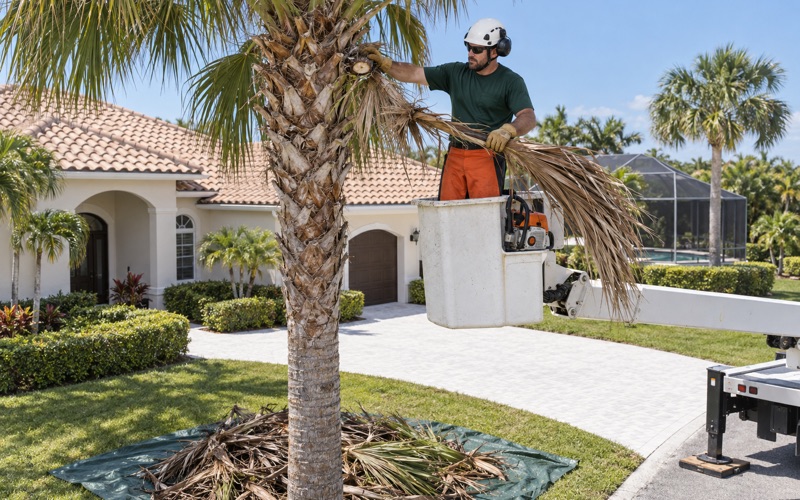
Whether or not a permit is in play, we put a condition report in writing on any tree we recommend taking down, so the reason is on the record before work begins. Our assessments follow the standard risk assessment practice the industry uses, and our pruning follows ANSI A300, which means no topping, no hat racking and no hurricane cuts on any tree or palm, whoever asks for them. Palms and hardwoods are different jobs, and a palm has no branch collar to cut back to.
Sometimes the honest recommendation is that the tree stays. A cable, a directional pruning plan or soil decompaction around a compacted root plate can buy years, and we will say so rather than sell a removal. Seasonal and second-home owners get the same findings in writing with photographs, so an inspection still means something when nobody is standing in the yard to hear it. Booking storm-season work before the season rather than scrambling after it is part of the same approach.
Where the debris actually goes
Unincorporated Lee County addresses get one curbside yard waste collection a week, limited to containers or securely tied bundles of 50 pounds or less and no longer than six feet, with up to 50 pounds of unbundled palm fronds allowed. Nothing in that allowance accommodates a removal. Debris from this work goes to the county’s horticultural waste stream at a gate rate of $43.92 per ton against $69.83 per ton for municipal solid waste, which is exactly why we price hauling and disposal as their own line rather than burying it in a lump sum.
- 20+ Years on This Coast
- Written Estimate Before Any Cut
- No Topping, No Hurricane Cuts