Bonita Springs Tree Removal offers crane assisted tree removal in Bonita Springs, FL, with twenty-plus years on this coast, serving surrounding cities including Estero, Naples Park, Florida Gulf Coast University, Fort Myers Beach and Naples. A crane is a tool for a specific kind of problem, not an upgrade we add to every quote, and the estimate says why one is on the job.
The problem it solves here is almost always geometry. Properties on this coast put large trees between villas, over pool cages, alongside seawalls and beneath service drops, and on those lots there is no clear drop zone and often no rigging path either.
The second reason is condition. A tree with basal decay, a compromised union or a palm with suspected upper-trunk rot is a tree nobody should be climbing, and a crane removes the need for anyone to be in it at all.
When a Crane Is the Right Tool
Trees Over Pool Cages, Lanais and Roofs
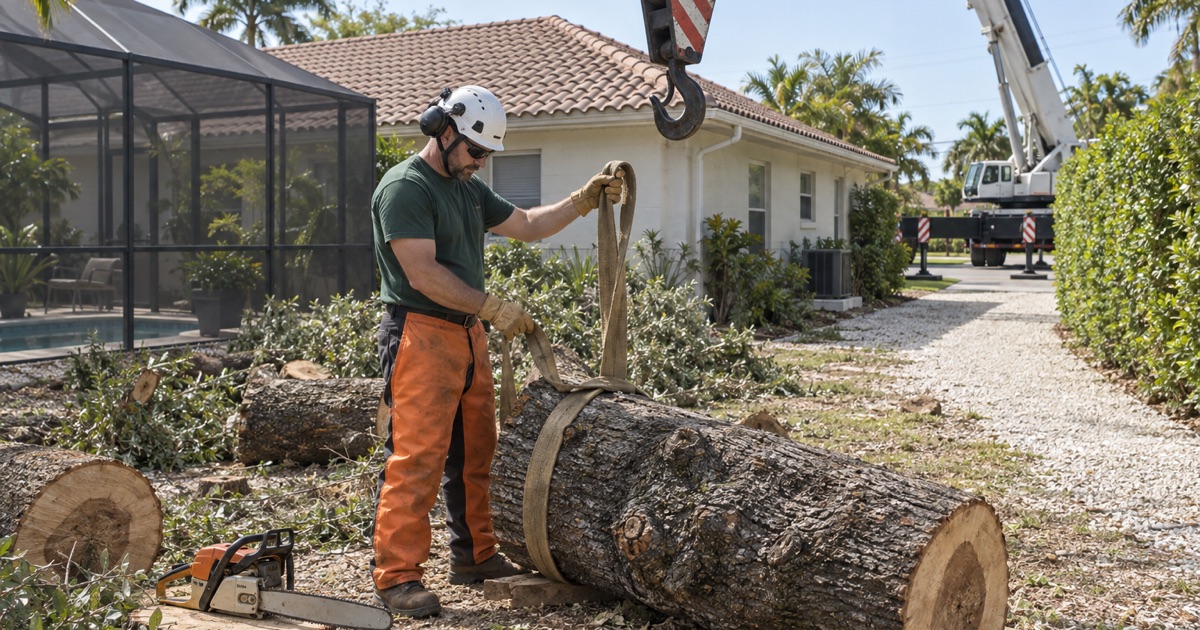
Screen enclosures are the classic case, because aluminum framing carries almost no load and a piece that brushes it does real damage. Lifting sections vertically out of the crown and carrying them clear on a controlled line keeps weight off the structure entirely, where conventional rigging would put every swing over the thing being protected. The same reasoning applies to tile roofs, which are unforgiving of even a light impact and expensive to match afterward.
No Drop Zone and No Rigging Path
On a tight lot there may be nowhere for a piece to land and no anchor point to rig from that does not swing over something breakable. That is the geometric argument for a pick: the load never travels through the tree or across the yard, it goes up and out. It is also why we assess the swing path and the set-down area at estimate time, since a crane with nowhere to place a section is only half a solution.
Trees Nobody Should Be Climbing
Basal decay, a cracked co-dominant union, storm damage part-way through a stem and suspected Thielaviopsis in the upper third of a palm trunk all point the same way. A climber’s safety depends on the wood holding, and where the wood is the defect that assumption fails. A crane lets a compromised tree be dismantled with nobody’s weight in it, which on those jobs is the entire justification regardless of what the hourly comparison says.
Planning a Pick
Setup, Outriggers and Ground Bearing
Outriggers concentrate a great deal of load into small areas, so where the machine stands matters as much as where the tree is. Mats spread that load, and on saturated sand or over an old irrigation run they are not optional. We identify the setup position, the protection going down and anything buried beneath it before the machine is booked, because moving a crane after it is set is slow and expensive.
Weight, Radius and the Load Chart
A crane’s capacity falls as the boom reaches further out, so the pick is planned around the weight of each section at the radius it will be lifted from. Green wood on this coast is heavy, and palm trunks are heavier than people expect, so sections are sized to the chart rather than to convenience. That planning is what keeps a pick uneventful, and it is the part of the job the customer never sees.
Access Routes, Gates and Overhead Lines
Getting the machine to the setup position is its own problem on properties built to the edge of the lot. Street width, gated entries, low branches over an access road and overhead service drops all constrain the route, and the last of those has a minimum approach distance that is not negotiable. We walk the route in advance so nobody arrives to find a machine that cannot reach the property it was booked for.
What It Costs, and What It Saves
Why the Hourly Rate Is Not the Whole Number
A crane costs more per hour than a climbing crew and typically finishes a large removal in a fraction of the time, with fewer crew hours, far less rigging and a much shorter period of disruption. On a big awkward tree the two totals often finish closer together than the hourly rates suggest. Where they do not, the difference is buying a controlled outcome on a job where the uncontrolled version has a real chance of hitting something expensive.
Damage Avoided Against Damage Repaired
The honest comparison is not crane against climber, it is crane against the cost of a screen enclosure, a tile roof section, a seawall cap or a neighbor’s lanai. Those repairs run well beyond the difference in method, and they arrive with an insurance conversation attached. We say plainly when we think a tree can be taken down conventionally, because recommending a crane on a job that does not need one is just as much a failure of judgment.
Storm Work, Palms and Scheduling
After a wide-area storm, crane availability tightens across the whole region at once, so a known hazard tree over a structure is much cheaper and much easier to deal with in spring than in September. Palms are frequently picked rather than climbed, particularly tall royals and Mexican fans wedged between buildings, and a palm trunk lifts cleanly as one piece. Booking that work before the season is the single most useful scheduling decision an owner here can make.
- 20+ Years on This Coast
- Written Estimate Before Any Cut
- No Topping, No Hurricane Cuts