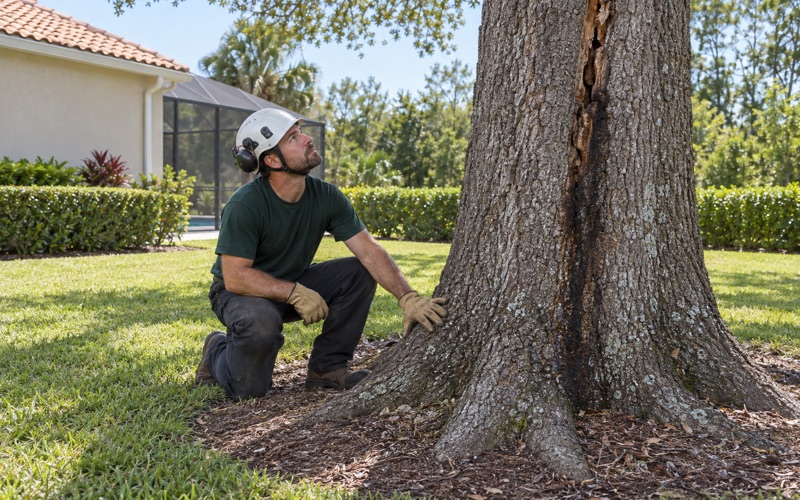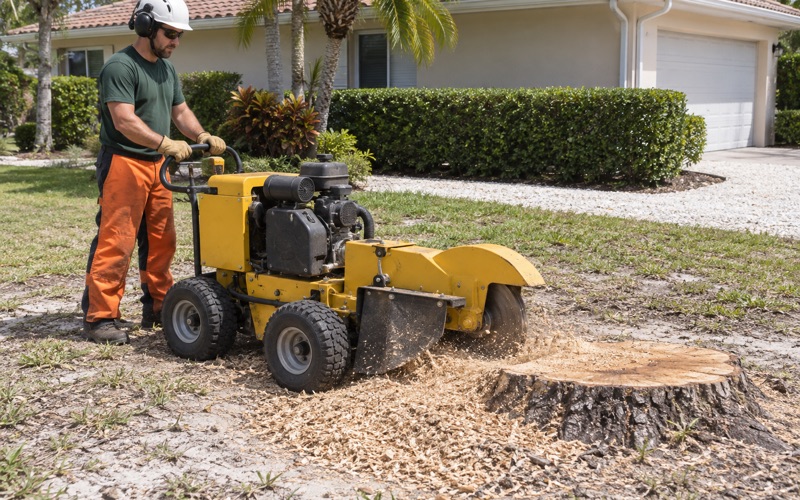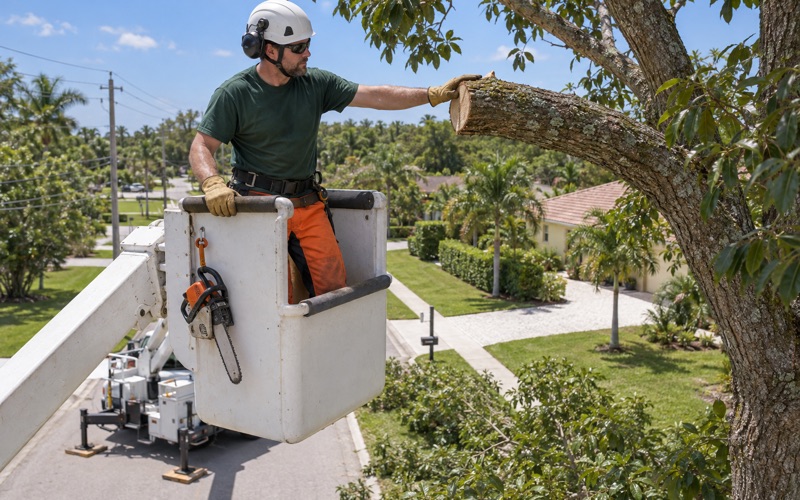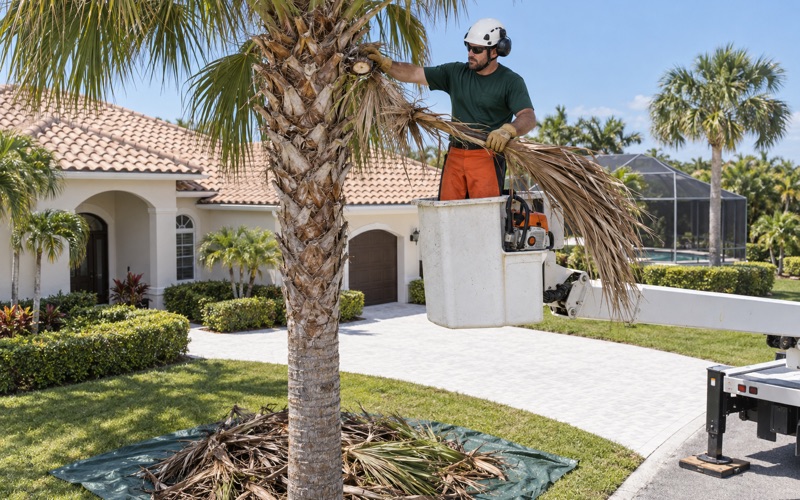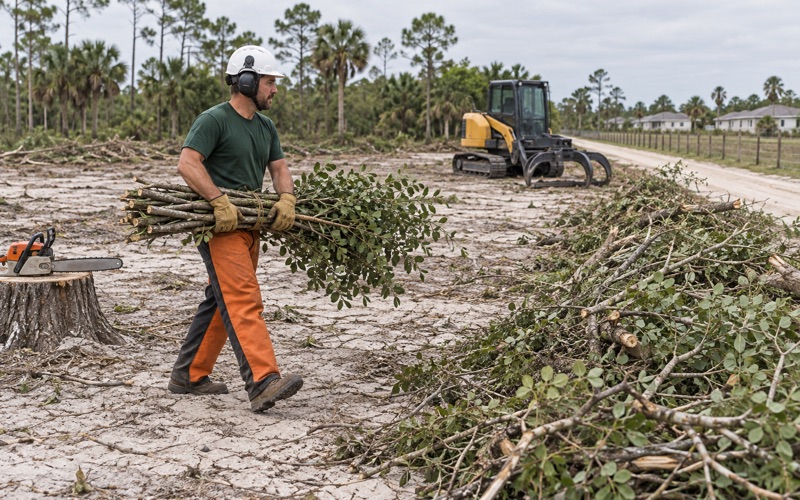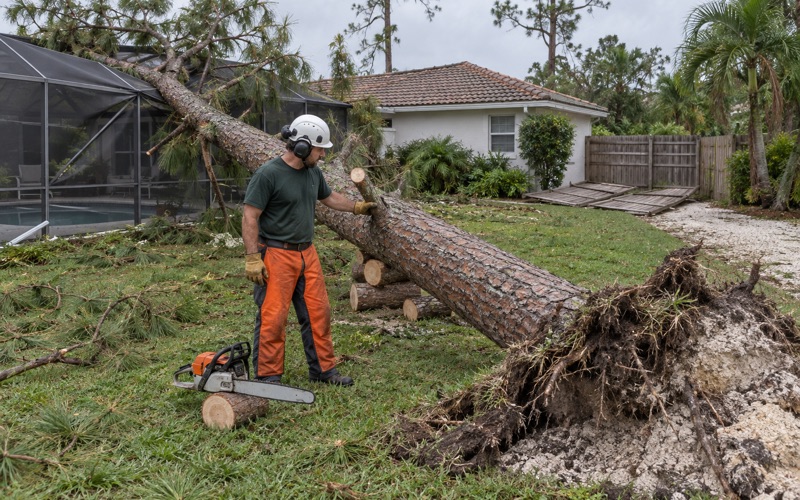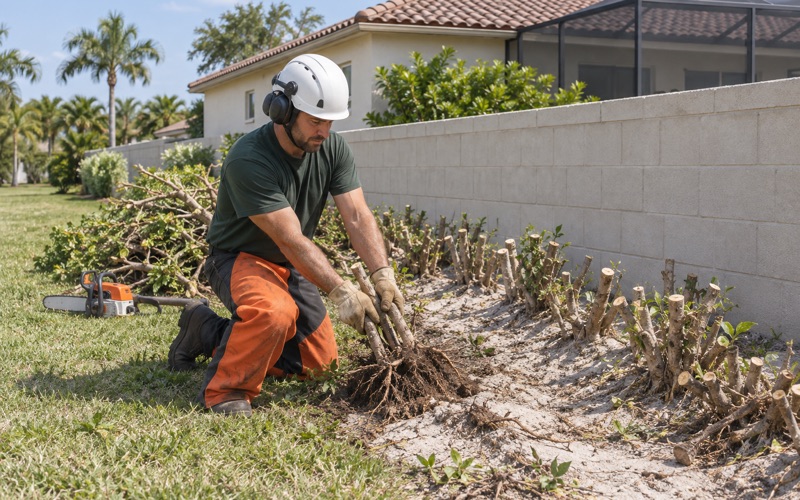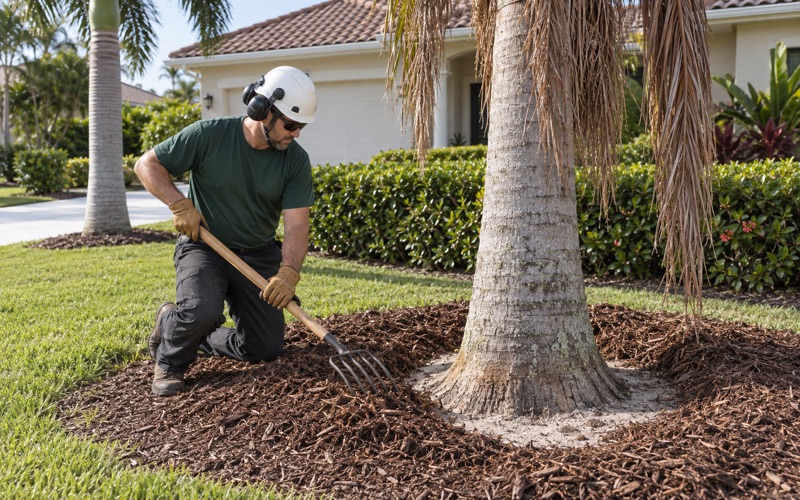
Bonita Springs Tree Removal handles tree removal in Captiva, and we have been doing this work on this coast for more than twenty years. We take down palms and hardwoods on island lots, we prune what does not need taking down, and we put the reasoning in writing before a saw touches anything. Every job here starts with a written estimate that prices hauling and disposal on their own line, because on this island moving the wood is a real share of the cost.
What makes a Captiva removal different from the same job on the mainland is not the tree. It is the paperwork that stands in front of it, the agencies that have to be named correctly, and the fact that everything cut has to be carried off the island by road. We work Lee, Collier and Hendry counties and we keep the rule differences straight across those lines, which on a barrier island address is most of the job before the climb.
A barrier island lot has no acreage floor before the county wants a plan
Lee County Community Development publishes a Vegetation Permit Submittal Requirements sheet, dated May 14, 2021, that sets out what a clearing application has to contain. One sentence on it names three triggers together: a single family lot of five acres or more in unincorporated Lee County, a lot on a barrier island, or a lot on Pine Island of two acres or more. Read the middle clause by itself and the point lands. Everywhere else the county states a threshold in acres; on a barrier island it states none at all.
Captiva is a barrier island in the Gulf of Mexico between Blind Pass and Redfish Pass, so that middle clause is this address. What it means in practice is that a detailed site plan may be asked for on a lot far smaller than the mainland five-acre figure, showing the shape and dimensions of the lot or a boundary survey and the location of existing or proposed structures and improvements. We build that package before we quote the removal, not after, and if the applicant is not the owner the county also wants a letter of authorization.
The ordinary single-family exemption is off the table here
Lee County’s tree code carries an exemption letting a homeowner take five trees or less a year from a single family residential lot with a house already on it, on lots of five acres or less. Section 14-377, the exemptions section, is indexed as excluding a list of coastal islands from those single-family exemptions, and Captiva Island is named on that list. We treat that island list as the working rule rather than a quotation, because the county’s online code library did not answer when we checked, but the permit form states the same rule in the language of paperwork.
What the arborist documentation route can and cannot do
Florida Statutes section 163.045 bars a local government from requiring a notice, application, approval, permit, fee or mitigation to prune or remove a tree on residential property when the owner holds signed documentation from an ISA-certified arborist or a Florida licensed landscape architect that the tree poses an unacceptable risk. That standard is the ISA Best Management Practices Tree Risk Assessment Second Edition 2017 definition: removal has to be the only practical way to get the risk below moderate. Subsection three bars a replanting requirement and subsection four leaves mangroves out.
The catch on Captiva is what the statute means by residential property: a single-family, detached building on a lot actively used for single-family residential purposes. American Community Survey five-year estimates count 22 owner-occupied one-unit detached units on this island against 1,176 total housing units, so that definition reaches a small minority of the parcels here. A condominium, a townhome, an attached dwelling, a vacant platted lot or a commercial property gets none of it, and the honest answer for most Captiva addresses is that the permit route is the route.
Looking for tree-removal closer to Alva? See Tree-Removal in Alva.
Which governments actually reach a Captiva address
Captiva is an unincorporated census designated place in Lee County. There is no city hall here, no mayor, no council, no municipal code and no municipal permit counter, so any contractor who tells you he will pull a Captiva permit is describing an office that does not exist. Lee County’s Land Development Code is the code that reaches this address, Lee County Community Development is the department that issues the vegetation permit, and the Lee County Board of County Commissioners is the legislative body behind both.
Two elected, taxing bodies do exist on the island, and neither of them is a general purpose government. The Captiva Erosion Prevention District is an independent special beach and shore preservation district under Chapter 161, Florida Statutes, codified by Chapter 2000-399, Laws of Florida, with its own elected board and the power to levy and assess an ad valorem tax. Its boundaries run all of Captiva Island from the centerline of Blind Pass to the centerline of Redfish Pass and extend 300 feet into the Gulf of Mexico and Pine Island Sound.
That district is a beach and shore authority rather than a tree authority, and we do not pretend otherwise. What its boundary description is useful for is the reminder that the Gulf and Sound edge of a Captiva parcel sits inside more than one jurisdiction at once, which is worth knowing before a crane sets up near the water. The other body is the Captiva Island Fire Control District, created by the Florida legislature in 1955 as an independent state taxing authority and governed by three elected fire board commissioners serving four-year terms.
The Captiva Community Panel is the body most often mistaken for a local government. The county commission tasked it with coordinating community planning and proposing goals, objectives, policies and land development regulations for Captiva, and it takes that seriously, but it is advisory: it adopts no ordinance and issues no permit. We name the right counter on the estimate, and on an island where law enforcement is the Lee County Sheriff and the utilities are Lee County Electric Cooperative and the Island Water Association, naming the right counter saves a week.
Mangroves here are permitted by the state, not by anyone on the island
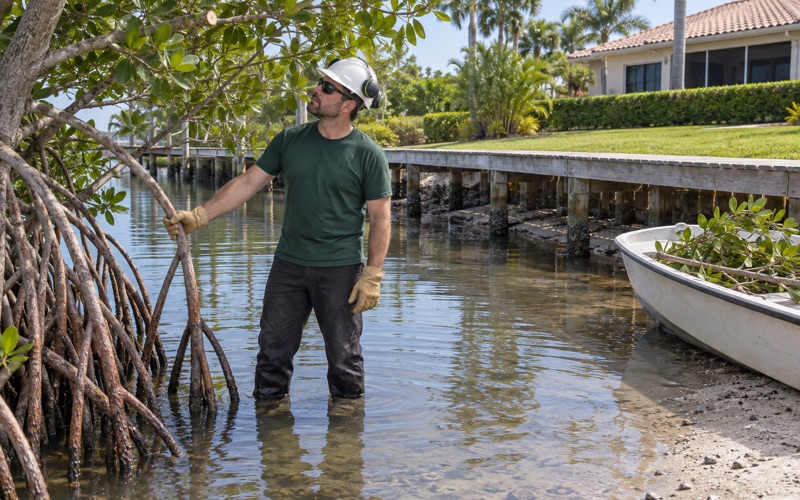
The Florida Department of Environmental Protection publishes the list of local governments holding delegated mangrove trimming authority, and it names seven: Miami-Dade County, Broward County, Hillsborough County, Pinellas County, the Town of Jupiter Island, the City of Sanibel and Sarasota County. Captiva is not on that list and neither is Lee County. A mangrove at a Captiva address is therefore governed by the Mangrove Trimming and Preservation Act at sections 403.9321 through 403.9333 and permitted, where a permit is required, by the Department’s South District office.
That distinction matters because the delegation held by the incorporated city across Blind Pass covers its own jurisdiction and stops at its own boundary. Sending a Captiva mangrove question to the wrong side of that pass means the wrong agency, a wasted application and a delay in the middle of a job that is usually being run for an owner who is not in the state. We keep the two straight and we put the answer in writing on any estimate that involves shoreline vegetation.
The statute itself is specific about what an owner may do without a permit. The exemption covers a riparian fringe no more than 10 feet high before trimming and never cut below 6 feet on a shoreline of 150 feet or less; a professional mangrove trimmer raises that pretrimmed height to 24 feet; anything 16 feet or over is staged at no more than 25 percent of foliage a year; first-time trimming of red mangrove requires 10 days written notice; and herbicides used to defoliate a mangrove are prohibited outright.
Over 150 feet of shoreline, no more than 65 percent may be trimmed under the exemption, and white, red and black mangrove are all protected species. We do not treat any of that as a reason to avoid the work. We treat it as the reason a shoreline job on this island gets scoped, written down and, where the numbers put it outside the exemption, permitted through the state before a crew is scheduled.
Sand, shell and a water table close to grade
The soil series named for this island has its type location in Lee County, and the USDA description of it explains more about the work here than any weather note could. Captiva soils are poorly drained with very rapid permeability, formed in thick deposits of sand and shell fragments on broad low flat areas near the Gulf coast, with slopes under 1 percent. The water table sits within 10 inches of the surface for one to two months during summer rains and within 10 to 40 inches for roughly ten months of the year.
What that does to a machine
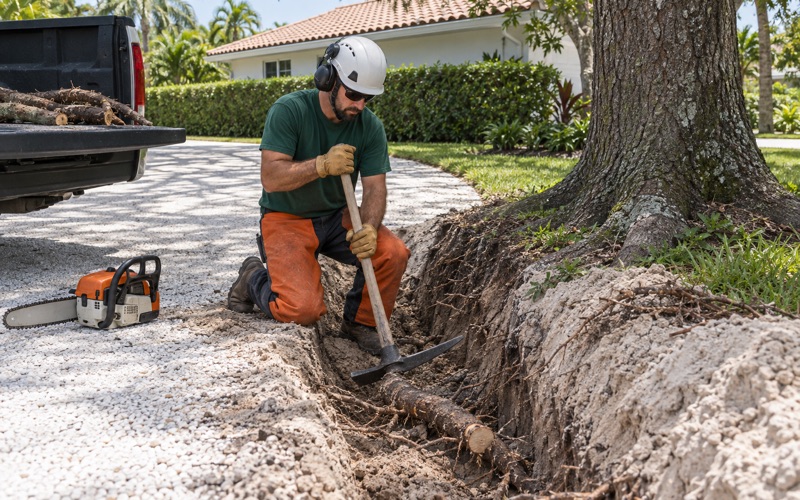
On the mainland side of our territory the constraint is what a stump grinder hits going down: Myakka hardpan, or limestone within reach of the wheel. Here there is neither. Nothing stops a below-grade cut except water, so the hole fills, the spoil is a slurry of sand and shell rather than a pile of chips, and the backfill has to be planned as part of the job instead of discovered at the end of it.
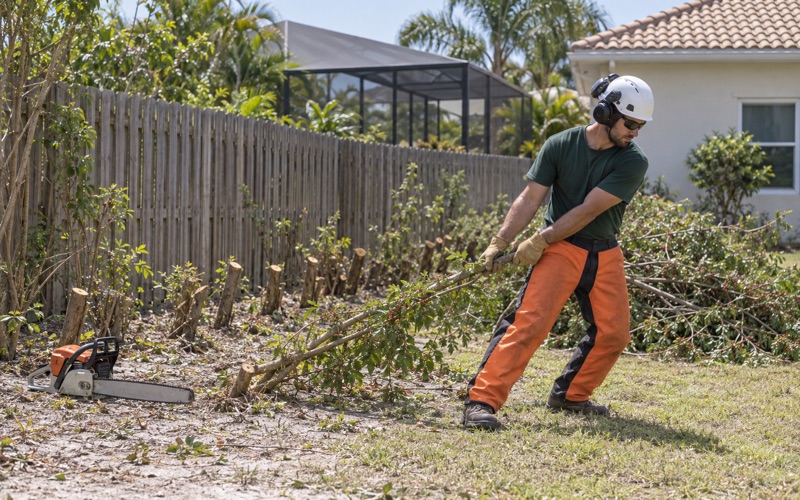
The same ground governs how a tree fails. A root plate in pure sand and shell, with the water table that close to grade, holds differently than one in soil over rock, which is why we look at the root collar and the lean before we look at the crown, and why we will say plainly when a tree does not need to come down. No topping, no hat racking and no hurricane cuts leave this crew, on a palm or a hardwood, whoever asks for them.
Every load leaves the long way
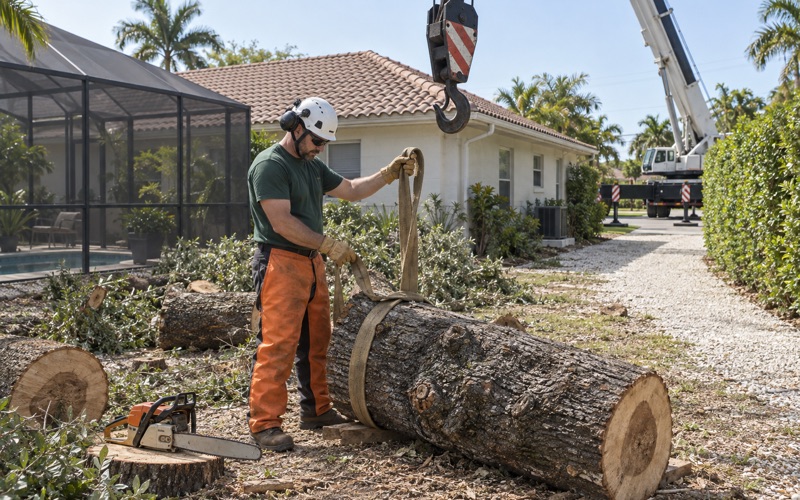
There is no bridge from Captiva to the mainland. Cut material travels the length of Captiva Drive, across Blind Pass, down Sanibel-Captiva Road and Periwinkle Way and out over the causeway, and no disposal, transfer or horticulture gate of any kind exists on either island. Lee County’s horticultural material rate is $43.92 per ton with a $15 minimum, and the causeway toll is collected inbound only, at $6.00 for two axles on a transponder with a prepaid account and $3.00 for each additional axle.
That is why hauling and disposal appear as their own line on every estimate we write here. An owner should be able to see what the wood costs to move separately from what the removal costs, particularly on this island, where most homes are seasonal and the person paying is often reading the invoice from another state. We also photograph what we find and put the findings in writing, so an inspection still means something when nobody is standing in the yard.
The census counted 318 residents here in 2020, down from 583 in 2010, and 70.5 percent of the housing units are for seasonal, recreational or occasional use. A place with almost no year-round population is a place where a leaning tree can stand unreported for months, which is the argument for booking storm-season work before the season rather than scrambling after it. The National Hurricane Center’s report on Hurricane Ian puts its landfall near Cayo Costa, immediately north of Redfish Pass, at 130 knots on September 28, 2022; this island sits directly south of that point.
- 20+ Years on This Coast
- Written Estimate Before Any Cut
- No Topping, No Hurricane Cuts