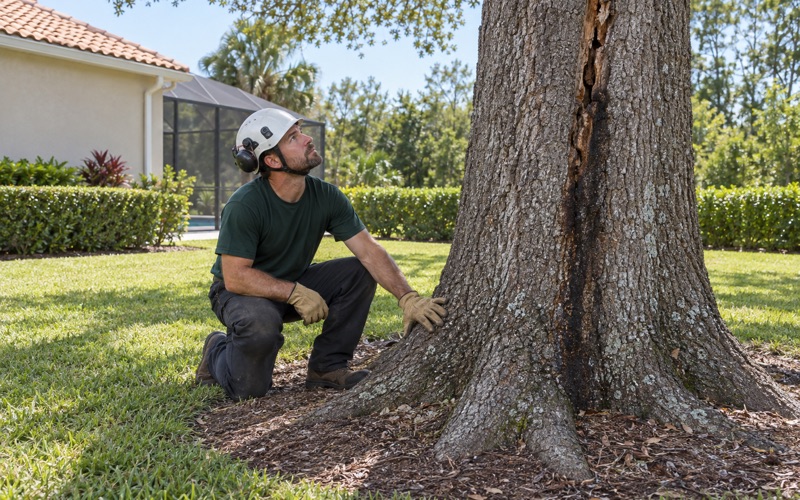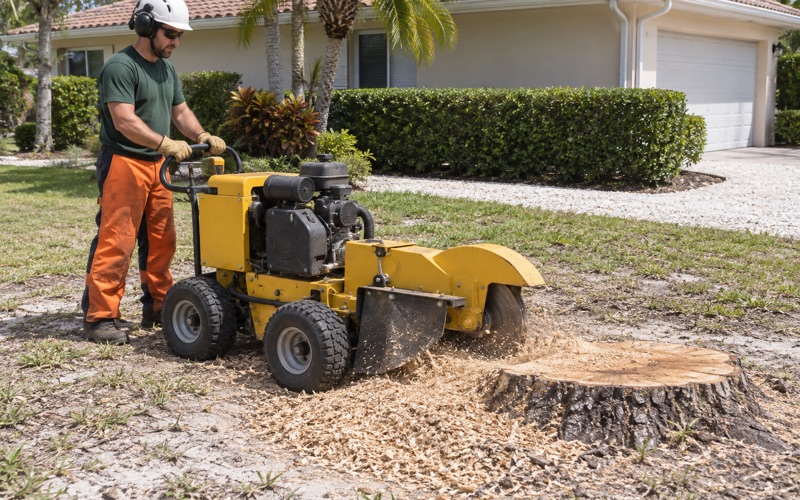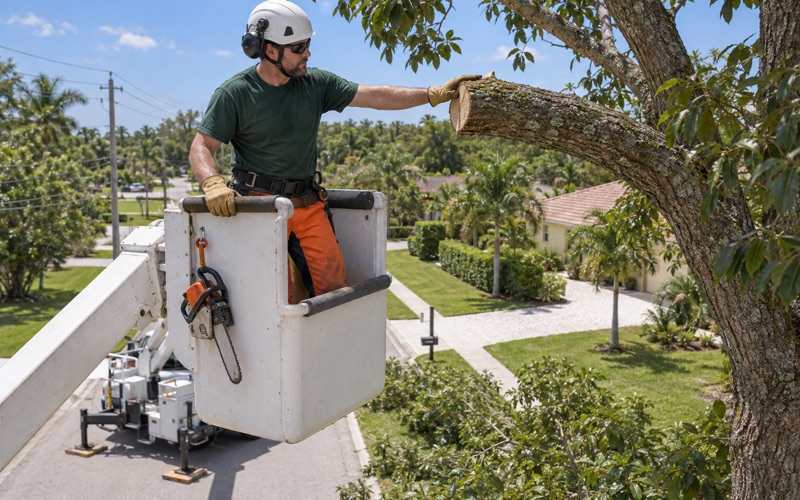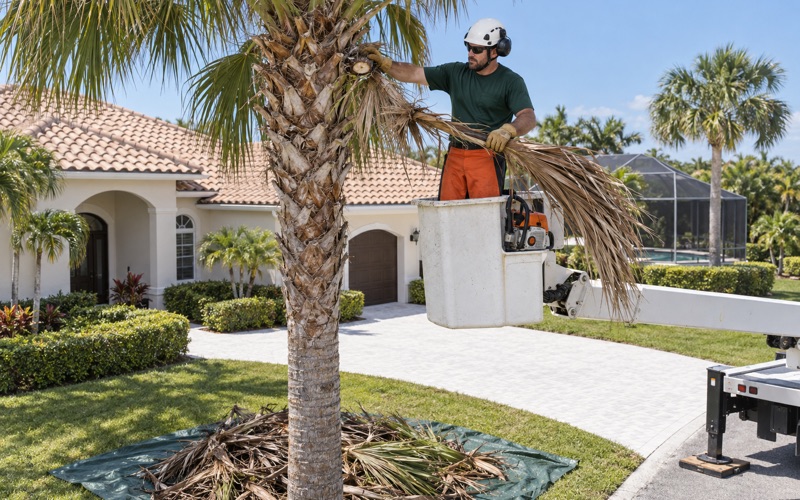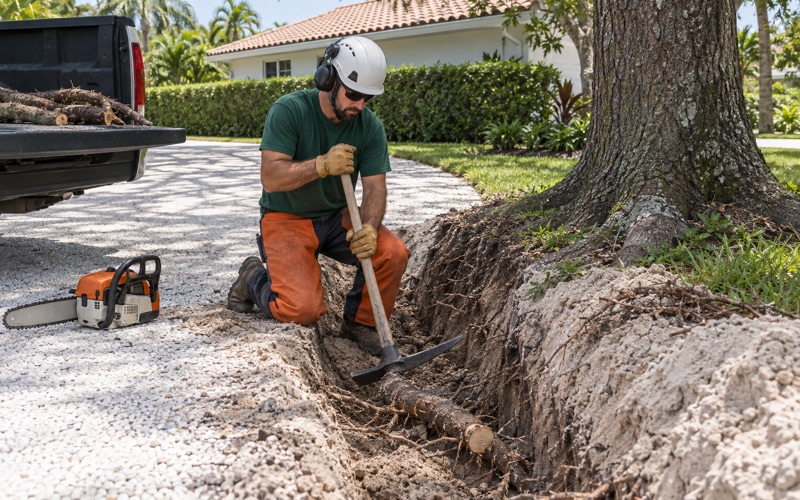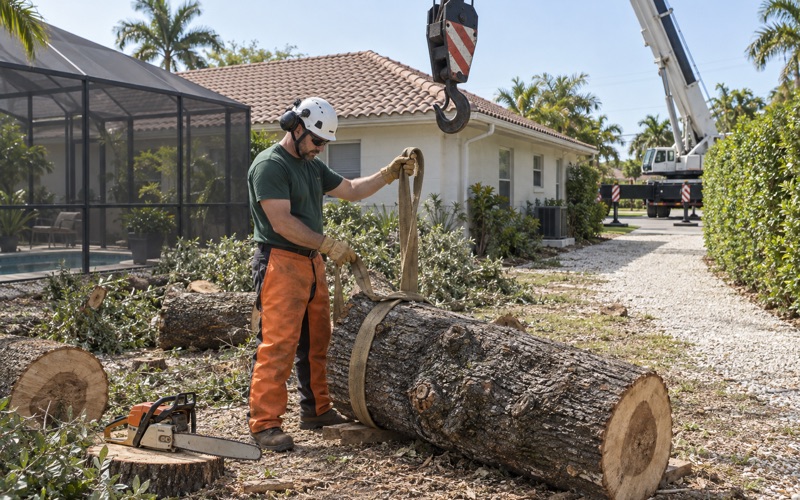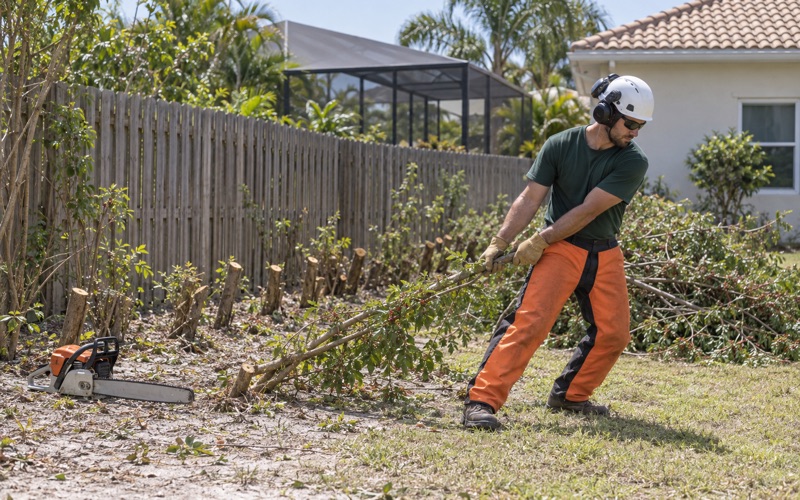
Bonita Springs Tree Removal handles tree-removal in Cape Coral with crews who have worked this coast for more than twenty years. We quote in writing before anything is cut, and hauling and disposal appear as their own line so the cost of moving the wood is never buried in the price of the felling. If a tree does not need to come down, we say so, and we put the reason in a written condition report. Palms and hardwoods are quoted as the separate jobs they are, because a palm carries no branch collar to cut back to.
Most of the work we are called to here sits on a canal lot, and that changes the sequence more than it changes the rigging. Before we price a removal we establish what the ground under the pad actually is, whether a burrow sits anywhere a truck or a chip pile would go, and whether the seawall is going to be touched. Those three answers decide the job. The saw work is the last part to be planned, not the first.
Ground that was dredged into place
Cape Coral was platted rather than settled. Leonard and Jack Rosen flew over the peninsula known as Redfish Point in 1957, bought a 103-square-mile tract with a small group of partners, and formed the Gulf American Land Corporation to build and pre-sell it. By 1963 there were 80 miles of road and 160 miles of canals. The canals were dug and the spoil became the buildable ground: the same dredging that opened the waterways raised the house pads above the natural floodplain, so the water and the yard came from one cut.
What the soil survey calls this fill
That fill has a name, and it was defined here. The United States Department of Agriculture established the Matlacha series in Lee County in 1982, with its type location about 0.7 mile east of Del Prado Boulevard and about 0.3 mile north of Veterans, both Cape Coral roads. The series is classed as sandy, siliceous, hyperthermic Anthroportic Udorthents and formed in 20 to 48 inches of material produced by dredge and fill operations over sandy marine sediments. It is somewhat poorly drained, with a water table at 18 to 42 inches, and carries shell fragments and pieces of limestone through the fill.
Why two lots on one street behave differently
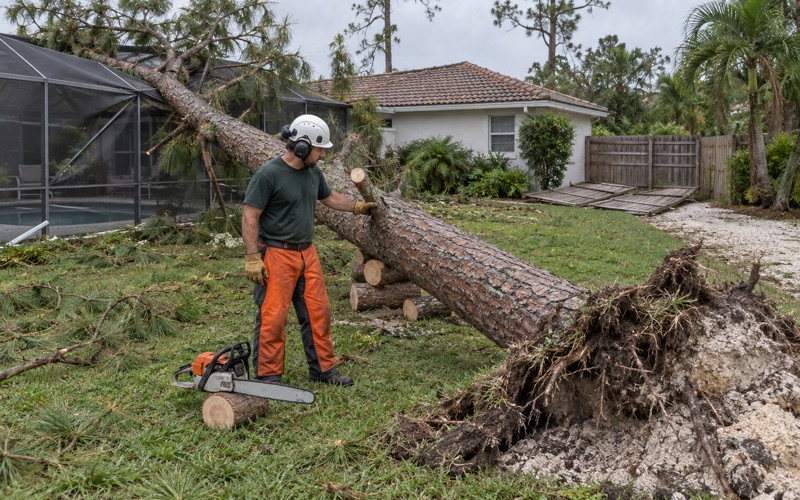
A crew grinding on that ground is working through placed canal spoil rather than an intact natural profile, and the shell and limestone in it are hard on grinder teeth. Fill depth varies with where the spoil landed, and the series description itself notes that water table depth varies depending on fill material and artificial drainage. Root plates are correspondingly shallow and the anchoring layer is inconsistent from lot to lot, which is why two adjacent properties on the same street can behave differently under the same wind. We read the root collar before the crown, because a flare buried in fill hides what the tree is standing on.
Where the natural flatwoods profile survives instead, the state soil applies and the numbers change. Myakka fine sand puts a spodic hardpan starting at 20 inches below the surface, is poorly drained, and holds a water table under 18 inches for one to four months in most years. Grinder depth and hardpan depth are the same number on that ground, which is a different quote from grinding fill, and we establish which one we are on before the machine is booked.
Looking for tree-removal closer to North Fort Myers? See Tree-Removal Services in North Fort Myers.
The permits that actually stop a job here
Florida Statutes section 163.045 applies here as it does everywhere in the state: for a single-family detached home on a lot in active residential use, no local notice, permit, fee or mitigation may be required for pruning or removal where the owner holds signed documentation from an arborist certified by the International Society of Arboriculture, or from a Florida licensed landscape architect, that the tree poses an unacceptable risk. No replanting can be required either. What the statute preempts is a local government, not a private covenant, a marine permit, a wildlife buffer or a nest zone, and in Cape Coral those are the gates that actually bind.
Florida issues no state tree or arborist contractor license and bars a city from licensing the trade, so the credential that matters here is certification with the International Society of Arboriculture plus verifiable general liability and workers’ compensation coverage. We work to ANSI A300 and assess risk against the second edition of the ISA Best Management Practices for Tree Risk Assessment, we do not top, hat rack or hurricane cut anything, and we will tell you when a cable or a pruning cycle is the honest answer instead of a removal.
The burrowing owl and gopher tortoise affidavit
Ground disturbance in Cape Coral comes with a wildlife affidavit, and it is the single most distinctive operational fact about working here. The city’s Burrowing Owl and Gopher Tortoise Affidavit requires the applicant to certify that within the last 30 days he has inspected the property and all vacant properties near the jobsite where he or his subcontractors may drive vehicles or place construction material. Burrows on the property, on adjacent property, or in the abutting city rights-of-way all have to be reported, including burrows that are not currently being used by owls.
The buffers are exact and they go in before anything moves. A burrowing owl burrow takes a protection zone with a radius of 33 feet during the nesting season from February 15 to July 10, and a minimum of 10 feet outside it; a gopher tortoise burrow takes a radius of 25 feet year-round under Ordinance 20-19. Every burrow is staked and roped to those dimensions, and no activity, materials, fill, equipment or parking is allowed inside them. A 33-foot no-equipment radius on the vacant lot next door reshapes a drop zone, and failure to maintain a buffer brings a stop work order on the site, so we stake before we start.
Eagle nest management zones
Bald eagles can stop tree work here under a city ordinance rather than only under federal law. Chapter 23, Article I of the Code of Ordinances, adopted by Ordinance 165-06 in November 2006, creates an Eagle Nest Management Zone: a circular area with the active nest at the center and a radius of 1,100 feet, or an irregular area of roughly equivalent acreage. During the nesting period, defined as October 1 to May 15 for most bald eagles, all construction and development activities inside that zone are prohibited, tree trimming and tree cutting named among them, along with lot mowing on vacant lots.
The chapter adds a personal distance rule as well: no person may be within 150 feet of the base of any tree occupied by an eagle or an eagle’s nest during nesting season, or beyond the edge of the nearest street to the tree, whichever distance is greater. Every nest is presumed active until the city determines it abandoned. That window runs seven and a half months and covers most of the dry-season work season, which is one reason we ask about nests when a job is booked rather than when the crew arrives.
Canal lots, seawalls and marine improvement permits
A tree on a seawall or a canal bank is a different job from a tree in a front yard, and the difference is permitting rather than rigging. A seawall repair or replacement here is a Marine Improvement permit through the city’s Development Services Department, and it requires a site plan locating the seawall and showing its length, site-specific engineering wet signed and sealed by a Florida Registered Professional Engineer, and a notarized burrowing owl and gopher tortoise affidavit. Before the first inspection the file also needs approval from the Department of Environmental Protection, or SAJ-91, except for freshwater. The repair permit fee is $180.00 and the permit expires in six months.
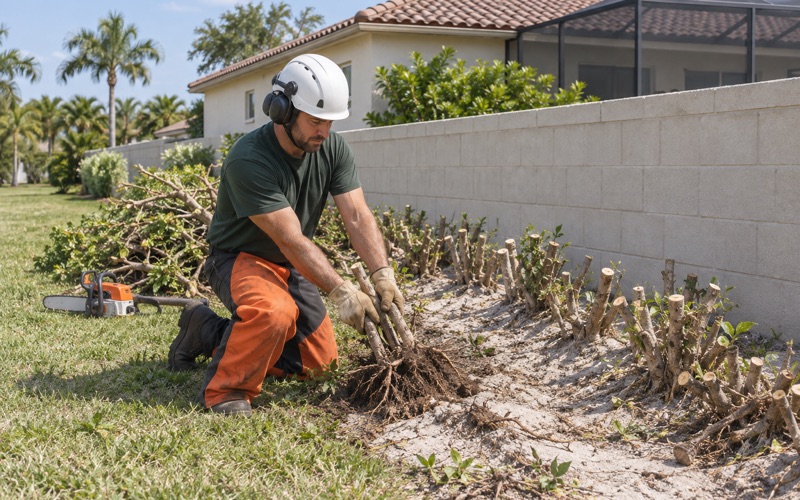
That matters for tree work because root work, grinding or equipment set-up that disturbs a wall or its backfill stops being a tree job on its own terms and becomes engineered marine work with a water-quality gate on top. The city’s minimum seawall specifications require an approved floating turbidity screen totally enclosing the site during all clearing, excavating, jetting and backfilling, held in place for at least 24 hours after work ceases or until turbidity is within 20 NTU of the pre-construction level. We establish before quoting whether the wall is going to be touched, because the answer changes who has to sign the drawings.
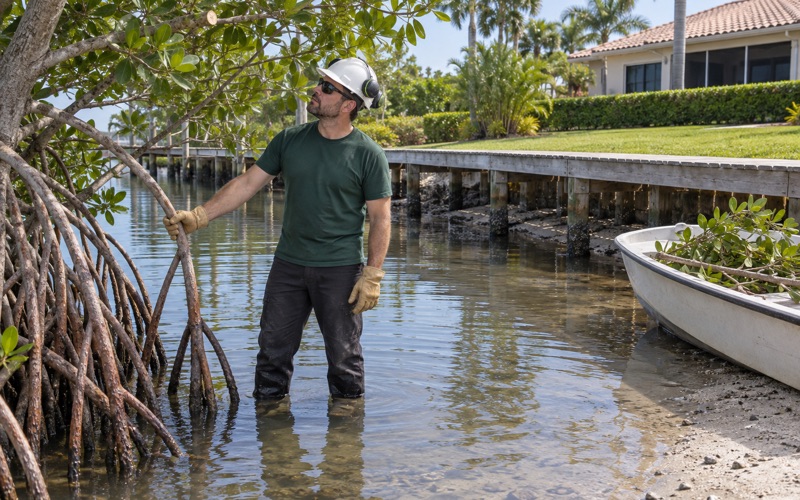
Mangroves on saltwater frontage are a separate authority again. They are protected by the state under the Mangrove Trimming and Preservation Act, Cape Coral holds no delegated mangrove authority, and the permit runs through the South District office of the Department of Environmental Protection. The risk-documentation exemption in Florida Statutes section 163.045 expressly excludes mangroves, so an arborist letter does not reach them, and trimming that needs doing is work for a professional mangrove trimmer rather than a general crew. We say so at the estimate rather than at the water’s edge.
What the code counts as a tree, and where the debris goes
The city’s residential landscape rules define the vocabulary a quote here has to use. Section 5.2 of the Land Use and Development Regulations defines a heritage tree as a Florida native canopy tree with a 20-inch caliper DBH or larger, measures the caliper of a tree as the average of the largest diameter and the one perpendicular to it, taken 12 inches above the ground, and measures a palm at the widest part of the trunk between 1 foot and 3 feet up. The code also defines a palm as a self-supporting, fibrous-stemmed monocotyledon of the family Arecaceae, which is to say it separates palms from trees the same way our crews do.
Trees required after December 2009
Those rules apply to all new single-family and duplex home sites permitted after December 1, 2009, and they set what has to stand on the lot afterward. Table 3 gives four options: three canopy trees; two canopy trees and three palms; two canopy trees and two accent trees; or one canopy tree, two accent trees and three palms. At least 50 percent of required canopy and accent trees must be Florida native, Category I invasive exotics cannot be counted toward the requirement, and where a septic tank sits between the house and the street a tree has to stand at least 6 feet clear of the tank or its drain field.
City Code 9-18 and where the debris goes
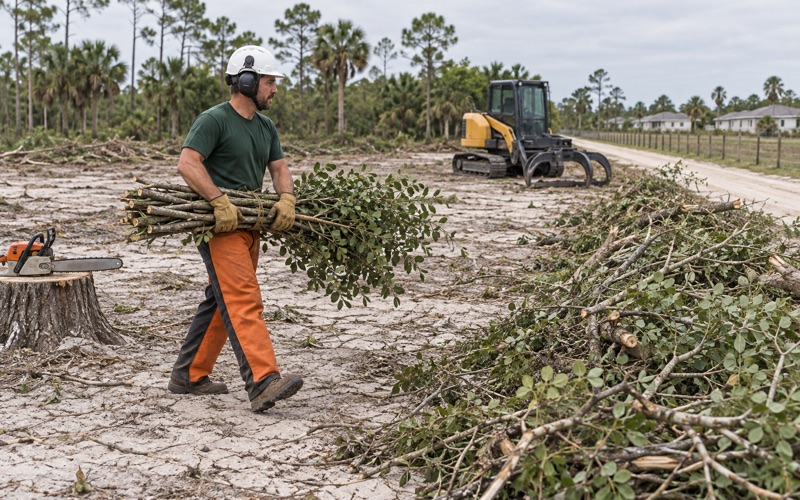
Debris is where a Cape Coral job differs most sharply from a homeowner’s expectation. City policy states that horticulture generated by tree surgeons, nurseries, landscapers or similar contractors must be removed by the company performing the work, under City Code 9-18, so nothing a crew cuts here belongs at the curb for Waste Pro. The size limits close the same door from the other side: residential bundles run no more than six feet long, no more than 4 inches in diameter and no more than fifty pounds, and trees, stumps, root balls and land-clearing debris are not accepted at all.
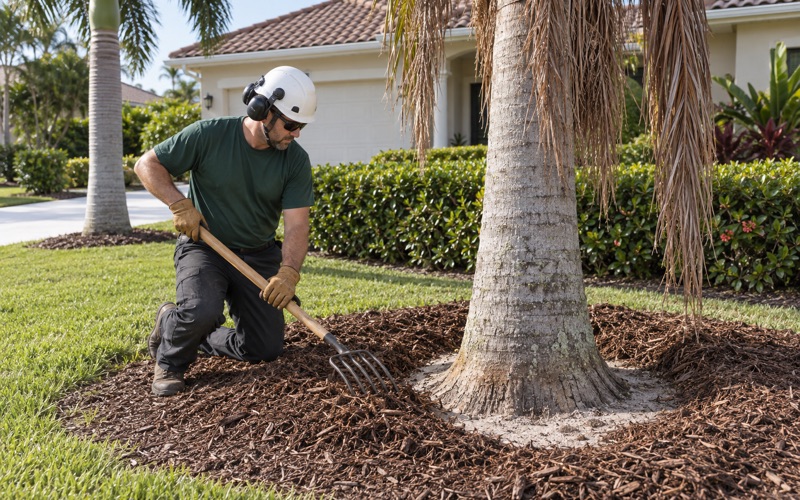
That is why our estimates carry hauling and disposal as their own line. The wood from a removal leaves on our trucks, priced where you can see it, rather than sitting on the swale waiting for a collection that is not coming. Palm fronds are the one thing a homeowner can still stage themselves, and the city asks only that they go in a single neat pile with all the fronds facing the same direction, uncut and untied. Anything larger than that is ours to move, and we price it that way from the start.
- 20+ Years on This Coast
- Written Estimate Before Any Cut
- No Topping, No Hurricane Cuts