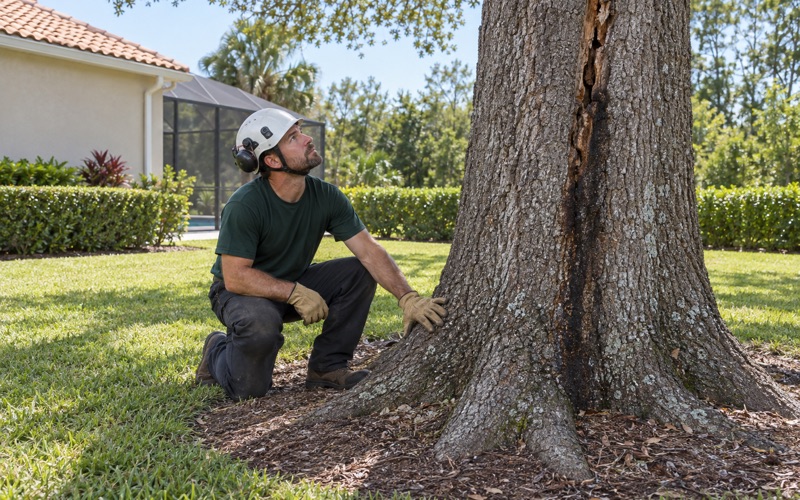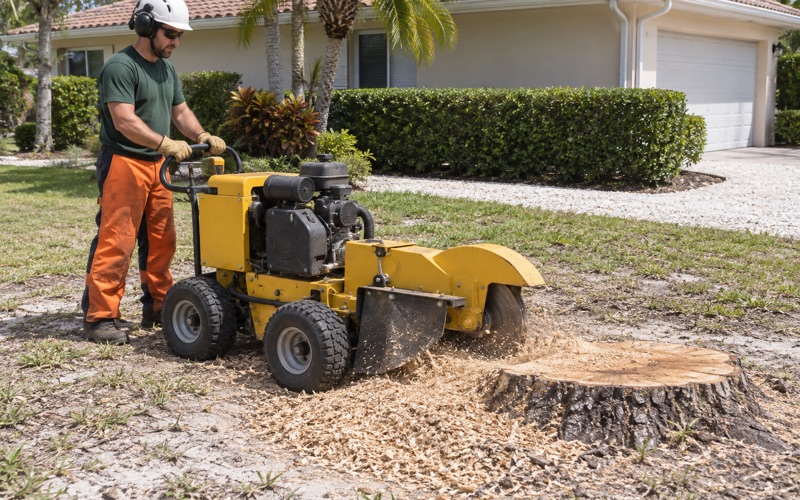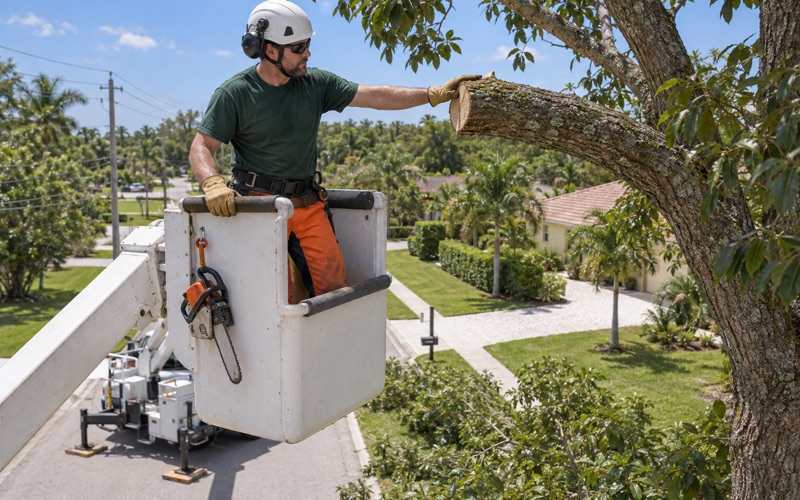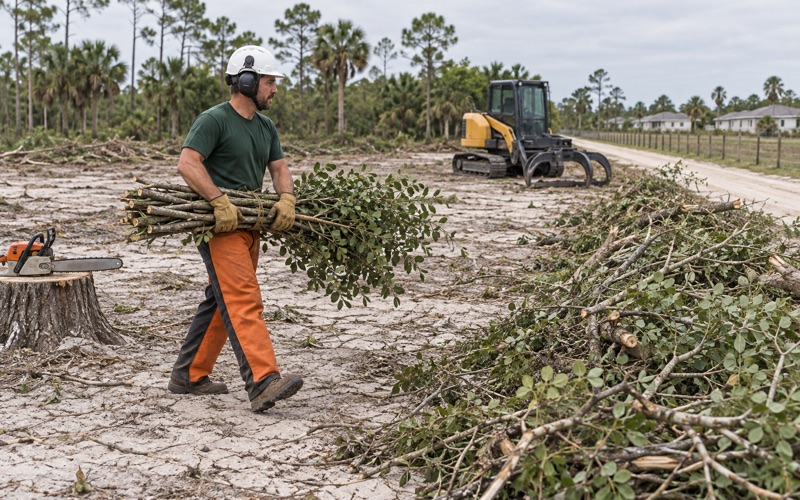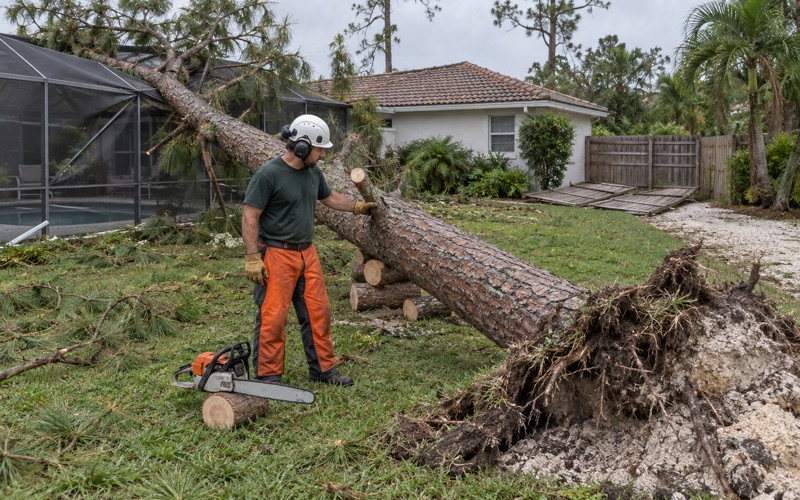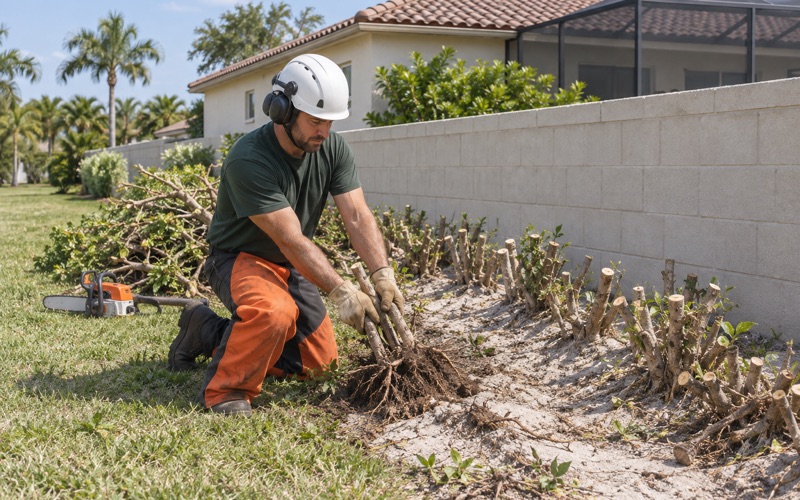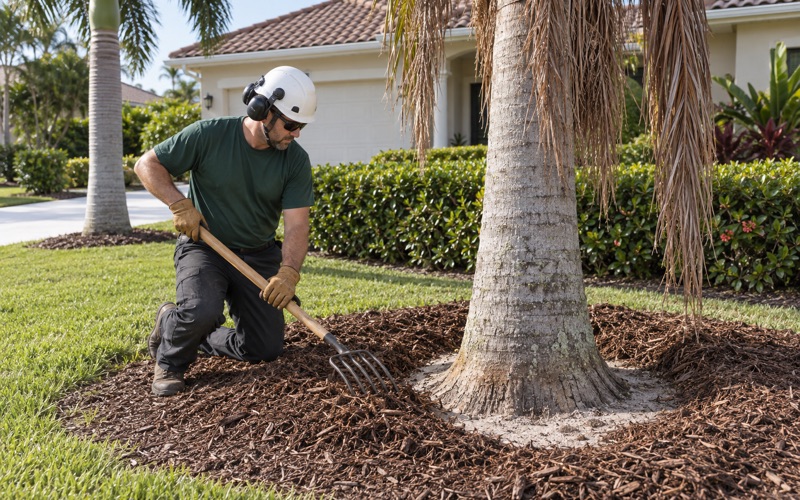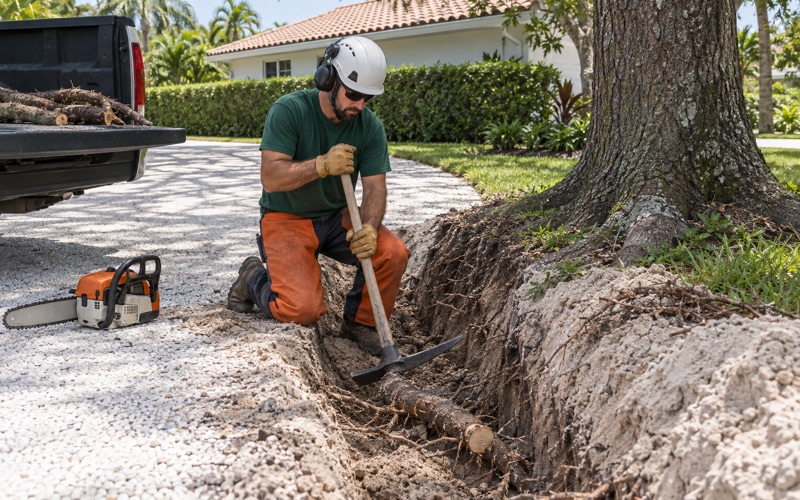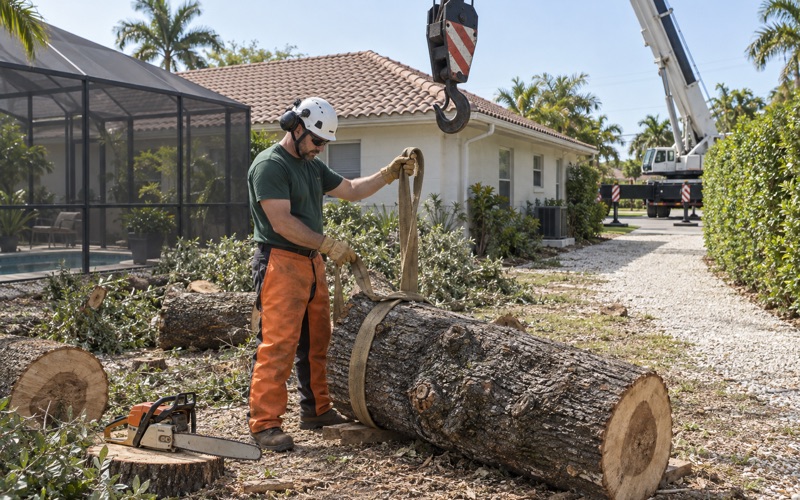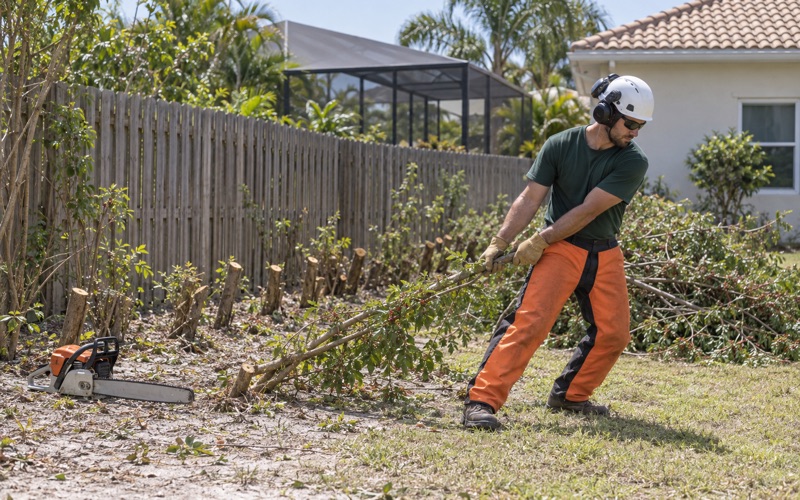
Bonita Springs Tree Removal handles tree removal in Ave Maria, and after more than twenty years of tree work on this coast we treat this town as its own kind of job rather than a smaller version of the one down the road. Most of what we prune or take down here is young, planted rather than grown, and standing exactly where a landscape plan decided it should stand. That changes which questions are worth asking before a saw ever comes off the truck, and the first of them is who has to say yes.
Every estimate we write goes out before anything is cut, with hauling and disposal carried on their own line so the cost of moving wood is visible instead of buried in one number. When we recommend that a tree come down, the reason goes into a written condition report first, and when the honest answer is a pruning cycle or a cable instead, we say that. Palms and hardwoods go on the schedule as the separate jobs they are, because a palm has no branch collar to cut back to.
We work across Lee, Collier and Hendry counties and keep a straight account of how the rules change at each line, and that account matters more in this town than in almost anywhere else we go. An owner here sits behind three separate gates, and only one of them belongs to a government. Working out which gate your particular tree stands behind is usually the difference between a job that starts next week and one that stalls.
Who actually says yes: the county, the district, or the covenant
Ave Maria is unincorporated, and that single fact reorganizes the whole permission question. There is no city hall here, no mayor, no town council and no municipal tree ordinance to read. The land use law that reaches a private lot is the Collier County Land Development Code, adopted as Ordinance 04-41 and amended many times since, together with the county Growth Management Plan, and the body that adopts and amends both is the Board of County Commissioners.
What the stewardship district owns, and what it leaves alone
The second layer is the Ave Maria Stewardship Community District, created by special act as chapter 2004-461, Laws of Florida, under chapter 189 of the Florida Statutes and governed by a five-member board of supervisors elected to four-year terms. It plans, finances, builds, operates and maintains the town’s public infrastructure, and it is funded entirely through assessments and developer contributions. Its enumerated special powers reach conservation areas, mitigation areas and wildlife habitat, and roadway improvements that include landscaping and irrigation as components.
A special district holds only those powers expressly provided by, or reasonably implied from, the authority in its charter, and this one is a property owner and infrastructure manager rather than a land use regulator. It may not exercise the powers of a law enforcement agency. Read against that charter, its trees are the ones it owns and maintains, the rights-of-way, the perimeter berms, the community entrances and the lake littoral plantings, and work on those is the district’s to arrange rather than a private owner’s.
The recorded covenant is a private gate, checked separately
The third gate is not governmental at all. Each residential neighborhood here sits under its own recorded declaration of covenants and its own architectural review committee, and under section 720.3035 of the Florida Statutes that authority reaches only as far as the declaration or the published guidelines state or reasonably infer. Whether Florida Statutes section 163.045 reaches a private covenant at all is an open question, so we treat the covenant as its own check rather than as something the county permit settles. A crew that clears the county and forgets the neighborhood has cleared one gate of three.
Looking for tree-removal closer to Immokalee? See Immokalee Tree-Removal.
The Collier vegetation removal permit and what it costs
Removing protected vegetation from a private lot here is authorized by a Vegetation Removal Permit, written under Land Development Code sections 3.05.01 through 3.05.05 and submitted through the county’s Growth Management development review portal. The fee schedule is published: $250 up to the first acre and $50 for each additional acre or fraction of one, capped at $3,000. On a single residential lot that is the low end of the range, and it is a real number we can put in the estimate rather than a placeholder.
The submittal is not a form on its own. Collier asks for an aerial photograph, a site plan showing the location and species of every protected tree on the property, and details of the protective barricading that will stand around anything being retained. We put that package together as part of the estimate, because the barricading detail in particular decides how machines move on a small lot and therefore what the work actually costs.
Where the state preemption reaches, and where it stops
Florida Statutes section 163.045 bars a local government from requiring a notice, application, approval, permit, fee or mitigation for pruning, trimming or removing a tree on residential property when the owner holds signed documentation from an arborist certified by the International Society of Arboriculture, or from a Florida licensed landscape architect, that the tree poses an unacceptable risk. Subsection (1)(b) then narrows what counts: a single-family detached building on a lot actively used for single-family residential purposes, and nothing else.
That narrowing bites harder in a town built to this mix of product than it would in an older subdivision. The American Community Survey counts 1,672 owner-occupied one-unit detached homes here, and the villas, coach homes, townhomes and attached active-adult product around them fall outside the statute entirely, as do the district’s common areas, the preserves and the platted lots nobody has built on yet. On any of those the county’s permit process is not preempted at all, and we say which side of that line your address sits on before we quote a schedule.
Listed species and exotics are a step before the saw, not after
Wildlife clearance is not boilerplate on this ground. The development itself proceeded under Florida Fish and Wildlife Conservation Commission permits for a caracara take, permit number WX05444, and for a migratory bird, burrowing owl, permit number WN05473, both issued in 2005. Open ground, mowed edges and young canopy are exactly the conditions those species use, and a nesting bird found on the morning of the job stops the job.
The county carries the same idea into ordinary work. Under Land Development Code section 3.05.05 E an owner may clear exotic vegetation mechanically, with a bush hog or a bobcat, only where the machine will not damage the root zone inside the drip line of native trees, will not affect listed species on the property, and will not cause wetland impacts. Exotic vegetation growing under the canopy of a native tree cannot be taken out mechanically at all, which in practice means hand crews and hand tools wherever a retained tree is close.
Exotic removal here has no end date
Prohibited exotic vegetation has to be removed in perpetuity under the county code, with a maintenance plan describing how reinvasion will be prevented and implemented yearly at a minimum. The district’s own engineer separately commits it to removal and control of exotic species in the preservation areas it manages, alongside hydro-period restoration and supplemental plantings. Brazilian pepper, melaleuca, Australian pine and earleaf acacia push hardest on disturbed and edge ground, and the western edge of this town runs against Camp Keais Strand, a cypress flow-way the county’s own plan singles out for greater protection.
Young trees standing in engineered fill
The ground under a tree here was placed, not developed. The district’s engineer’s report records that the roadway drainage systems and fill material are maintained by the district, that stormwater runs through a designed network of lakes, interconnecting pipes and control structures, and that the landscape arrived as a system of sod, shrubs, groundcover, littoral plantings, trees, irrigation and lighting. With 82.0% of the housing here built in 2010 or later, most of the canopy is still in its establishment years, which is a different tree from the one a crane comes out for.
That changes what we are digging into. A root plate in placed and compacted fill spreads wide and shallow rather than anchoring deep, and the excavation risk on a lot like this is the buried utility and irrigation network rather than a mapped hardpan. Reclaimed water comes from Ave Maria Utility Company into the district’s lined reservoirs and is distributed under pressure to residential lots, so root intrusion into a pressurized main is a live possibility wherever the trees and the irrigation went in during the same season.
Structural pruning while the cuts are still small
Most of what we are asked to look at here is not a removal candidate at all. Co-dominant stems and included bark in a young tree are cheap to correct with a few directional cuts made to ANSI A300 standards, and expensive to correct once the union has carried that weight for years. We do not top, hat rack or make hurricane cuts on any tree or any palm, whoever asks for them, and a written condition report goes on the record before we recommend that anything come out.
Palms are the other half of the work
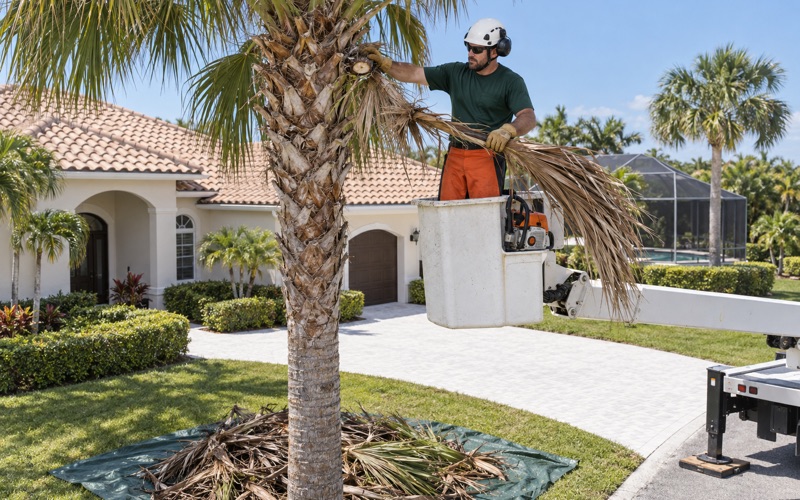
Streetscape and entry planting in a town built all at once leans heavily on palms, and a palm is not a small tree. A self-cleaning species drops its own fronds off a crownshaft and needs almost nothing, while a sabal palmetto holds a frond skirt and gets over-trimmed by anyone working to a look rather than to the nine and three clock rule. We prune to living tissue and leave the costapalmate fronds above horizontal, because a palm cannot grow a replacement bud.
The removals we do write up on palms are usually disease rather than damage. Ganoderma butt rot, caused by Ganoderma zonatum, and lethal bronzing both show up late, as spear leaf collapse or as a canopy pencil-pointing down to nothing, and neither is prunable, so the palm and its stump come out and the wood leaves the property. Thielaviopsis trunk rot is the one that turns a standing palm into a failure hazard without looking dramatic first.
Getting the wood off the lot
Electric service in this town is Lee County Electric Cooperative, whose own guidance is that only line clearance qualified arborists may work within ten feet of an energized line, and which offers a free site visit and consultation before private work inside that envelope. The service drop from the pole to the house is the owner’s responsibility, and on a young, densely planted street it is the wire a falling limb finds first. We plan the drop zone around it rather than around the tree.
Disposal has a curb rule and a gate rule and they are not the same rule. Waste Pro takes yard waste at the curb on the recycling day, but Collier caps a household at ten bundles, paper bags and containers per collection, with bundles under 50 pounds, no longer than 4 feet and holding no branch thicker than 4 inches. A whole removal does not fit that program in any configuration, so it goes to the landfill or a transfer station at the county’s horticultural waste gate rate, priced as its own line on your estimate.
- 20+ Years on This Coast
- Written Estimate Before Any Cut
- No Topping, No Hurricane Cuts