Bonita Springs Tree Removal has provided arborist inspections and tree risk assessments in Bonita Springs, FL for twenty-plus years, serving surrounding cities including Estero, Naples Park, Florida Gulf Coast University, Fort Myers Beach and Naples. The product is a written condition report: what is standing, what is wrong with it, what sits underneath it, and what we recommend doing about it, with the reasoning attached.
We write that report before we quote a removal, and the two are deliberately separate. An assessment that only exists to justify a sale is not an assessment, and it is worth nothing to the insurer, the association board or the neighbor who eventually reads it. Sometimes the honest finding is that a tree needs a reduction cut and a cable rather than a chipper, and we would rather write that down than talk you out of it.
The local half matters as much as the technical half. Lee, Collier and Hendry counties answer a vegetation removal question three different ways, Bonita Springs adds a city layer on top of the county one, and a Florida statute cuts across all of it for one specific kind of property. Knowing which of those governs your address is part of what an assessment here is for.
What a Tree Risk Assessment Measures
Defects, Targets and Likelihood
A risk rating is built from three readings, not one. We record the defect itself, the target it threatens, and the likelihood of failure and of impact over a stated assessment period. A leaning laurel oak over a screened lanai and the same oak over a vacant side lot carry identical defects and completely different ratings, which is why a report that lists only what is wrong with the tree cannot support a decision.
Root Plate, Root Collar and Buttress Flare
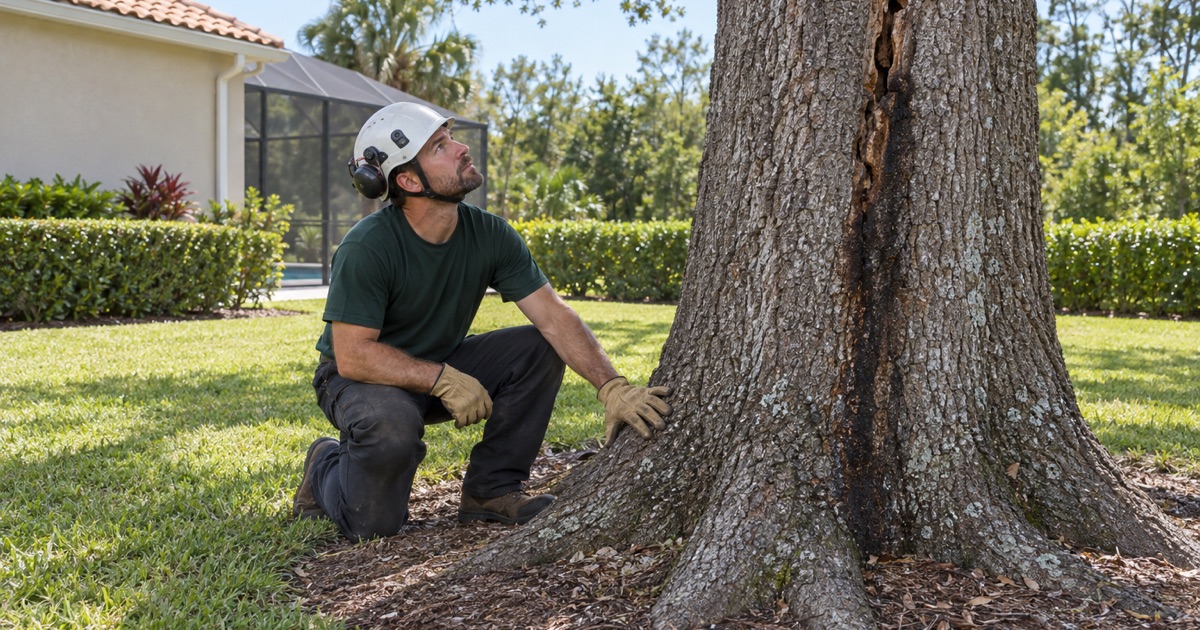
Most of what fails a tree on sand is below the mulch line. We excavate the root collar with an air spade where the flare is buried, because a stem girdling root or a rotted buttress is invisible under six inches of landscape bed and is the single most common thing missed in this market. Soil decompaction over a damaged plate is sometimes the fix, and it is a very different conversation from removal.
Co-Dominant Stems and Included Bark
Where two leaders of similar size meet, bark can be trapped inside the union instead of wood knitting across it. That union looks sound from the driveway and is a documented failure point, especially on laurel oak. We measure the aspect ratio, look for cracks and old failures on the same tree, and say whether the answer is a subordination cut, a dynamic cable in the upper crown, or removal.
The Arborist Letter and Florida Statutes Section 163.045
What the Statute Grants
Section 163.045 bars a local government from requiring notice, application, approval, permit, fee or mitigation to prune, trim or remove a tree on residential property when the owner possesses signed documentation from an ISA-certified arborist or a Florida licensed landscape architect that the tree poses an unacceptable risk. Subsection (3) also bars a replanting requirement in that case. The verb is possesses, so the paperwork has to exist before the cut, not afterward.
Where It Stops
The grant is narrower than the headline. Residential property is defined as a single-family detached building on a lot actively used for single-family residential purposes, which excludes duplexes, townhomes, attached villas, condominium buildings, mobile homes in co-ops, association common areas, vacant and platted-but-unbuilt lots, and all commercial, industrial and agricultural land. Subsection (4) carves out mangroves entirely, which no letter of any kind can clear.
The Local Documents That Do Not Mention It
What a resident finds when they search is the local process, and here that process predates the statute. The City of Bonita Springs tree removal permit application is a document last saved in December 2017, before section 163.045 existed, and lists only two valid reasons to remove a tree, neither of which is a hazard tree. Neither it, the City’s hurricane document, nor Lee County’s own vegetation removal guide mentions the statute at all.
Neighbor Trees, Property Lines and Association Disputes
Who Owns the Tree, and Who Owns the Branch
Ownership follows the trunk. A tree whose trunk stands on your neighbor’s side is their tree even where most of its crown is over your roof, and the general rule is that you may prune what crosses the line, to the line, at your own expense, without cutting so hard that you kill it. We survey which side the trunk actually sits on before quoting, because a self-help pruning that kills a neighbor’s tree is an expensive mistake.
A Report Both Sides Can Read
Boundary tree disputes stall because each side has an opinion and neither has a record. A dated condition report giving species, diameter, the defects found, the targets on both properties and the realistic failure direction converts that into something two insurers can process. We write findings in plain language and attach photographs, precisely so the document works when nobody involved is a tree professional.
Covenants Are Not Local Government
An association’s covenants are a private agreement, so the statutory preemption does not settle what a board may require of an owner. That cuts both ways: a board cannot rely on the statute to force a removal either, and a well-documented assessment is the instrument that moves the discussion off precedent and personality. For seasonal owners we deliver written findings and photographs so the inspection still means something with nobody standing in the yard.
Commercial, Condominium and HOA Tree Inspections
Portfolio Inspections on a Fixed Cycle
Community associations, districts, resorts, campuses and commercial property owners need the same reading over many trees and repeated over time. We inventory by location with species, size, condition and recommended action, so a manager can budget the work in order of risk rather than in order of who complained. A schedule also creates the record that shows an issue was known and addressed.
The Properties the Statute Leaves Out
Condominiums, townhomes and commercial parcels are outside section 163.045 entirely, so for them the ordinary permit route under Lee County’s Land Development Code, Collier County Land Development Code section 3.05.00 or the applicable municipal ordinance is the only route. We identify which authority governs the parcel and what a vegetation removal permit will require before any crew is scheduled, rather than discovering it at inspection.
Pre-Season Assessment and Post-Storm Walks
Assessment work belongs in spring and early summer, when the calendar has room and any recommended reduction can still be done before a system enters the Gulf. After a storm we walk the same inventory again looking for lifted root plates, cracked unions and the delayed decline that follows salt inundation. Trees inside a surge footprint can hold green canopy for a season or two before failing.
Our Step-by-Step Tree Risk Assessment Process
Step 1: Site Walk and Target Mapping
We start with what the tree could reach: structures, cages, driveways, walkways, utilities and the parts of a property people actually occupy. Occupancy matters as much as distance, because a target used daily and a target used twice a year carry different consequences. That map is recorded first so the rest of the assessment has something to be measured against.
Step 2: Ground Assessment and Root Collar Work
Next comes the tree itself from the base upward, with a root collar excavation where the flare is buried and an air spade where the soil is compacted or mounded. We note lean history, soil heaving, fruiting bodies, cavities, cracks, old failures, and the species-specific patterns this coast produces, from laurel oak decline to Ganoderma at the base of a palm.
Step 3: Aerial or Advanced Inspection Where It Is Warranted
When a defect cannot be resolved from the ground we go up, or use a sounding or probing method appropriate to the wood. This step is added when it will change the answer and skipped when it will not, and the report says which happened. Padding an assessment with unnecessary aerial work is a cost with no finding attached.
Step 4: The Written Condition Report and Its Recommendation
The report names species, diameter, defects, targets, method, assessment period, risk rating and recommendation with reasoning, dated and photographed. Where the recommendation is not removal we say so and quote the alternative, whether that is directional pruning, a subordination cut, a dynamic cable or soil work. Where it is removal, the reason is on the record before the saw starts.
- 20+ Years on This Coast
- Written Estimate Before Any Cut
- No Topping, No Hurricane Cuts