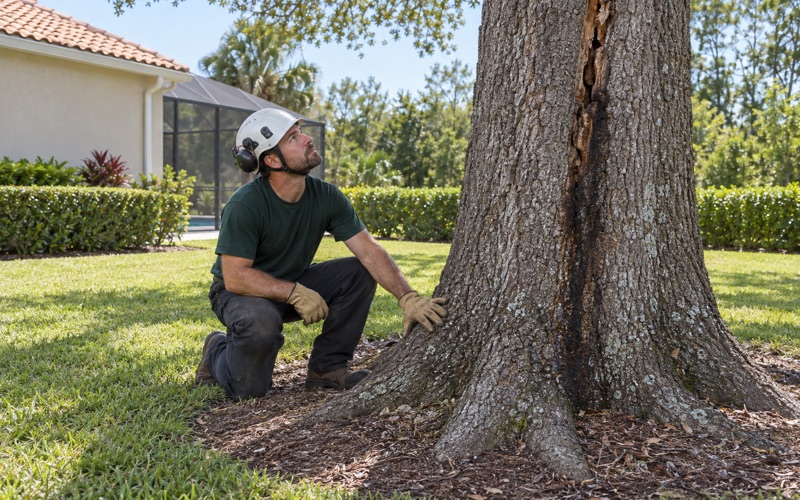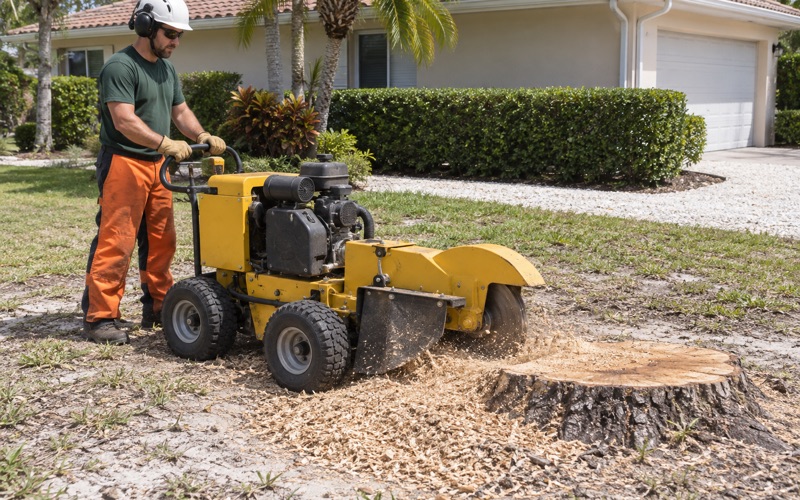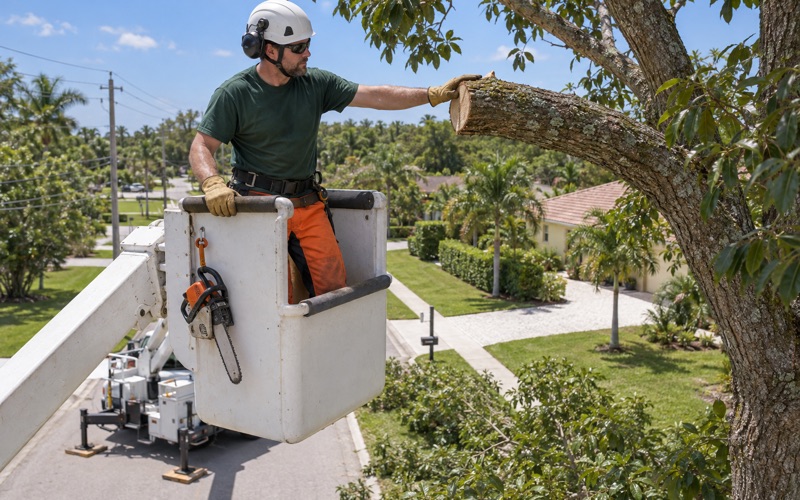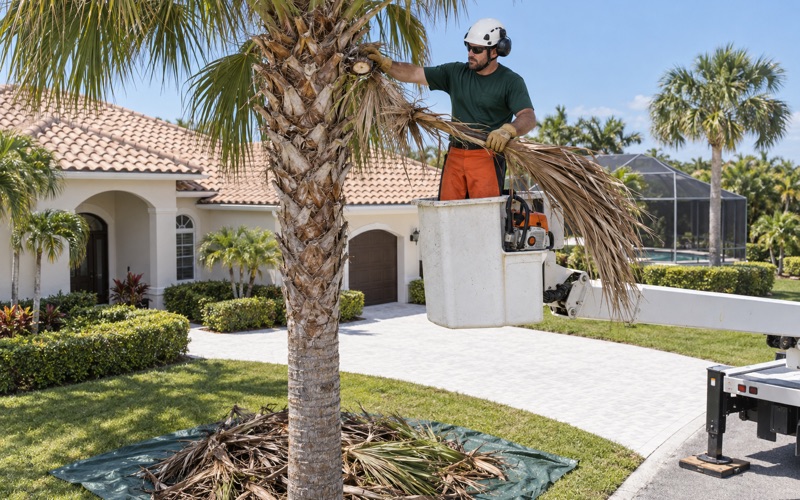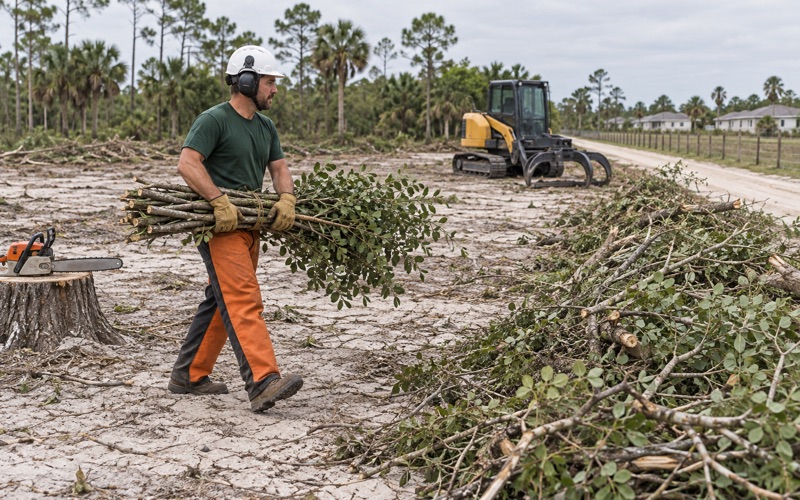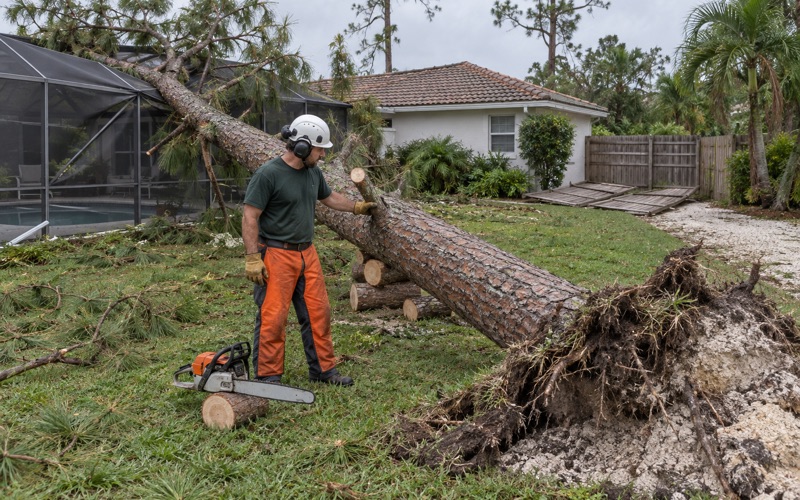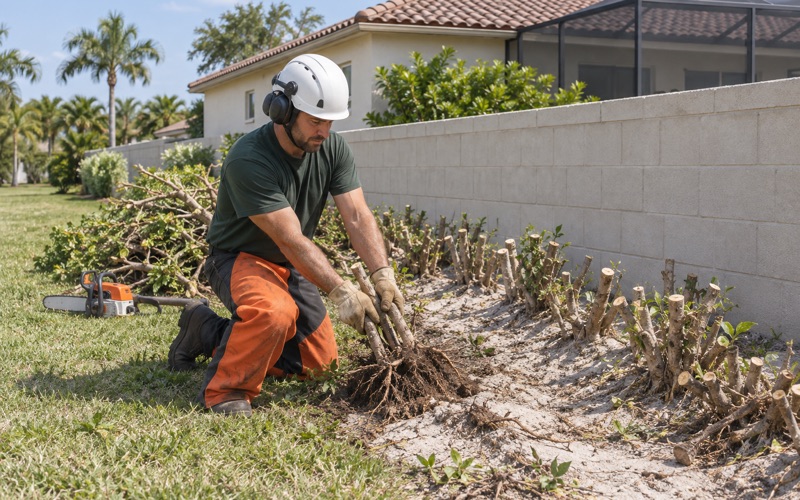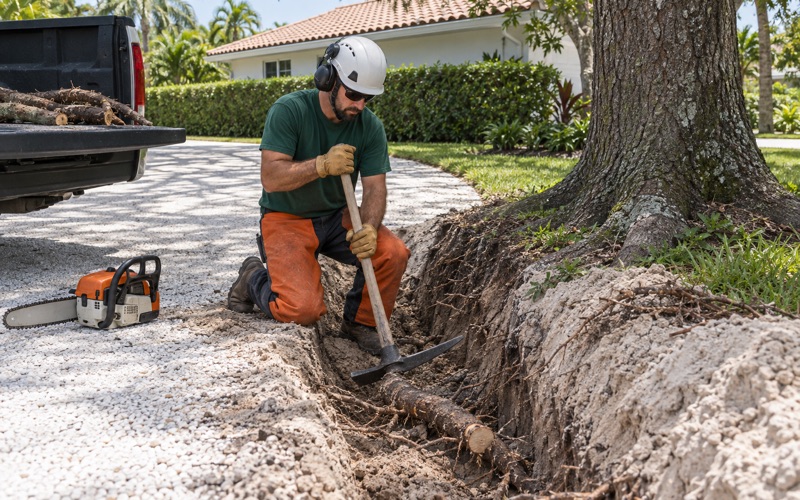
Bonita Springs Tree Removal has spent twenty-plus years taking trees down on this coast, and tree removal in Alva is a particular corner of that work: big riverside hardwoods, long driveways, and roads that close over your head. Every job starts with a written estimate before anything is cut, with hauling and disposal priced as their own line so you can see what the wood costs to move rather than finding it folded into one number. When we say a tree should come down, the reason goes into a written condition report first, so it is on the record before a saw runs.
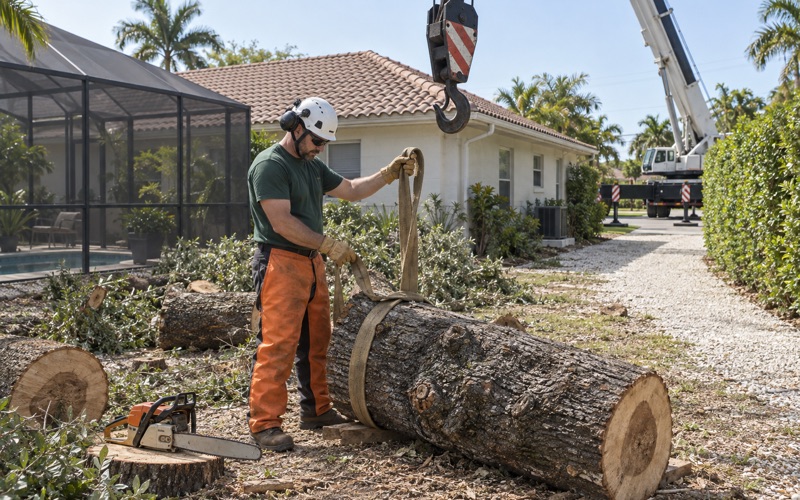
Palms and hardwoods are different jobs and we crew them that way, because a palm has no branch collar to cut to and a mature laurel oak does. Access gets sized to the property rather than the other way round, from a narrow-gate machine that fits through a side gate to a crane pick where there is somewhere solid to set one. We do not top, hat rack or hurricane cut anything, on any tree or any palm, whoever asks for it, and we will tell you plainly when pruning or a cable is the honest answer instead of removal.
The county plan that puts Alva’s canopy in writing
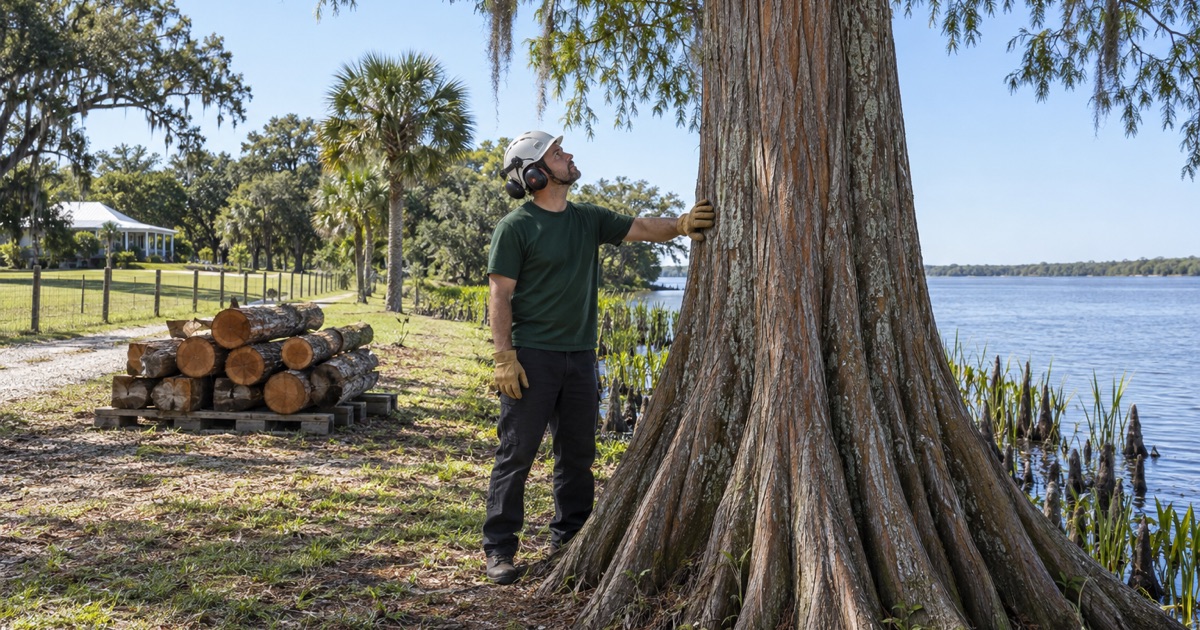
Alva is unincorporated, which means there is no city hall, no council and no municipal tree ordinance at your address. The land use law is the Lee Plan, adopted by the Lee County Board of County Commissioners and amended many times since, together with the Lee County Land Development Code. What makes this community unlike the rest of unincorporated Lee County is that it has its own adopted chapter inside that plan, and the chapter is explicitly about trees.
Goal 34 and what it commits the county to
Lee County Ordinance 11-21, the Alva Community Plan, was adopted on 28 September 2011 and folded a new Goal 34 into the Lee Plan in place of the old one. Goal 34 commits the county to support and enhance Alva’s unique rural, historic, agricultural and natural environment and resources, including the rural village and the surrounding area shown on the plan’s own map. The ordinance describes the place in its own words: with its huge oaks and cypress trees, the river, the surrounding citrus groves and the natural resource areas, Alva has a country ambiance that is rapidly becoming hard to find in Florida.
Two policies inside that goal matter to anyone thinking about a tree. Policy 34.2.6 directs the county to write design standards that preserve native plant communities, including subtropical and tropical hardwood hammock, scrub and wetlands, so as to enhance the existing native vegetation and tree canopy, and in the same breath to encourage the removal of exotic species. Policy 34.5.2 goes at the other end, directing the county toward conservation funding and acquisition priorities that protect habitat from the impacts of clear cutting for residential or agricultural purposes. Read together, they say what is welcome and what is not.
Nobody in Florida holds a tree contractor license
It is worth saying plainly, because the word gets thrown around: Florida issues no state tree or arborist contractor license, and Lee County cannot create one either, since state law preempts local occupational licensing for this trade. What stands in its place is certification through the International Society of Arboriculture, plus general liability and workers’ compensation coverage you can actually verify. Ask for the certificate numbers and the insurance, in writing, from anyone quoting work under a canopy like this one.
Looking for tree-removal closer to Fort Denaud? See Tree-Removal Services in Fort Denaud.
Narrow streets, a closed canopy, and getting the equipment in
The same ordinance contains a sentence that reads as scenery and works as a job description: streets remain narrow with a dense tree canopy. That is not a pleasant detail when you are trying to bring a chipper and a truck to a back yard. There is often nowhere to set a crane in the road, no clean arc for a boom to swing through, and a drop zone that sits under somebody else’s limbs rather than open sky.
Rigging instead of dropping
Where a crew on an open lot would fell a stem and clean up afterward, a canopy road job comes down in controlled pieces, roped and lowered through a gap you have to find first. That takes longer, it takes more people on the ground, and it is the part of the estimate a low bid usually leaves out. We walk the approach before we quote: where the truck parks, where the chipper sits, what the machine has to fit through, and which neighbor’s tree the work is happening underneath.
Old trees carry old defects
This canopy did not arrive as a planting cohort that all reached size in the same decade. The rural village includes ground originally platted in the late 1800s, and roughly 35.7 percent of the housing stock here predates 1980, which tells you how long the oaks and cypress along the river have been accumulating cavities, included bark and co-dominant stems. A tree that size with a century of history in it gets assessed rather than eyeballed, against ANSI A300 and the ISA Best Management Practices for Tree Risk Assessment, and the findings go in the condition report.
Most of the housing here is owner-occupied, and a good share of it is on acreage with the tree well away from the road, so the question is rarely just whether the tree is sound. It is whether the equipment can reach it without tearing up a pasture, a septic drain field or a driveway that was never built for a loaded truck. Where an owner is seasonal or living elsewhere, we send written findings and photographs, so the inspection still means something when nobody was standing in the yard.
Clearing for agriculture, and the notice that goes with it
Alva has two clearing tracks running side by side, and which one you are on changes the paperwork completely. A single-family lot of five acres or more in unincorporated Lee County needs a detailed site plan with the vegetation permit: the shape and dimensions of the lot or a boundary survey, and the location of existing or proposed structures and other improvements, the drain field and driveway included. On acreage that threshold is reachable, so this is a routine submittal here rather than an exotic one.
What a Notice of Clearing has to carry
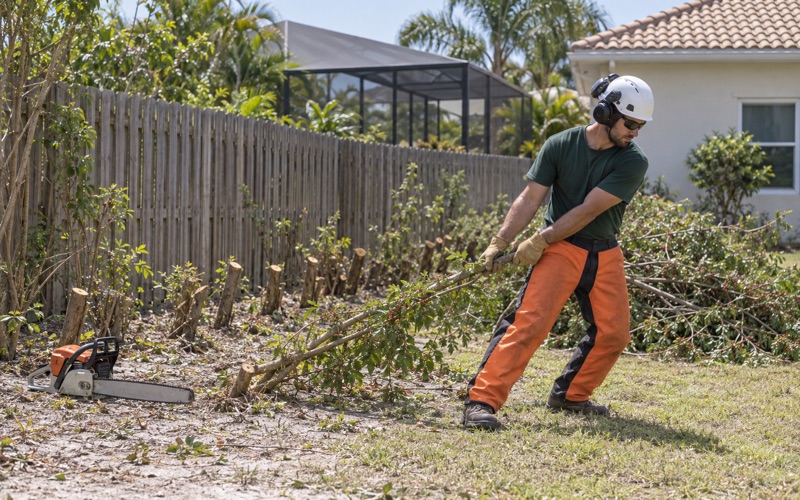
Clearing for agricultural purposes runs on a Notice of Clearing instead, and the county tells you exactly what it wants. A written, notarized statement from the owner that the clearing is for bona fide agricultural reasons, naming the proposed use; current aerial section maps with the property boundaries clearly outlined; a sealed sketch of the legal description; and documents showing the intent is real. The county’s own examples are a South Florida Water Management District water use permit, a cattle lease, a forestry management plan, the expansion of an existing operation, or receipts for stock materials.
The three-year rezone condition
The trap sits in the note underneath. If an application to rezone the parcel is filed within three years of the date the most recent Notice of Clearing was issued, and that rezoning is granted, the open space requirements of Chapter 10 of the Land Development Code have to be satisfied by planting: trees from Appendix E, placed and maintained consistent with Section 14-384, to the extent existing natural forest cannot cover the requirement. The reforestation required under Section 14-377 is then imposed as a condition on any final development order issued within eight years after the rezoning.
In plain terms: clear a grove as agriculture, rezone inside three years, and the planting obligation follows the land for another eight. That is worth knowing before the first tree comes out, not after, and it is one of the reasons we ask what you intend to do with a parcel before we price the clearing. We work Lee, Collier and Hendry, and we will tell you straight where the county line changes the answer.
Where the residential statute stops
Florida Statutes section 163.045 bars a local government from requiring a notice, application, approval, permit, fee or mitigation to prune or remove a tree on residential property when the owner holds signed documentation from an ISA-certified arborist or a Florida licensed landscape architect that the tree poses an unacceptable risk. The statute defines residential property as a single-family detached building on a lot actively used for single-family residential purposes. Much of the land around here is agricultural, and the statute does not reach agricultural property at all, which is precisely why the clearing tracks matter.
River ground, wet season, and where the wood goes
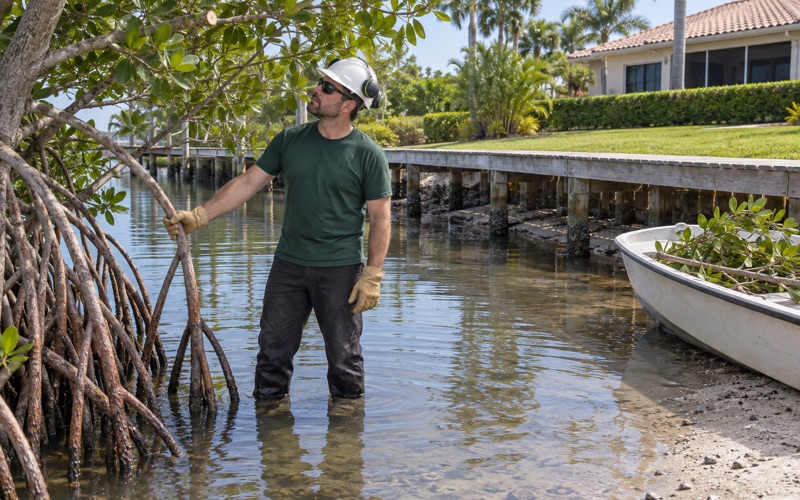
The Caloosahatchee runs east to west straight through the middle of the community, and the ordinance describes its watershed as lined with huge oaks and cypress, flowing west through citrus, cattle, farming and conservation land. The oxbows are the old bends left behind after the dredging that began with the Cross State Ship Channel in the 1930s. Lee Plan policy here pushes development setbacks back from natural areas and surface waters and asks for drainage design that works around natural flowway corridors, cypress heads and natural lakes, so a cypress head on your parcel is a protected feature and not a wet patch.
Water table, root plates and stump grinding
We do not guess at which soil sits under a particular address, and neither should anyone quoting you. What is established for this region is that the limiting layer under these flatwoods is a hardpan and a shallow seasonal water table rather than rock: the published series descriptions for soils of this area put a spodic horizon at 30 to 50 inches with a water table within 6 to 18 inches of the surface for one to four months in most years, and for the wetter slough and floodplain soils within 10 inches for two to six months.
That matters twice on a removal. In the saturated months a mature oak’s root plate has the least holding it will have all year, which changes how a leaning tree gets approached and when it should come out. And a grinder here is working in wet sand over a restrictive layer rather than chasing a deep taproot, so the below-grade cut is planned around the drain field, the well line and the irrigation before the machine starts, not discovered halfway through.
What it costs to move the wood
Debris from contractor work is not curbside work, whatever the residential yard waste rules say, and the wood from a big oak is measured by the ton. Commercial horticultural waste crosses the scale at Lee County facilities at a published gate rate of $43.92 per ton with a $15.00 minimum charge, and the county sells finished mulch back at $10.00 per cubic yard. That is why hauling and disposal sit on their own line in our estimate: on a large removal it is a real share of the price, and you are entitled to see it.
Storm season is the other reason to think about this ahead of time. We would rather book the work before the season than sort it out afterward, when every crew on this side of the county is spoken for and the tree that failed is lying across the driveway. If you want an opinion on a big oak or cypress here, we will look at it, put the findings in writing, and tell you honestly if the answer is a prune, a cable, or nothing at all.
- 20+ Years on This Coast
- Written Estimate Before Any Cut
- No Topping, No Hurricane Cuts